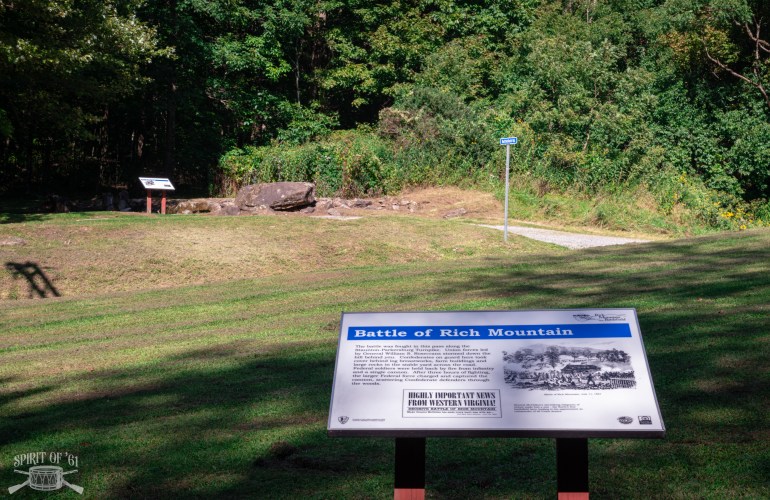
When Maj. Gen. George B. McClellan arrived in northwestern Virginia in late June to take command of his Army of the West, also known as the Army of Occupation, he reorganized and expanded it into five brigades under Brig. Gens. William S. Rosecrans, Thomas A. Morris, Charles W. Hill, Newton Schleich, and Col. Robert L. McCook. In all, he commanded more than 20,000 men, though roughly half were 90-day volunteers whose enlistments would expire near the end of July.
Hill’s brigade was assigned to guard the Baltimore & Ohio Railroad, while Morris moved to confront Confederate Brig. Gen. Robert S. Garnett at Laurel Hill. McClellan retained direct command of his three remaining brigades as he moved against the smaller Confederate force at Rich Mountain.
Between June 29 and July 2, McClellan’s main body occupied the strategically placed town of Buckhannon in Upshur County, about 23 miles west of the Confederate camp at Rich Mountain. On July 6, without consulting McClellan, Schleich ordered a reconnaissance of the Middle Fork Bridge east of Buckhannon along the Staunton–Parkersburg Turnpike, resulting in a small but deadly skirmish. The following day, McCook’s brigade secured the bridge, and by the evening of July 9, McClellan had advanced to Roaring Creek at the base of Rich Mountain.
On July 10, McClellan ordered McCook to conduct a reconnaissance in force against the Confederate fortifications. After probing the line, he judged the position too strong to assault head-on. Fortune intervened when David Hart, a young man whose family farm lay near the summit of Rich Mountain, told Rosecrans he could guide a column across the heavily wooded heights to the rear of the Confederate camp.
McClellan authorized Rosecrans to lead his brigade on a flanking march, with the intent of coordinating an attack from front and rear. When the sound of fighting reached him, however, he hesitated. His men spent hours cutting a path through the woods to position artillery, and by the time word arrived of Rosecrans’ success, the Confederates had already begun to slip away, many surrendering after a few days.
To my knowledge, no one has produced a precise accounting of McClellan’s strength at Rich Mountain. Estimates vary. What follows is the most complete picture I have been able to assemble of the force on hand on July 10–11, 1861. Not every regiment in each brigade is represented here, as some were drawn off by Henry A. Wise’s cavalry demonstration at Glenville on the 7th.
Rosecrans’ Flanking Force
Rosecrans did not take his entire brigade on his flanking march, having left behind camp guards, sick, etc. Most of the Eighth Indiana Regiment stayed behind. Burdsall’s Dragoons were also temporarily attached to his force from McCook’s Brigade. On July 19, Rosecrans reported a total of 1,917 men participated, not including Col. Frederick W. Lander, who volunteered to come along, and David Hart, their guide. Rosecrans reported a loss of 12 killed and 49 wounded. Careful examination of the records shows 13 killed and 58 wounded (5 mortally), and 1 missing.
| Unit | Strength |
|---|---|
| 8th Indiana Inf. Regiment | 242 |
| 10th Indiana Inf. Regiment | 425 |
| 13th Indiana Inf. Regiment | 650 |
| 19th Ohio Inf. Regiment | 525 |
| Burdsall’s Ind. Company Ohio Cavalry | 75 |
| 1,917 |
The following Federal units were present at the Battle of Rich Mountain, including nine infantry regiments, one cavalry company, and three artillery batteries.
Third Ohio Infantry
The 3rd Ohio Infantry Regiment was organized at Camp Jackson, near Columbus, Ohio, on April 21, 1861, for three months’ service, and mustered in on April 27. Throughout May, it drilled at Camp Dennison. Before it received orders for the field, however, the call went out for three-year volunteers. The regiment reenlisted, reorganized on June 12, and was mustered into three years’ service on June 20 under Col. Isaac H. Morrow. Those who declined to reenlist were mustered out on August 22. Its initial strength was 941, and the regiment was able to move at once into active service. It was added to Schleich’s Brigade. On July 5, without McClellan’s approval, Schleich dispatched a mixed scouting party of 50 men from the 3rd Ohio, led by Captain Orris A. Lawson, to scout Middle Fork Bridge. The resulting skirmish left one man dead and six wounded.
Fourth Ohio Infantry
The 4th Ohio Infantry Regiment was organized at Camp Jackson, Ohio, between April 18 and 25, 1861. It drew its companies from across the state. On May 2, the regiment moved to Camp Dennison, where it was mustered into United States service two days later. When a majority of its men signaled their intention to enlist for three years, the regiment reorganized at Camp Dennison in June under Col. Lorin Andrews for extended service. When it reached northwest Virginia, it joined McCook’s Brigade and helped capture Middle Fork Bridge on July 7. On the morning of the 10th, McCook’s Brigade reconnoitered the Confederate works on Rich Mountain, withdrawing after a brief skirmish.
Ninth Ohio Infantry
The 9th Ohio Infantry Regiment was composed largely of German Americans from Cincinnati, who responded enthusiastically to the President’s call for 75,000 three-month volunteers. Its ten companies were enrolled on April 22, 1861, and mustered into United States service on May 8 at Camp Harrison, near Cincinnati, under Col. Robert L. McCook of the “Fighting McCooks.” On May 18, the regiment moved to nearby Camp Dennison to be equipped for active service. There, nearly the entire command agreed to reenlist for three-years. The process began on May 27, making it the first three-year regiment organized in Ohio. In Virginia, McClellan elevated McCook to brigade commander and assigned him to capture Middle Fork Bridge on July 7. The regiment was involved in a brief skirmish while reconnoitering the Confederate works on Rich Mountain on the 10th, in which Gustave Stoecker of Company I was killed and George Buettner of Company K was wounded.
19th Ohio Infantry (3-months)
The 19th Ohio Infantry Regiment formed at Camp Taylor in Cleveland, where it remained until May 27, 1861, when it traveled by rail to Camp Jackson in Columbus. There the regiment elected its officers, including Col. Samuel Beatty, and on May 29 was mustered into state service for three months, retroactive to April 27. Companies A and B were immediately sent to Bellaire to guard the ferry, then moved on June 3 to Glover’s Gap and Mannington for similar duty until June 20, when they rejoined the regiment at Bellaire.
The following day, the regiment embarked on steamers for Parkersburg, Virginia, arriving June 23, and was assigned to Rosecrans’ Brigade. On June 25 it moved by rail to Clarksburg, remaining there until June 29, when it began its first sustained march. It reached Buckhannon on July 2 and Roaring Creek on July 7, encamping before the fortified Confederate position at Rich Mountain. Its term of service expired soon after, and on July 23 the regiment was ordered home for muster out, arriving in Columbus on July 27, 1861. Its initial strength was 939, but 15 men were discharged prior to the Battle of Rich Mountain, leaving 924.
Eighth Indiana Infantry (3-months)
The 8th Indiana Infantry was organized for three months’ service at Indianapolis in April 1861 and mustered in on April 25 under Col. William P. Benton. It left the state on June 19, moving to Clarksburg and then to Buckhannon, where it joined Rosecrans’ brigade. The regiment took part in the Battle of Rich Mountain and afterward went into camp at Beverly. It was mustered out at Indianapolis on August 2, 1861, having begun with 784 officers and men.
Tenth Indiana Infantry (3-months)
The 10th Indiana Infantry was organized at Indianapolis in April 1861 for three months’ service and mustered in on April 25. Its first colonel, Joseph J. Reynolds, was commissioned brigadier general of volunteers on June 10, prompting the promotion of Maj. Mahlon D. Manson to colonel and Capt. William C. Wilson of Company D to major.
The regiment left the state on June 19, moving by way of Parkersburg to Buckhannon. It reached Rich Mountain on July 10 and, the following day, charged the enemy’s works, routing the force and capturing its guns. It then moved to Beverly, where it remained in camp until July 24, and was mustered out at Indianapolis on August 2, 1861. Its original strength was 789, with one recruit added, for a total of 790.
13th Indiana Infantry
The 13th Indiana Infantry was first accepted for one year of state service and organized at Indianapolis for United States service from companies already in camp. Jeremiah C. Sullivan was appointed colonel. It became one of the first four Indiana regiments to volunteer for three years and was mustered in on June 19, 1861. The regiment left the state on July 4 and joined Gen. McClellan’s forces at Rich Mountain, western Virginia, on July 10, taking part in the battle there the following day. Its original strength was 1,047.
14th Indiana Infantry
The 14th Indiana Infantry was organized at Camp Vigo, near Terre Haute, in May 1861 under Col. Nathan Kimball. Initially accepted for one year, it volunteered for three years in response to the new call, becoming the first Indiana regiment mustered for that term. It was mustered in on June 7 and left the state on July 5. The regiment proceeded to Clarksburg in western Virginia, and marched to Rich Mountain, where it was held in reserve during the battle. From July 16 to October 8, it was stationed at Cheat Mountain. Its original strength was 1,055.
15th Indiana Infantry
The 15th Indiana Infantry was organized at Lafayette in May 1861 for state service and reorganized in June for three years in United States service. It was mustered in on June 14 under Col. George D. Wagner and left the state on July 1 for Clarksburg. From there it marched to Rich Mountain, arriving during the fighting on July 11, and joined in the pursuit of the retreating enemy, capturing numerous prisoners. Its original strength was 1,056.
Burdsall’s Ind. Company Ohio Cavalry
Henry W. Burdsall, a veteran of the Mexican-American War, organized his Independent Company of Ohio Cavalry (commonly known as Burdsall’s Dragoons) in Cincinnati. The company mustered in at Carthage, Ohio, on June 15, 1861. Like many Confederate cavalry units, but rare for a Union outfit, most of the men in Burdsall’s company provided their own horses and equipment. In return, the U.S. government compensated them at a rate of 50 cents per day. If their horse was killed or injured, they were eligible for additional compensation. The company joined General McClellan’s army in Northwestern Virginia, serving as scouts. After three months of service, the unit was mustered out on August 23, 1861.
First Michigan Artillery, Battery A
The 1st Michigan Artillery, Battery A, known as the “Coldwater Artillery,” was mustered into service for three months on April 23, 1861, under Capt. Cyrus O. Loomis. It remained at Fort Wayne in Detroit until reorganizing for three years’ service on May 28. The battery left the state for Cincinnati on May 31 and performed duty at Camp Dennison until June 12, when it was ordered to western Virginia and attached to McCook’s Brigade. It reached Clarksburg on June 23, then marched to Buckhannon between June 28 and July 1. The battery was engaged at Middle Fork Bridge on July 7 and arrived at Rich Mountain on July 10. It was equipped with six brass 6-pounder guns.
Fourth U.S. Artillery, Battery G & I
The 4th U.S. Artillery, formed in 1821, was commanded at the outbreak of the Civil War by Col. Francis S. Belton. Its batteries were broken up and assigned to different armies. In northwestern Virginia, Batteries G and I were attached to McClellan’s Army of Occupation. Battery G, under Capt. Albion P. Howe, fielded four 6-pounders and two 12-pounder howitzers, while Battery I, commanded by Capt. Oscar A. Mack, was equipped with four light howitzers. During the Battle of Rich Mountain, McClellan kept his regular artillery in reserve at Roaring Creek.
Rosecrans’ Brigade
Brig. Gen. William S. Rosecrans
| Regiment | Commander | Strength | KIA | MW | WIA | MIA |
|---|---|---|---|---|---|---|
| 19th Ohio Inf. Regiment | Col. Samuel Beatty | 924 | 0 | 0 | 3 | 0 |
| 8th Indiana Inf. Regiment | Col. William P. Benton | 786 | 3 | 1 | 22 | 0 |
| 10th Indiana Inf. Regiment | Col. Mahlon D. Manson | 790 | 3 | 1 | 21 | 1 |
| 13th Indiana Inf. Regiment | Col. Jeremiah C. Sullivan | 1,047 | 7 | 2 | 7 | 0 |
| 3,547 | 13 | 4 | 53 | 1 |
McCook’s Brigade
Col. Robert L. McCook
| Regiment | Commander | Strength | KIA | MW | WIA | MIA |
|---|---|---|---|---|---|---|
| 4th Ohio Inf. Regiment | Col. Lorin Andrews | 976 | 0 | 0 | 0 | 0 |
| 9th Ohio Inf. Regiment | Col. Robert L. McCook | 1,155 | 1 | 0 | 1 | 0 |
| 1st Michigan Artillery, Battery A | Capt. Cyrus O. Loomis | 6 guns, 137 men | 0 | 0 | 0 | 0 |
| Burdsall’s Ind. Company Ohio Cavalry | Capt. Henry W. Burdsal | 75 | 0 | 1 | 0 | 0 |
| 2,343 | 1 | 1 | 1 | 0 |
Schleich’s Brigade
Brig. Gen. Newton Schleich
| Regiment | Commander | Strength | KIA | MW | WIA | MIA |
|---|---|---|---|---|---|---|
| 3rd Ohio Inf. Regiment | Col. Isaac H. Morrow | 934 | 0 | 0 | 0 | 0 |
| 14th Indiana Inf. Regiment | Col. Nathan Kimball | 1,055 | 0 | 0 | 0 | 0 |
| 15th Indiana Inf. Regiment | Col. George D. Wagner | 1,056 | 0 | 0 | 0 | 0 |
| 3,045 | 0 | 0 | 0 | 0 |
Unattached
| Regiment | Commander | Strength | KIA | MW | WIA | MIA |
|---|---|---|---|---|---|---|
| 4th U.S. Artillery, Battery G | Capt. Albion P. Howe | 6 guns, 120 men* | 0 | 0 | 0 | 0 |
| 4th U.S. Artillery, Battery I | Capt. Oscar A. Mack | 4 guns, 100 men* | 0 | 0 | 0 | 0 |
| 10 guns, 220 men | 0 | 0 | 0 | 0 |
A careful examination of primary and secondary sources shows that McClellan had approximately 9,150 men and 16 artillery pieces in front of Rich Mountain on July 11, 1861. Only about 1/4 of this force actively participated in the fighting. McClellan’s total loss at Rich Mountain was 14 killed and 59 wounded (5 mortally), and 1 missing.
Sources
Annual Report of the Adjutant General of the State of Michigan, for the Year 1862. Lansing: John A. Kerr & Co., 1863.
Beatty, John. The Citizen-Soldier, or Memoirs of a Volunteer. Cincinnati: Wilstach, Baldwin & Co., 1879.
Grebner, Constantin. “We Were the Ninth”: A History of the Ninth Regiment, Ohio Volunteer Infantry, April 17, 1861 to June 7, 1864. Translated by Frederic Trautmann. Kent: Kent State University Press, 1987.
Heselberger, Fritz. Yanks from the South! The First Land Campaign of the Civil War: Rich Mountain, West Virginia. Baltimore: Past Glories, 1987.
Keifer, J. Warren. The Battle of Rich Mountain and Some Incidents. Cincinnati: The Ohio Commandery of the Loyal Legion, 1911.
Kepler, William. History of the Three Months’ and Three Years’ Service from April 16th, 1861, to June 22d, 1864, of the Fourth Regiment Ohio Volunteer Infantry in the War for the Union. Cleveland: Leader Printing Company, 1886.
McClellan, George B. Report of the Organization and Campaigns of the Army of the Potomac: to Which is Added an Account of the Campaign in Western Virginia. New York: Sheldon & Company, 1864.
Official Roster of the Soldiers of the State of Ohio in the War of the Rebellion, 1861-1866, Vol. 1. Akron: The Werner Company, 1893.
Official Roster of the Soldiers of the State of Ohio in the War of the Rebellion, 1861-1866, Vol. 2. Cincinnati: Wilstach, Baldwin & Co., 1886
Report of the Adjutant General of the State of Indiana, 1861-1865, Vol. 2. Indianapolis: W. R. Holloway, State Printer, 1865.
Report of the Adjutant General of the State of Indiana, 1861-1865, Vol. 4. Indianapolis: Samual M. Douglass, State Printer, 1866.
Rodenbough, Theophilus F. and William L. Haskin, eds. The Army of the United States: Historical Sketches of Staff and Line with Portraits of Generals-in-Chief. New York: Maynard, Merrill, & Co., 1896.
Rosecrans, William S. “The Battle of Rich Mountain” in Battles and Leaders of the Civil War, Vol. 6. Champaign: University of Illinois Press, 2004.
Three Months in Camp and Field Diary of an Ohio Volunteer. Cleveland: By the author, 1861.
The War of the Rebellion: A Compilation of the Official Records of the Union and Confederate Armies. Series I, Vol. II. With additions and corrections. Washington: Government Printing Office, 1902.
The War of the Rebellion: A Compilation of the Official Records of the Union and Confederate Armies. Series I, Vol. LI, Part I. With additions and corrections. Washington: Government Printing Office, 1902.


