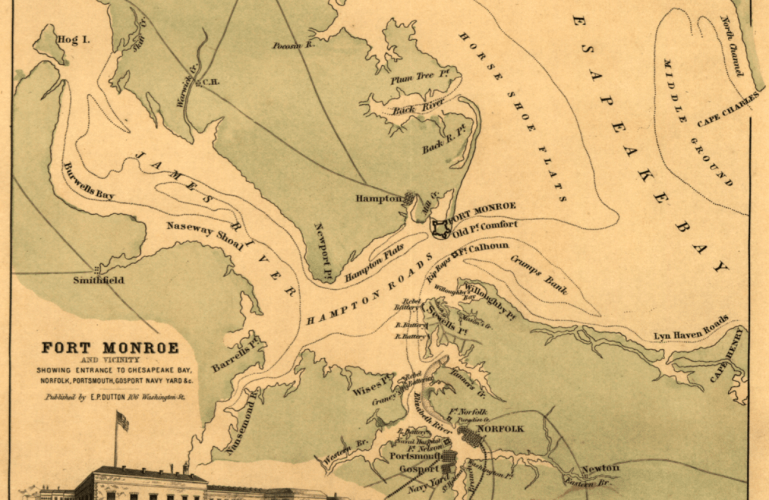
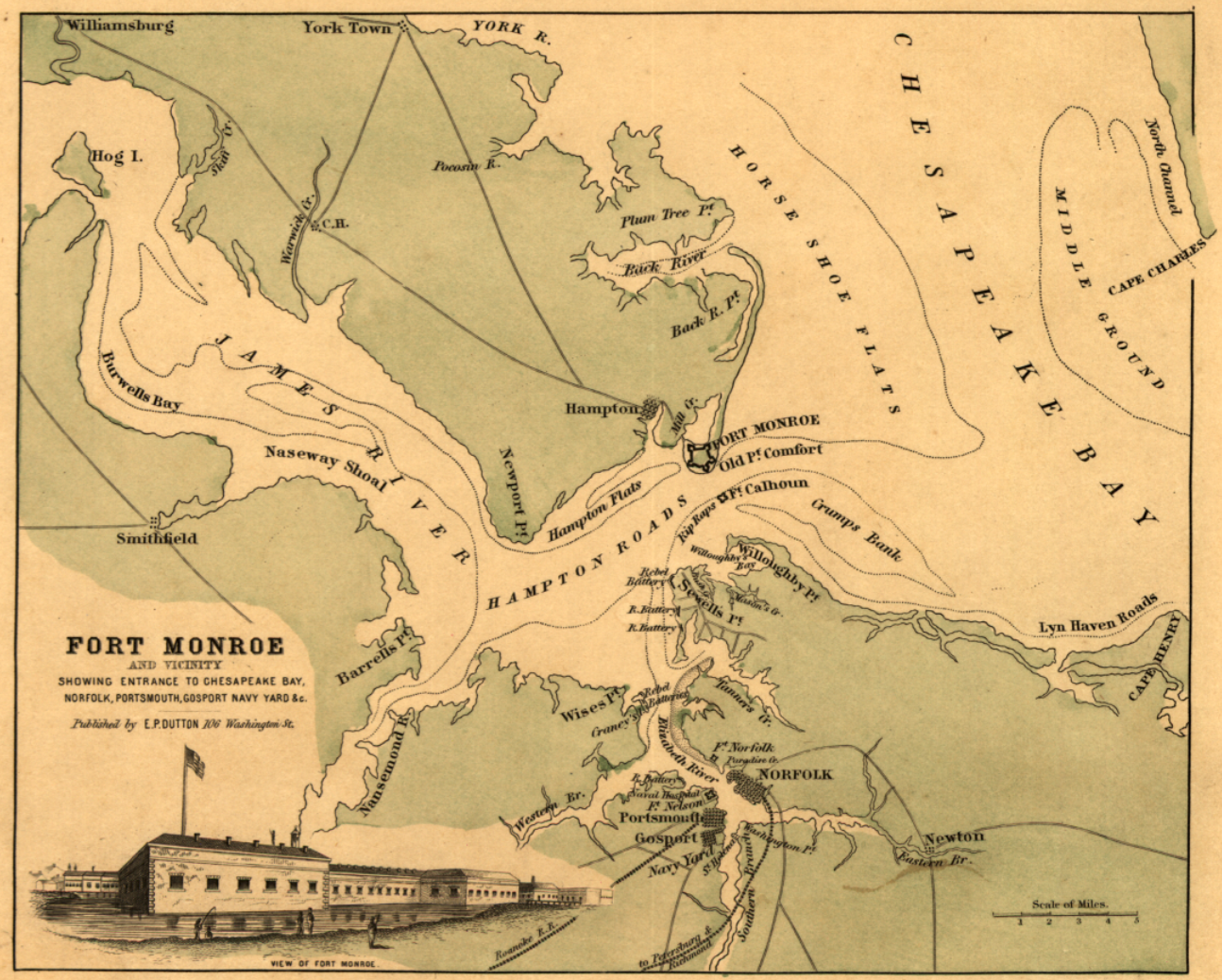
Benjamin F. Butler, a major general of Massachusetts volunteers, assumed command of the Military Department of Virginia on Wednesday, May 22, 1861. His department encompassed everything within a sixty-mile radius of Fort Monroe. The massive stone-and-brick bastion fort, constructed between 1819 and 1844, stood at Old Point Comfort overlooking the entrance to Hampton Roads. Following the surrender of Fort Sumter in South Carolina, Fort Monroe remained the only federal fort in the South not seized by secessionists.
One of Butler’s first acts was to briefly occupy Hampton, a town on the eastern edge of the Virginia Peninsula not far from Fort Monroe. According to Butler, the expedition’s purpose was to reconnoiter the area for a suitable campsite for the volunteer regiments certain to arrive in the coming weeks. If it was merely coincidence that the operation took place on the same day Virginians voted on the referendum to ratify the ordinance of secession, the people of Hampton did not see it that way.
To carry out the mission, Butler dispatched the First Vermont Infantry Regiment under Col. John W. Phelps of Brattleboro. A ninety-day regiment, the First Vermont numbered 779 men. The following excerpt comes from Butler’s report dated May 24, 1861, though it also later describes events that occurred on May 25. Whether Butler began the report on the 24th and completed it the following day, or whether the date was a typo, is unclear.
“On Thursday I directed Colonel Phelps, of the Vermont regiment, to make a reconnaissance in force in Hampton and its neighborhood within two miles of the fort, in order to examine its capabilities for encamping the troops about to arrive, and at the same time I made personal examination of the ground, Colonel De Russy being of opinion that the wood suggested by the Lieutenant-General might be a little unhealthy, and I was further determined upon encamping in this direction by considerations of probable advances in this direction, to which I will take leave to call your attention soon. The rebels upon our approach attempted to burn the bridge over Hampton Creek, but the fire was promptly extinguished by the Vermonters, assisted by the citizens. Colonel Phelps passed into the village of Hampton, and found only a few citizens, who professed to be watching their negroes, in which occupation I have not as yet disturbed them. I therefore encamped Colonel Phelps’ Vermont regiment and Colonel Carr’s New York regiment on the point of land just above the spring, about half way between Fort Monroe and Hampton.”
– Report of Maj. Gen. Benjamin F. Butler, May 24, 1861
Forty-one-year-old Maj. John Baytop Cary commanded the Virginia militia in Hampton. A graduate of the College of William and Mary, he served as principal and instructor of languages and mathematics at Hampton Academy. In April 1861, he received a commission as a major of artillery in Virginia’s provisional army. The following is an excerpt of his May 23 report.
“I have the honor to inform you that quite a full regiment of the enemy, estimated, by count of companies, to contain eight hundred men, under command of Colonel Phelps, made a demonstration against this place this afternoon, between 4 and 5 o’clock, which seemed at first to wear a very ugly aspect, but which, happily, resulted in no damage, save the alarm of our women and children and the excitement of our citizens.
“I had nearly perfected my arrangements for the defense indicated in your instructions, by making preparations for the destruction of all the bridges leading across the main tributary of Back River as well as the Hampton Bridge. Unfortunately, the absence during the day of the party chosen for the firing of the latter, and their consequent failure to have the combustibles on the spot, delayed operations so far that the enemy were in sight before the fire could be started, though it would have made sufficient progress, I think, to have arrested their entrance into the town. At this stage, meeting with Lieutenant Cutshaw, at his suggestion I sent him forward as my aid to demand of the colonel the intent of his approach with so large a body of men, and being assured that he came with no hostile purpose, but simply, as he said, by order of General Butler, to reconnoiter, and having received the subsequent assurance from him in person that he would make no attack upon our people nor injure their property in any way unless he himself was molested, and coinciding in your view that defense at this point was useless and hopeless, I aided him in extinguishing the fire, and gave the assurance that he should not be fired upon by the volunteer force under my command (which, by the way, had by that time nearly retreated to the line of defense which I intended to occupy and where I designed to making the first resistance). I also urged our citizens to abstain from any attack, which counsel, I am pleased to say, prevailed with them. The entire body then marched into the town as far as the intersection of our main streets, halted for a short while, and then returned. I have since learned that this body was supported by about three hundred men, with a battery of six brass pieces, and that there was a still further reserve on the march. But this latter information I do not consider so reliable. I have only to add, in this connection, that the force at my command, as estimated by information since derived from the several captains, was only one hundred and thirty men on the approach of the enemy.”
– May 23, 1861 Report of Maj. John Baytop Cary, Virginia Artillery
Although the U.S. Navy had already exchanged fire with Virginia shore batteries, the occupation of Hampton on the afternoon of May 23 marked the first time Union troops had set foot on the “sacred soil of Virginia” since the convention in Richmond voted for secession in April. The incident drew some newspaper attention, but it was quickly overshadowed by the invasion of northeastern Virginia and the occupation of Alexandria the following day. The following newspaper accounts describe the events at Hampton:
HAMPTON IN POSSESSION OF THE LINCOLNITES.
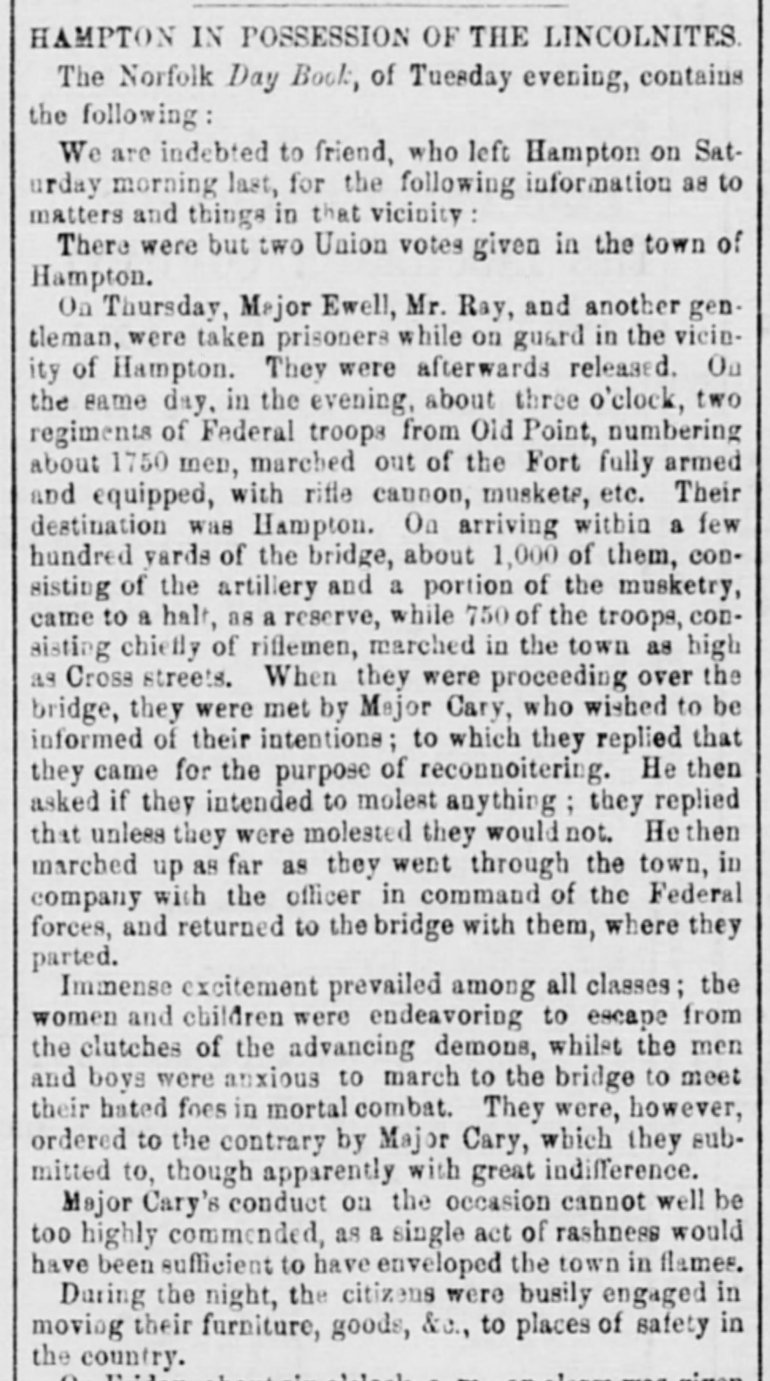
The Norfolk Day Book, of Tuesday evening, contains the following:
We are indebted to friend, who left Hampton on Saturday morning last, for the following information as to matters and things in that vicinity:
There were but two Union votes given in the town of Hampton.
On Thursday, Major Ewell, Mr. Ray, and another gentleman, were taken prisoners while on guard in the vicinity of Hampton. They were afterwards released. On the same day, in the evening, about three o’clock, two regiments of Federal troops from Old Point, numbering about 1750 men, marched out of the Fort fully armed and equipped, with rifle cannon, muskets, etc. Their destination was Hampton. On arriving within a few hundred yards of the bridge, about 1,000 of them, consisting of the artillery and a portion of the musketry, came to a halt, as a reserve, while 750 of the troops, consisting chiefly of riflemen, marched in the town as high as Cross street. When they were proceeding over the bridge, they were met by Major Cary, who wished to be informed of their intentions; to which they replied that they came for the purpose of reconnoitering. He then asked if they intended to molest anything; they replied that unless they were molested they would not. He then marched up as far as they went through the town, in company with the officer in command of the Federal forces, and returned to the bridge with them, where they parted.
Immense excitement prevailed among all classes; the women and children were endeavoring to escape from the clutches of the advancing demons, whilst the men and boys were anxious to march to the bridge to meet their hated foes in mortal combat. They were, however, ordered to the contrary by Major Cary, which they submitted to, though apparently with great indifference.
Major Cary’s conduct on the occasion cannot well be too highly commended, as a single act of rashness would have been sufficient to have enveloped the town in flames.
During the night, the citizens were busily engaged in moving their furniture, goods, &c., to places of safety in the country.
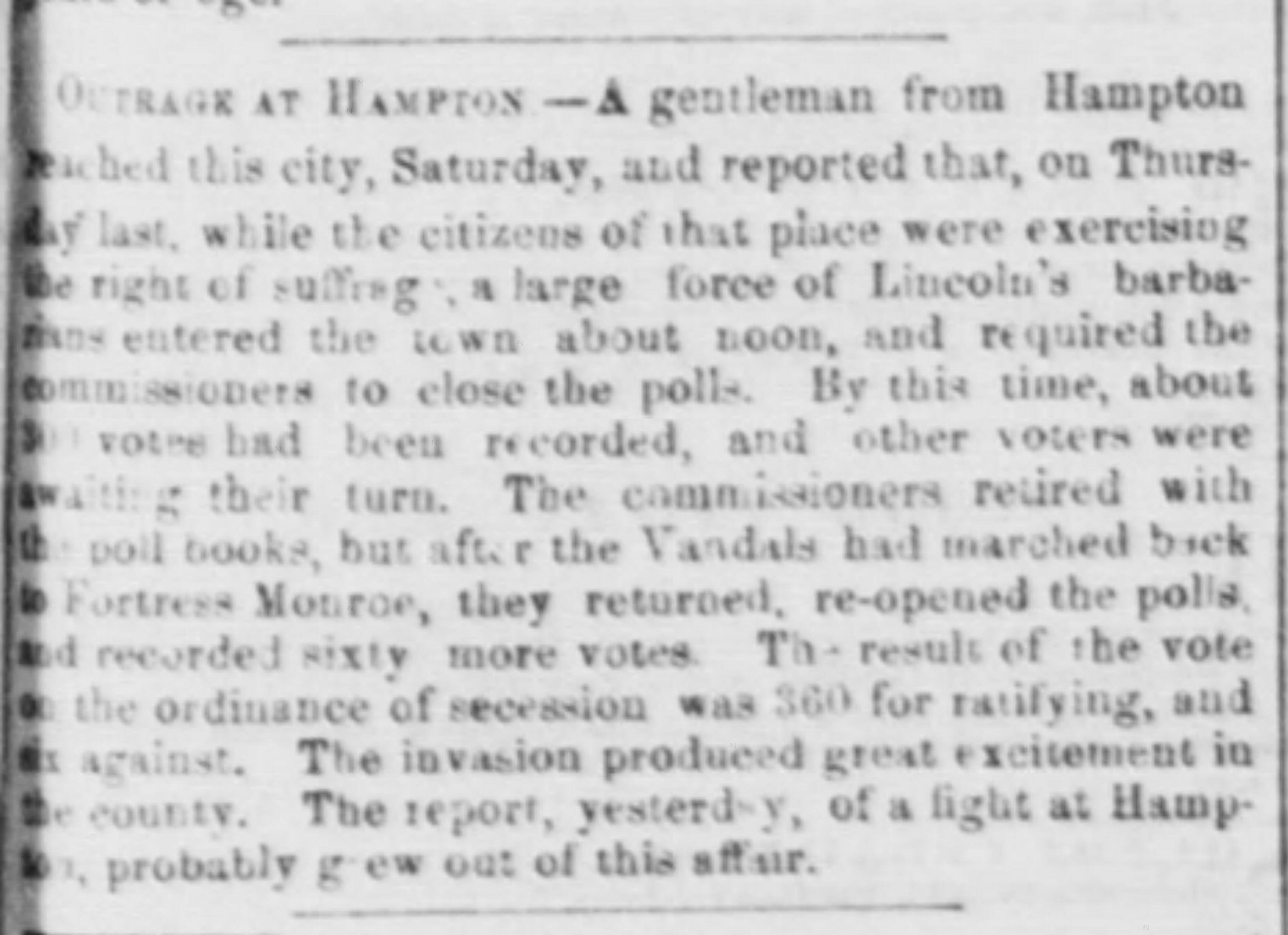
OUTRAGE AT HAMPTON.—A gentleman from Hampton reached this city, Saturday, and reported that, on Thursday last, while the citizens of that place were receiving the right of suffrage, a large force of Lincoln’s barbarians entered the town about noon, and required the commissioners to close the polls. By this time, about 50 votes had been recorded, and other voters were awaiting their turn. The commissioners retired with the poll books, but after the Vandals had marched back to Fortress Monroe, they returned, re-opened the polls, and recorded sixty more votes. The result of the vote on the ordinance of secession was 360 for ratifying, and 3 against. The invasion produced great excitement in the community. The report, yesterday, of a fight at Hampton, probably grew out of this affair.
Discussion
Compare Butler’s report with Major Cary’s report. In what ways do the two officers agree about what happened, and where do their accounts differ?
Major Cary chose not to resist the Union troops directly. Do you think his decision was wise? Why or why not?
Newspapers used emotionally charged phrases such as “Lincoln’s barbarians” and “advancing demons.” How might this language have shaped public opinion in Virginia?
Why do you think the people of Hampton viewed the timing of the Union expedition, occurring on the same day as the secession referendum, as significant?
Butler referred to local residents “watching their negroes.” What does this brief statement reveal about slavery and white anxieties in eastern Virginia at the beginning of the war?
Sources
Cobb, J. Michael, Edward B. Hicks, and Wythe Holt. Battle of Big Bethel: Crucial Clash in Early Civil War Virginia. El Dorado Hills: Savas Beatie LLC, 1997.
Richmond Whig (Richmond, VA) 27 May 1861.
Richmond Whig (Richmond, VA) 31 May 1861.
The War of the Rebellion: A Compilation of the Official Records of the Union and Confederate Armies. Series I, Vol. II. With additions and corrections. Washington: Government Printing Office, 1902.


