The Tygart Valley–Cheat River Campaign was, in many respects, the Civil War’s first true military campaign. From the outset, it pursued clear objectives. Major General George B. McClellan, commanding the Department of the Ohio, was tasked with carrying the war into western Virginia by driving out Confederate forces, securing vital railroads, and restoring Federal authority. The final objective was political. Under the protection of McClellan’s army, the region’s unionist majority moved to reorganize Virginia’s government along loyal lines.
McClellan achieved all three. His success in the spring and early summer of 1861 propelled him to national prominence and soon placed him in command of the Union’s principal field army in the Eastern Theater. Yet the campaign is often overlooked, reduced to a passing mention or a few sentences in most histories. It deserves better. By any measure, it stands among the most compelling early stories of the war.
In 1861, Trans-Allegheny Virginia was a rugged land of hills and mountains carved by the Kanawha, Little Kanawha, Tygart, Cheat, and Greenbrier rivers. Small towns and subsistence farms dotted the countryside. Industry was limited to coal mining, salt works, a modest iron trade, and, on the eve of war, the first oil wells. Slavery existed but was uncommon and played only a marginal role in the local economy, especially when compared with eastern Virginia.
A border compromise in the 1780s had left Virginia with a narrow, 63-mile ribbon of land thrust between Ohio and Pennsylvania, the Ohio River forming its western boundary. Along this Northern Panhandle, Wheeling emerged as Virginia’s fourth-largest city. Geographically and culturally, it was closer to Pittsburgh than to Richmond, with expanding industry, a large German immigrant population, and steady investment flowing in from its northern neighbors.
Because the region lacked an extensive network of improved roads and railroads, the Ohio River served as its principal artery, carrying trade for 277 miles along Virginia’s western edge. The coming of war threatened to choke off this commerce and isolate the region from its most profitable markets.
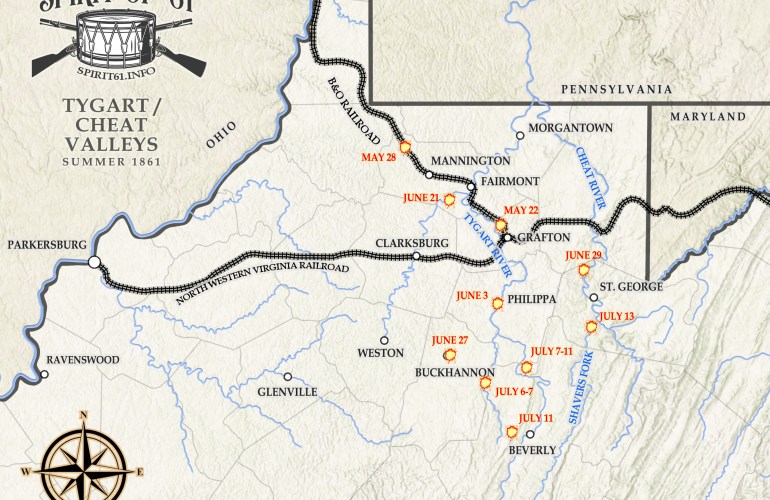
Farther south, the Baltimore & Ohio and the Northwestern Virginia railroads, the only lines crossing western Virginia, converged at Grafton on the Tygart Valley River. These routes were strategically vital but difficult to defend. Politically, northwestern Virginia was strongly unionist. Many residents opposed secession. After the Richmond Secession Convention voted to leave the Union, U.S. Congressman John S. Carlile and other unionist delegates convened a rival meeting in Wheeling to determine their course.
In June 1861, they established the “Reorganized State of Virginia,” with Francis H. Pierpont as governor. This government, loyal to the Union and based in Wheeling, laid the groundwork for the creation of West Virginia in 1863. A significant minority, however, supported secession, and guerrilla warfare, raids, and civil unrest would trouble the region throughout the conflict.
McClellan’s campaign in this region can be divided into three phases:
- Mobilization and Invasion (April 17 – June 6)
- Occupation and Defense (June 7 – June 29)
- Advance and Retreat (June 30 – July 22)
Each phase had a distinct beginning and end. The first, Mobilization and Invasion, began the moment the Virginia Convention in Richmond voted in favor of secession and ended with Porterfield’s retreat from Philippi. Second, Occupation and Defense, began when Robert S. Garnett was promoted to brigadier general and given command of Confederate troops in northwestern Virginia and ended with the Confederate foraging expedition to Buckhannon. The third, Advance and Retreat, began with McClellan’s advance on Buckhannon and ended when McClellan was called to Washington and turned over command to Brig. Gen. William S. Rosecrans.
Mobilization and Invasion (April 17 – June 6)
Union Goals: Control the Baltimore & Ohio and Northwestern Virginia railroads. Mobilize Virginia unionists to form volunteer units and support an alternative state government loyal to the Union.
Confederate Goals: Control the Baltimore & Ohio and Northwestern Virginia railroads. Mobilize Virginia secessionists to form volunteer units and align Virginia with the Confederacy.
Military engagements;
- Action at Fetterman, May 22, 1861
- Action at Glover’s Gap, May 28, 1861
- Action at Philippi, June 3, 1861
As Virginians debated their future course, Robert E. Lee called upon Maj. Alonzo Loring in Wheeling and Francis M. Boykin Jr. of Weston to raise volunteer companies to protect key points in the northwestern region. He ordered Col. George A. Porterfield, a veteran of the Mexican-American War, to proceed to Grafton and organize recruits. Volunteers proved scarce, and those who did assemble were poorly armed and equipped. After the secession vote, Porterfield ordered bridges on the Baltimore & Ohio and Northwestern Virginia railroads north and west of Grafton destroyed to hinder Federal advances.
Unionists responded in kind. Citizens raised companies for Federal service, including the First Virginia Regiment (U.S.), organized at Camp Carlile on Wheeling Island under Colonel Benjamin Franklin Kelley. In late April 1861, Ohio Governor William Dennison recruited George B. McClellan to command the state’s volunteers. On May 3, General Orders No. 14 created the Department of the Ohio, combining Illinois, Indiana, and Ohio into a single military district. Recalled to federal service at age thirty-four and promoted to major general, McClellan was placed in command and soon organized an invasion of western Virginia.
In response to the bridge burnings, McClellan ordered a multi-pronged advance by Brig. Gen. Thomas A. Morris with the First Virginia (U.S.) and regiments from Indiana and Ohio to secure and repair the railroads in the region and seize the key junction at Grafton. He directed one column to move out from Wheeling along the B&O, while the other advanced from Parkersburg on the Northwestern Virginia Railroad. On June 3, 1861, the united columns defeated Porterfield at Philippi, scattering his small command.
The Federal success at Philippi dealt a blow to secessionist morale in the northwest from which they never fully recovered. Though a military court of inquiry later cleared Porterfield, and his outnumbered, untrained, poorly armed force was unlikely to have offered much resistance, the men under him blamed him for the disaster. He was reassigned to an administrative post, while his demoralized volunteers drifted 44 miles south to Huttonsville, unsure of what would come next.
Occupation and Defense (June 7 – June 29)
Union Goals: Control the Baltimore & Ohio and Northwestern Virginia railroads. Establish an alternative state government loyal to the Union.
Confederate Goals: Block northerly routes over the Alleghenies into the Shenandoah Valley. Disrupt use of the Baltimore & Ohio Railroad and delegitimize unionist state government.
Military engagements;
- Action at Righter’s House, June 21, 1861
- Action at Buckhannon, June 27, 1861
- Skirmish at Bowman’s Place, June 29, 1861
As Union reinforcements poured into northwestern Virginia, Lee’s adjutant general, Robert S. Garnett, was promoted to brigadier general and assigned command of the region’s Confederate forces. He inherited a difficult landscape and a small army with which to defend it. Luckily for him, the Federals, under direct command of Brig. Gen. Thomas A. Morris, seemed paralyzed, allowing Garnett time to organize and train his force.
Two principal north-south waterways shaped operations there: the Tygart Valley River, flowing from Huttonsville north to Fairmont, and the Cheat River with its tributary, Shavers Fork, running from Cheat Mountain to the Pennsylvania border. The Tygart Valley River cut between Rich Mountain and Laurel Mountain, steep ridges that were nearly impassable except at two critical crossings.
The Staunton-Parkersburg Turnpike and the Beverly-Fairmont Turnpike were the only improved east-west roads by which wagons could traverse those mountains without a long and impractical detour.
Recognizing that any Federal advance toward the Alleghenies and the Shenandoah Valley would have to follow those routes, Garnett concentrated his small force along them. He fortified positions at Laurel Hill and Rich Mountain, anchoring his line to the two turnpikes. His main supply base lay just east of Rich Mountain at Beverly.
Behind his front ran a north-south road from Beverly through St. George to Rowlesburg, where Union troops already guarded the Baltimore & Ohio Railroad. Garnett’s problem was clear: hold the mountain gateways with limited men, or risk opening the door to the Shenandoah Valley beyond.
Garnett did not have enough men to hold the passes and carry out offensive operations, so both sides settled into a tense stalemate. Reconnaissance patrols probed the countryside while each army waited for the other to make a mistake. Something had to change, and that change came on June 21 with the arrival of George B. McClellan to assume direct command. A Confederate foraging expedition and brief skirmish with Union home guards in Buckhannon spurred McClellan into action, and by the end of June his forces were on the move.
Advance and Retreat (June 29 – July 22)
Union Goals: Clear Confederate forces from northwestern Virginia, opening northerly routes over the Alleghenies into the Shenandoah Valley. Seize Cheat Mountain pass.
Confederate Goals: Block northerly routes over the Alleghenies into the Shenandoah Valley. Disrupt use of the Baltimore & Ohio Railroad and delegitimize unionist state government.
Military engagements;
- Skirmish at Middle Fork Bridge, July 6 – 7, 1861
- Battle of Bellington/Laurel Hill, July 7 – 11, 1861
- Battle of Rich Mountain, July 11, 1861
- Battle of Corrick’s Ford, July 13, 1861
- Action at Greenbrier River, July 19, 1861
In late June, McClellan joined his army in person and launched a coordinated offensive in concert with Brig. Gen. Jacob D. Cox’s advance in the Kanawha Valley. Union forces soon drove Garnett from his mountain strongholds. By mid-July, Garnett was dead, his command scattered, and hundreds of Confederates had fallen into Union hands. On July 16, the 14th Indiana occupied Cheat Mountain, securing the high ground and placing northwestern Virginia firmly under Federal control.
How had the situation unraveled so quickly?
Garnett’s defense of the two main routes through the Alleghenies into the Shenandoah Valley rested on mutually supporting positions, each intended to reinforce the other if threatened. McClellan’s plan, however, applied pressure to both at once, leaving Garnett’s forces divided and exposed. Morris’ role was to pin Garnett in place while McClellan struck across Rich Mountain toward Beverly, cutting off his line of retreat.
Several times, Garnett appealed to Henry A. Wise, then operating in the Kanawha Valley, to unite their forces against McClellan before the Federals grew too strong. Wise hesitated, sending only a small expedition to Glenville that tied down a few Union regiments, but it was too little and came too late.
For five days, Union forces under Morris skirmished with Garnett’s Confederates around the small hamlet of Belington. By the evening of July 9, McClellan had reached Roaring Creek at the base of Rich Mountain. Two days later, Brig. Gen. William S. Rosecrans launched a successful flank attack at Hart’s Farm in the rear of the Confederate position. The defenders escaped in several groups, but during the next few days more than 660 men surrendered.
When word arrived that McClellan had outmaneuvered and overwhelmed the garrison at Rich Mountain, Garnett abandoned his fortifications under cover of darkness. His men initially moved south toward Beverly, but after receiving erroneous reports that the road had been blockaded, they reversed course and retreated northeast along Shavers Fork of the Cheat River. The Union advance caught up with them at Corrick’s Ford, where Garnett was killed and his army routed. Morris captured dozens of prisoners along with wagons and supplies.
The death of Garnett and the crippling of the Army of the Northwest at Corrick’s Ford temporarily ended organized Confederate resistance in northwestern Virginia. When the 14th Indiana Infantry secured Cheat Mountain, strategically positioned astride the Staunton-Parkersburg Turnpike roughly eighty miles northwest of Staunton, the Union gained uncontested control of more than 10,000 square miles of Trans-Alleghany Virginia.
Meanwhile, John S. Carlile and other unionists successfully established the Reorganized Government of Virginia in Wheeling and elected Francis H. Pierpont governor. President Abraham Lincoln quickly recognized the new regime as Virginia’s legitimate state government, and Congress seated its senators and representatives. Carlile would later help create the new state of West Virginia, while the Reorganized Government eventually relocated to Union-occupied Alexandria.
Conclusion
It would be difficult to find a more complete Union victory in 1861 than the Tygart Valley–Cheat River Campaign. McClellan achieved nearly all of his political and military objectives before his unexpected transfer, combined with stubborn Confederate resistance east of Cheat Mountain, effectively brought the campaign to an end. That fall, Robert E. Lee unsuccessfully attempted to retake Cheat Mountain, and aside from a few brief interruptions, the region remained in Union hands for the rest of the war.


