Saturday, July 13, 1861
The culminating battle of the Tygart Valley Campaign was a disaster for the Confederacy, resulting in the death of a promising commander and the irrecoverable loss of northwestern Virginia.
Narrative
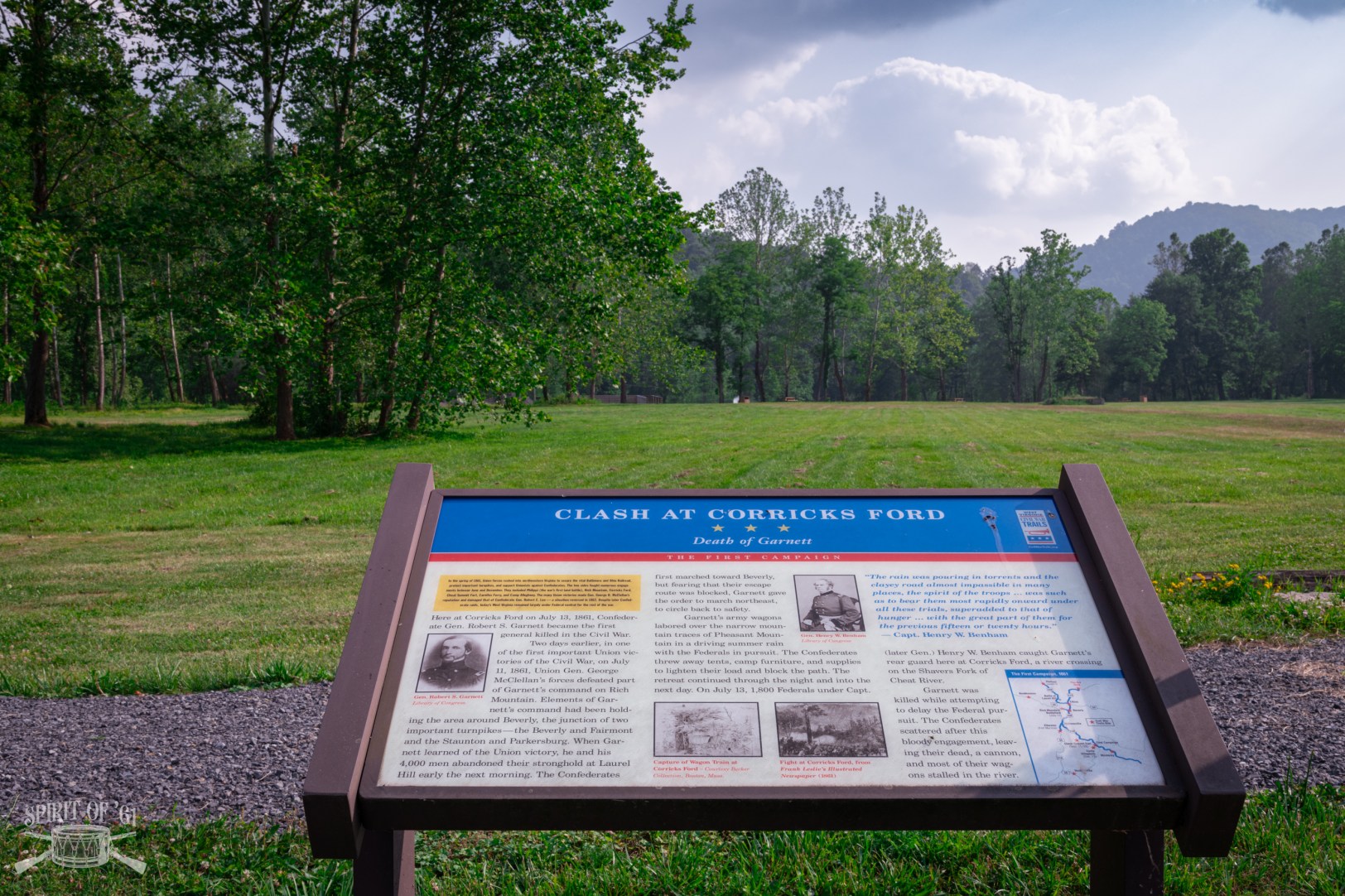
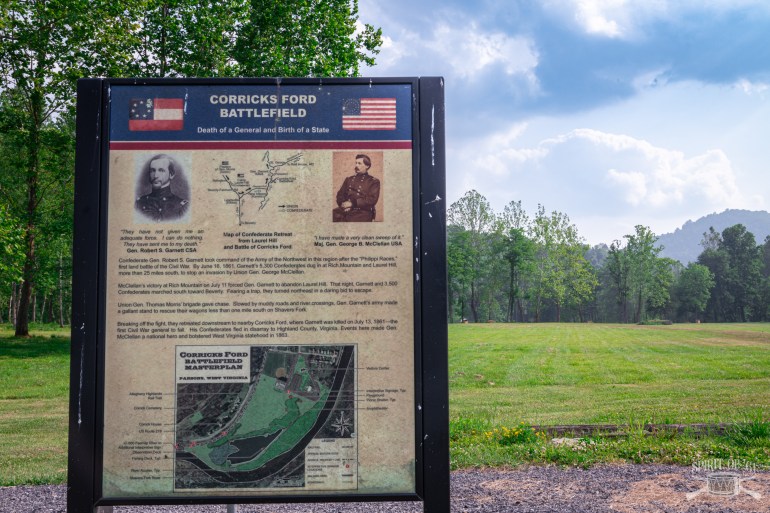
The Battle of Corrick’s Ford was fought on Saturday, July 13, 1861 between Union forces commanded by Capt. Henry Washington Benham and Confederate forces commanded by Brig. Gen. Robert S. Garnett in Tucker County, West Virginia during the American Civil War. The battle was a Union victory, ending in the collapse of Garnett’s command and the death of the first general officer killed in the Civil War.
For five days in early July 1861, Union forces under Brig. Gen. Thomas A. Morris skirmished with Brig. Gen. Robert S. Garnett’s Confederates around the small hamlet of Belington, in the foothills of Laurel Mountain in Barbour County, Virginia. The fighting formed part of a broader plan to create a diversion while Maj. Gen. George B. McClellan advanced against Rich Mountain with a separate force. What happened there would shape the fate of Garnett’s men on Laurel Hill and, ultimately, Garnett himself.
By mid-June, Garnett had established his headquarters and main camp at Laurel Hill, astride the Beverly–Fairmont Turnpike. He sent a smaller force to fortify Rich Mountain, which overlooked the Staunton–Parkersburg Turnpike. His primary supply base lay just east of Rich Mountain at Beverly. Behind his lines ran a road from Beverly north to St. George and on to Rowlesburg, where Union Brig. Gen. Charles W. Hill’s brigade guarded the Baltimore & Ohio Railroad.
If those Union troops slipped in behind Laurel Hill, Garnett’s position would be cut off with no clear avenue of escape. To guard against that threat, he posted Lt. Col. George W. Hansbrough’s four-company 9th Virginia Battalion and Capt. Robert B. Moorman’s Greenbrier Cavalry at the junction of the Beverly–Fairmont Turnpike and the road to St. George, near the community of Leedsville, or Leadsville (present-day Elkins, West Virginia). The detachment numbered fewer than 400 men fit for duty.
Garnett’s defense of the two main routes through the Alleghenies into the Shenandoah Valley rested on mutually supporting positions, each meant to reinforce the other if threatened. McClellan’s plan, however, pressed both at once, leaving Garnett’s forces exposed and divided. Morris’ role was to hold Garnett in place while McClellan struck across Rich Mountain toward Beverly, cutting off any retreat.
On July 1, Garnett wrote of his intention to have Hansbrough’s battalion switch positions with Heck’s 25th Virginia Infantry on Rich Mountain. He quickly reversed the order when McClellan’s main force occupied Buckhannon in Upshur County, about 23 miles west of the Confederate camp. Instead, he sent the 20th Virginia Infantry under Lt. Col. John Pegram to reinforce Heck.
McClellan reached Roaring Creek at the base of Rich Mountain by the evening of July 9. Two days later, on the 11th, Brig. Gen. William S. Rosecrans launched a successful flank attack at Hart’s Farm, in the rear of the Confederate position. The defenders escaped in several groups, the largest under Pegram, but over the next few days more than 660 men, including Heck and Pegram, surrendered.
When word arrived that McClellan had outmaneuvered and overwhelmed the garrison at Rich Mountain, Garnett prepared to abandon his fortifications. After nightfall, in a driving rainstorm, his small army withdrew along the Beverly–Fairmont Turnpike as it zigzagged across Laurel Mountain. They moved south toward Beverly, but acting on erroneous information that the road had been blockaded, reversed course. The 37th Virginia, which had been in the rear, now became the lead regiment, until Hansbrough’s battalion joined them and took the lead.
The next morning, Union pickets from Morris’ brigade cautiously probed toward the Confederate works and reported the enemy gone. Capt. Henry W. Benham, a civil engineer serving as a volunteer aide, rode forward with a small party to inspect the abandoned fortifications. He and the 9th Indiana Infantry soon set off in pursuit, but on the far side of Laurel Mountain, Morris ordered them to halt. Nightfall ended a day of indecision and delay.
Meanwhile, Garnett’s column moved slowly northeast along Shavers Fork of the Cheat River, its wagon train stretched in a thin line for more than two miles over rough, muddy roads. All the while, Garnett feared an attack from Hill’s brigade advancing out of Rowlesburg. That night, the lead elements bivouacked at Kaler’s Ford and did not get underway again until 8 a.m. on July 13.
Before sunrise that morning, Benham and an advance force from Morris’ brigade, consisting of the 7th and 9th Indiana Infantry, the 14th Ohio Infantry, and a section of the 1st Ohio Light Artillery, about 2,600 men in all, set off in earnest pursuit. Benham quarreled with Col. Ebenezer Dumont of the 7th Indiana over who was in command, Dumont claiming to be the senior officer on the field. Nevertheless, they reached Kaler’s Ford at noon after skirmishing with Garnett’s rearguard, which was protecting pioneers felling trees across the road.
With the enemy closing in, Garnett adopted an innovative defense. First, Col. James N. Ramsey’s Georgia regiment would stand fast, buying time for the wagons to move ahead. Then Col. William B. Taliaferro’s 23rd Virginia Infantry would take up a strong position and cover the Georgians’ withdrawal. By leapfrogging from one position to the next, Garnett hoped to keep his pursuers at bay while the column made its escape.
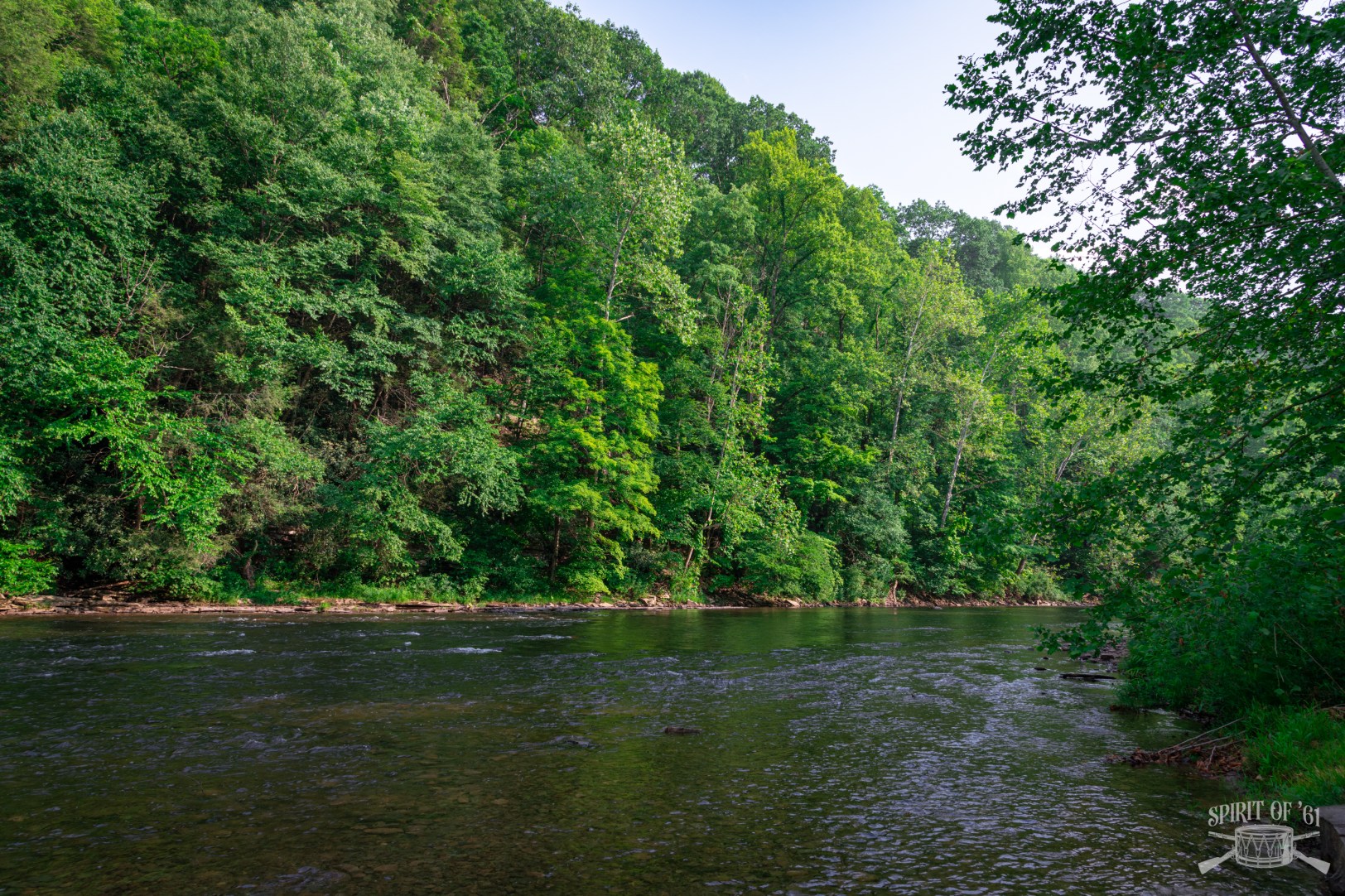
Garnett’s wagon train struggled to cross Corrick’s Ford, often misspelled Carrick’s Ford, just south of where Shavers and Black forks join to form the Cheat River, near present-day Parsons. The ford consisted of two crossings over an oxbow in the river. The first was broad, the river swollen by recent rains. Teamsters fought to get their wagons through. Some, mired in rocks and mud, had to be abandoned.
The ford’s one advantage was a high, brush-covered ridge overlooking the first crossing. As Benham later reported, “The enemy was found to have taken a strong position, with his infantry and artillery upon a precipitous bank of some fifty to eighty feet in height upon the opposite side of the river, while our own ground was upon the low land, nearly level with the river.”
Lt. James Elliott McPherson Washington, a distant relative of George Washington and one of Garnett’s aides assigned to the guns, gave a rousing cheer that opened the fight. Pelted by rain beneath a low, dreary sky, the 14th Ohio pushed forward, supported by two artillery pieces. It soon became clear the Confederate position could not be carried by a direct assault, and Benham ordered Dumont and the 7th Indiana to work around the flank.
Running low on ammunition and recognizing the threat, Col. Taliaferro ordered a withdrawal. His iron rifled 6-pounder had to be left behind, damaged and immobile. Washington spiked it to keep it from being used against them. Despite holding the high ground and commanding a clear field of fire, the Confederates suffered more than three times as many casualties in the brief, 30-minute fight.
As the Virginians fell back from the first crossing, Garnett rode up and ordered Taliaferro to post ten riflemen behind driftwood piled at the second crossing. He sat his horse midstream, bullets striking the water around him. A small party from the 7th Indiana worked its way forward through the wrecked wagon train and opened fire. As Garnett turned, he was struck in the back and fell. First Sergeant Benjamin F. Burlingame of Company E was credited with the fatal shot. Another man beside Garnett was killed.
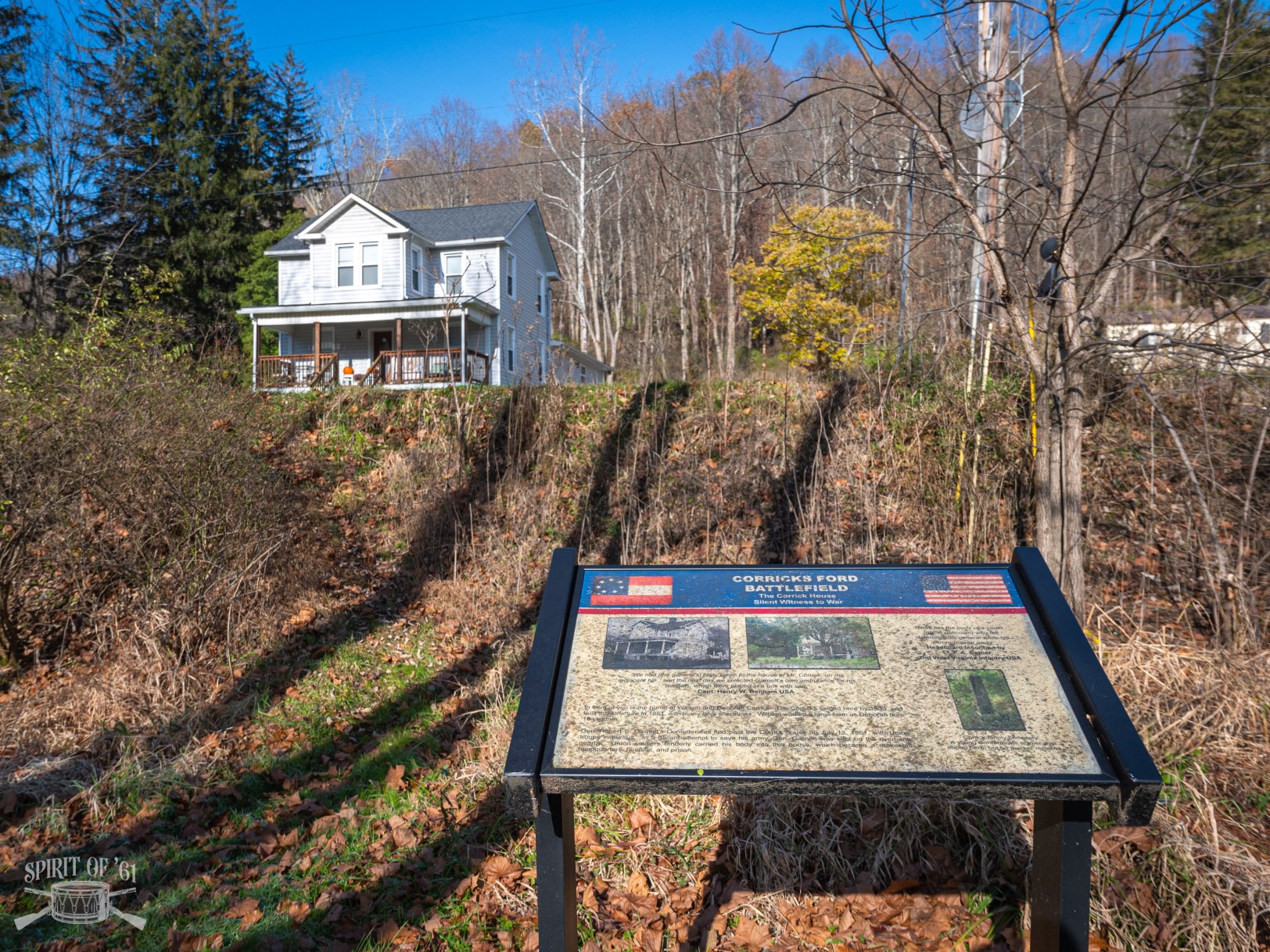
The Confederate defense collapsed with their general’s fall, though the Federals pursued only a short distance. They captured dozens of wagons and took nearly 90 prisoners at a cost of just two killed and ten wounded. Garnett’s body was carried to the nearby home of William and Deborah Corrick, which served as a makeshift hospital and prison. The house still stands.
Garnett’s army struggled on to the northeast toward the Maryland border. From Rowlesburg, Hill’s scattered command could do little to pursue. Aside from rounding up a few stragglers, they failed to interfere with the retreat. Six companies of Ramsey’s 1st Georgia became separated early in the fighting and wandered the wilderness for days before rejoining the army. In the weeks that followed, the remnants gathered at Monterey under Garnett’s replacement, Brig. Gen. Henry R. Jackson.
McClellan praised the conduct of his volunteers and trumpeted the victories at Rich Mountain and Corrick’s Ford, writing to his army on July 16, “I am proud to say that you have gained the highest reward that American troops can receive—the thanks of Congress and the applause of your fellow-citizens.” He would soon leave Rosecrans in command, however, after being called to Washington following the disaster at the First Battle of Bull Run.
Opposing Forces
Confederate
Brig. Gen. Robert S. Garnett, Commanding
| Unit | Commander(s) | Strength | KIA | MW | WIA | Captured / Missing |
|---|---|---|---|---|---|---|
| 1st Regiment, Georgia Infantry (Ramsey’s) | Col. James N. Ramsey | 944 | 0 | 0 | 1 | 28* |
| 23rd Virginia Inf. Regiment | Col. William B. Taliaferro | 611 | 12 | 4 | 14 | 47** |
| Danville Battery | Capt. Lindsay M. Shumaker | 3 Guns, 72 men | 0 | 0 | 0 | 1 |
| 1,627 | 13*** | 4 | 15 | 76 |
Union
Capt. Henry W. Benham, Commanding
| Unit | Commander(s) | Strength | KIA | MW | WIA | MIA |
|---|---|---|---|---|---|---|
| 14th Ohio Inf. Regiment | Col. James B. Steedman | 1,009 | 2 | 0 | 10 | 0 |
| 7th Indiana Inf. Regiment | Col. Ebenezer Dumont | 781 | 0 | 0 | 0 | 0 |
| 9th Indiana Inf. Regiment | Col. Robert H. Milroy | 780 | 0 | 0 | 0 | 0 |
| 1st Ohio Light Artillery | Col. James Barnett | 2 guns, 50 men* | 0 | 0 | 0 | 0 |
| 2,620 | 2 | 0 | 10 | 0 |
Casualties
Confederate
| Name | Unit | Killed | Mortally Wounded | Wounded | Captured |
|---|---|---|---|---|---|
| Brig. Gen. Robert S. Garnett | Army of the Northwest | K | |||
| Pvt. William P. S. Poole | 1st GA, Co. I | W | C | ||
| Pvt. Thomas B. Walthall | 23rd VA, Co. B | K | |||
| Pvt. James Walk | 23rd VA, Co. B | W | |||
| Pvt. John R. Walk | 23rd VA, Co. B | W | |||
| Pvt. George W. Lockett | 23rd VA, Co. C | K | |||
| Pvt. Travis Hastings | 23rd VA, Co. C | W | |||
| Pvt. James T. Meeks | 23rd VA, Co. D | K | |||
| Pvt. Joseph C. Lanford | 23rd VA, Co. D | W | C | ||
| Pvt. Henry W. Hagood | 23rd VA, Co. E | MW | |||
| Pvt. Phillip P. Vass | 23rd VA, Co. E | MW | C | ||
| Sgt. William B. Moody | 23rd VA, Co. F | W | C | ||
| Pvt. James H. Mason | 23rd VA, Co. G | K | |||
| Pvt. William Smith | 23rd VA, Co. G | W | C | ||
| Pvt. Samson Phillips | 23rd VA, Co. H | K | |||
| Pvt. Cornelius C. Beazley | 23rd VA, Co. H | MW | C | ||
| Pvt. John A. Carter | 23rd VA, Co. I | K | |||
| Pvt. Elijah F. Collins | 23rd VA, Co. I | K | |||
| Pvt. Joshua Foster | 23rd VA, Co. I | K | |||
| Pvt. Irby King | 23rd VA, Co. I | K | |||
| Sgt. Henry Venable | 23rd VA, Co. I | K | |||
| Pvt. John W. Cave | 23rd VA, Co. I | W | C | ||
| Cpl. Henry W. Edmonds | 23rd VA, Co. I | W | C | ||
| Pvt. Thomas L. Hines | 23rd VA, Co. I | W | |||
| Pvt. Samuel C. Hines | 23rd VA, Co. I | W | |||
| Pvt. Drury Lacy | 23rd VA, Co. I | W | |||
| Pvt. Benjamin A. Womack | 23rd VA, Co. I | W | |||
| Pvt. William J. Atwell | 23rd VA, Co. K | K | |||
| Pvt. Cain Mahoney | 23rd VA, Co. K | K | |||
| Pvt. Robert Osborne | 23rd VA, Co. K | MW | |||
| Pvt. George O. Crenshaw | 23rd VA, Co. K | W | |||
| Pvt. John T. Locke | 23rd VA, Co. K | W |
Union
| Name | Unit | Killed | Mortally Wounded | Wounded |
|---|---|---|---|---|
| Pvt. Samuel Mills | 14th Ohio, Co. A | K | ||
| Pvt. Daniel Mills | 14th Ohio, Co. A | W | ||
| Pvt. John Neihouse | 14th Ohio, Co. A | W | ||
| Pvt. Henry Morrow | 14th Ohio, Co. B | W | ||
| Sgt. Henry Reichelderfer | 14th Ohio, Co. C | K | ||
| Pvt. Richard Henderson | 14th Ohio, Co. C | W | ||
| 1st Sgt. Charles Greenwood | 14th Ohio, Co. C | W | ||
| Capt. Benjamin H. Fisher | 14th Ohio, Co. C | W | ||
| Pvt. Lemuel N. Richards | 14th Ohio, Co. C | W | ||
| Pvt. Casper Sirolff | 14th Ohio, Co. D | W | ||
| Lt. Samuel Sherman | 14th Ohio, Co. K | W | ||
| Pvt. William Smith? | 14th Ohio, Co. K | W |
Timeline
June 16, 1861: Confederate Brig. Gen. Robert Seldon Garnett assigns Col. Jonathan M. Heck to guard the Staunton and Parkersburg Turnpike at Rich Mountain, while he fortifies Laurel Hill.
July 7, 1861: Union forces commanded by Maj. Gen. George B. McClellan arrive in front of Rich Mountain and Laurel Hill.
July 7-11, 1861: Skirmishing takes place at Laurel Hill between Garnett’s force and Union forces commanded by Brig. Gen. Thomas A. Morris.
July 11, 1861: Union Brig. Gen. William S. Rosecrans flanks the Confederate position at Rich Mountain, forcing them to retreat. Garnett abandons his camp at Laurel Hill and attempts to retreat to Beverly. Lt. Col. John Pegram surrenders.
July 13, 1861: Garnett is killed directing his men across a ford in Shavers Fork of the Cheat River.
Battlefield
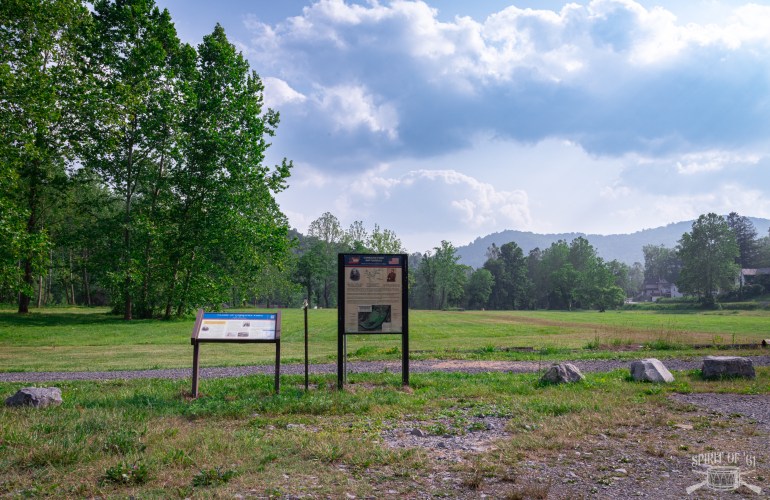
In 1926, the Tucker County Historical Society dedicated a bronze plaque affixed to a six-ton boulder at the county courthouse to commemorate the battle, which was moved closer to the actual site in 1938. The American Battlefield Trust has preserved 26 acres of the battlefield, and interpretive signage and a trail is part of Corricks Ford Battlefield Park in Parsons, West Virginia. The Corrick House, where Garnett’s body was taken after the battle, still stands.
Corricks Ford Battlefield Park is located at the end of Poplar Street in Parsons, West Virginia. The Beverly Heritage Center is at 4 Court Street in Beverly, West Virginia, and is open Sunday through Thursday 11am to 5pm and Friday and Saturday 10am to 6pm. The captured 6-pounder iron cannon was taken to Cleveland and is currently on display at the Cleveland Grays Armory Museum, 1234 Bolivar Rd. Cleveland, OH 44115.
Location
GPS Coordinates — 39.08968, -79.68079
Primary Sources
News Articles
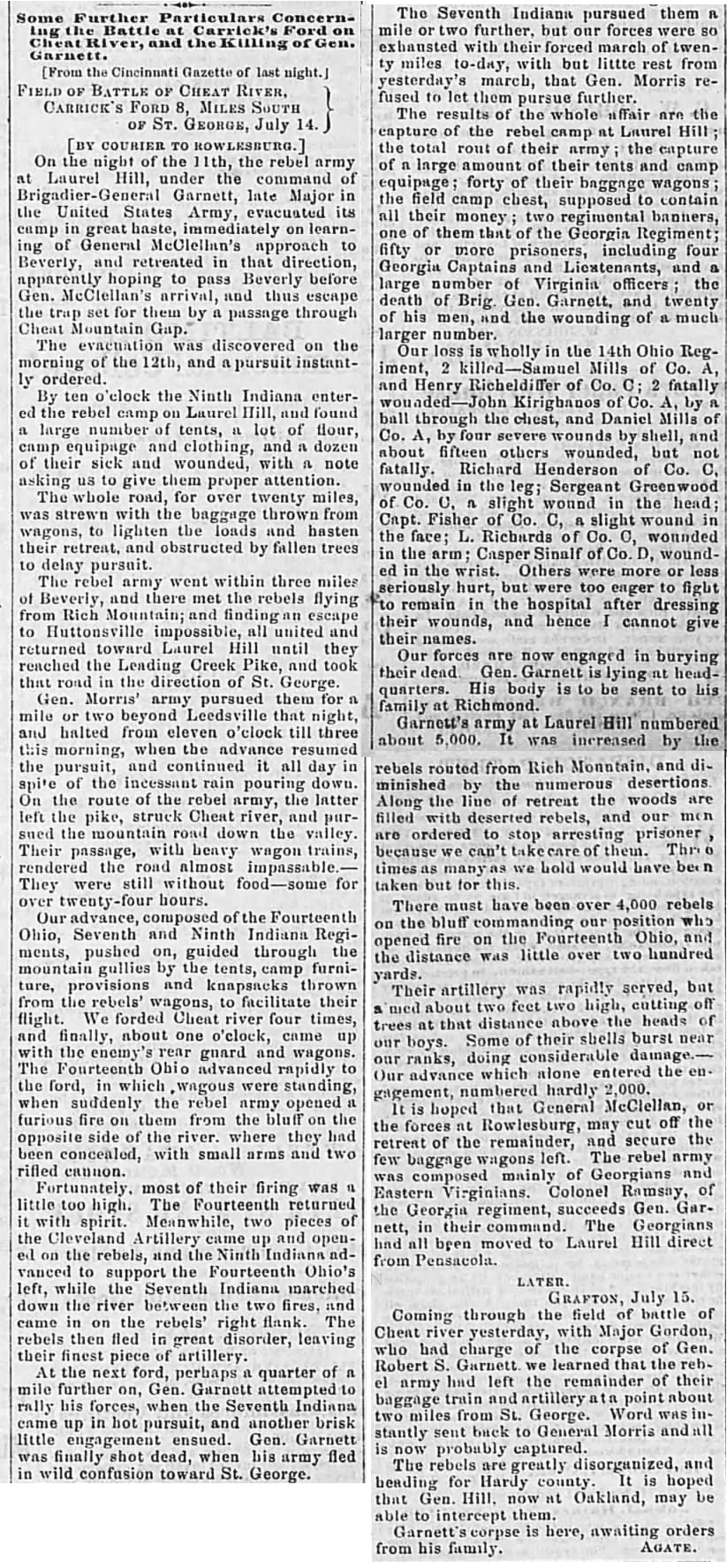
Wheeling Daily Intelligencer (Wheeling, VA) 17 July 1861.
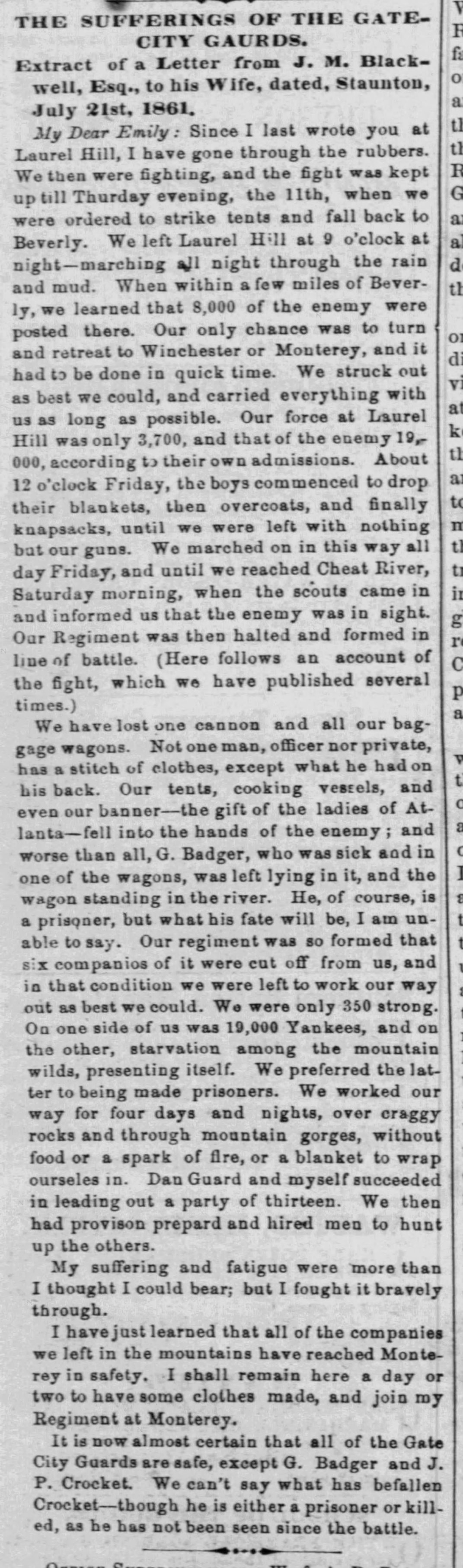
Southern Confederacy (Atlanta, GA) 31 August 1861.
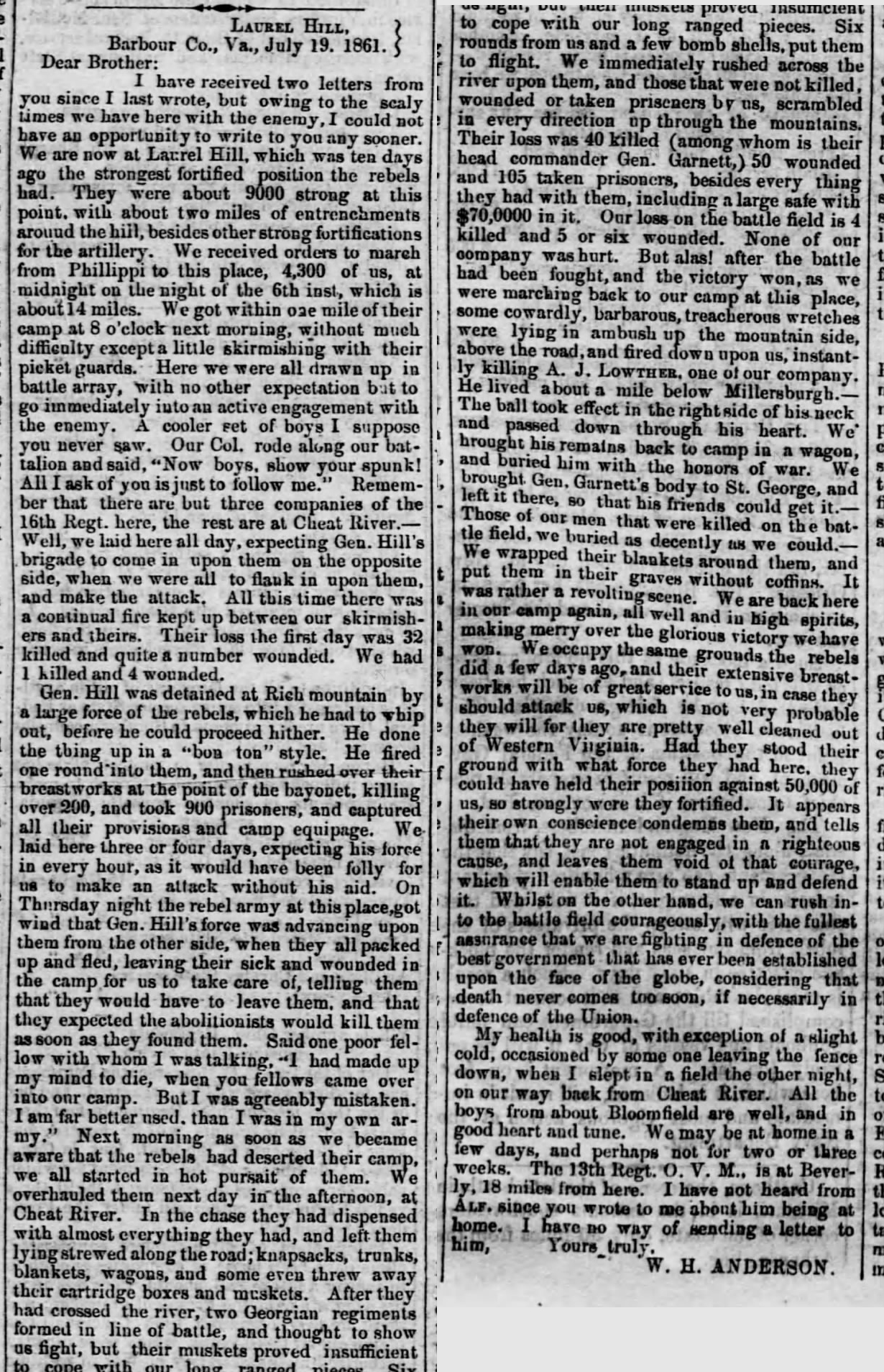
Holmes County Republican (Millersburg, OH) 1 August 1861.
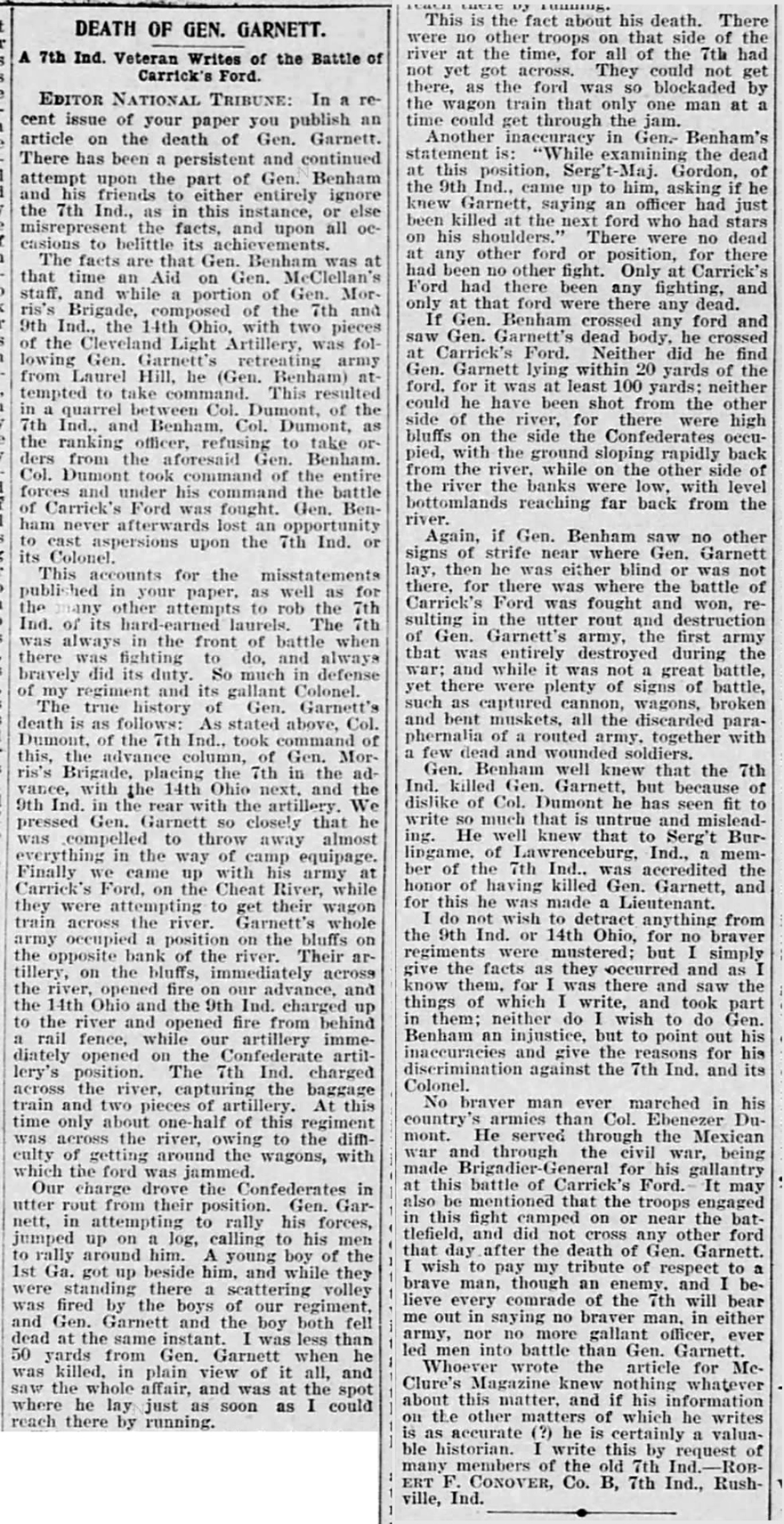
The National Tribune (Washington, DC) 6 June 1901.
Reports and Letters
- Jul. 13 Report of Maj. Gen. George B. McClellan
- July 13 Report of Capt. H. W. Benham, U. S. Corps of Engineers
- July 14 Report of Brigadier General T. A. Morris, Indiana Militia
- Jul. 14 Report of Maj. Gen. George B. McClellan (1st)
- Jul. 14 Report of Maj. Gen. George B. McClellan (3rd)
- July 15 Report of Colonel Samuel Beatty, 19th Ohio Volunteers
- Jul. 15 Report of Maj. Gen. George B. McClellan
- Jul. 15 Letter from George B. McClellan
- Jul. 16 Congratulatory address from General McClellan
- July 16 Report of Brig. Gen. Henry R. Jackson, C. S. Army
- July 16 Report of Brigadier General T. A. Morris, Indiana Militia
- July 20 Report of Captain Lindsay Mayo Shumaker, Captain, C.S. Army
- July 24 Statement of Col. Samuel Vance Fulkerson, 37th Virginia
- July 31 Report of Captain John Keys, Ringgold Cavalry
- August 6 Report of Adjutant David W. Marshall, 16th Regiment, Ohio Volunteer Militia
- August 10 Report of Colonel W. B. Taliaferro, Twenty-third Virginia Infantry
- Narrative of Brevet Brigadier-General Charles W. Hill, on operations around Cheat River, July 4-17
Diaries and Memoirs
Benham, Henry Washington. Recollections of West Virginia Campaign with ‘The Three Months Troops’. Boston: Privately Printed, 1873.
Folsom, James M. Heroes and Martyrs of Georgia: Georgia’s Record in the Revolution of 1861. Macon: Burke, Boykin & Company, 1864.
Hill, Charles W. Comments on Major-Gen. McClellan’s Account of his West Virginia Campaign. Toledo: By the author, 1864.
Ranson, A. R. H. “Reminiscences of the Civil War by a Confederate Staff Officer.” The Sewanee Review 22 (January 1914): 1-23.
Reid, Whitelaw. A Radical View: The “Agate” Dispatches of Whitelaw Reid, 1861-1865, Vol. 1, Ed. by James G. Smart. Memphis: Memphis State University Press, 1976.
Skidmore, Richard S., ed., The Civil War Journal of Billy Davis from Hopewell, Indiana to Port Republic, Virginia. Greencastle: The Nugget Publishers, 1989.
Stokes, J. W. “The Retreat from Laurel Hill, West Virginia.” The Southern Bivouac 3 (September 1884): 11-16.
Taliaferro, William B. “Folly and Fiasco in West Virginia” in Battles and Leaders of the Civil War, Vol. 5. Champaign: University of Illinois Press, 2002.
Secondary Sources
Boeche, Thomas L. “McClellan’s First Campaign” in America’s Civil War (January 1998): 30-36.
Burton, Matthew W. The River of Blood and the Valley of Death: The Lives of Robert Selden Garnett and Richard Brooke Garnett, C.S.A. Columbus: The General’s Books, 1998.
Haselberger, Fritz. Yanks from the South! The First Land Campaign of the Civil War. Baltimore: Past Glories, 1987.
Henderson, Lillian. Roster of the Confederate Soldiers of Georgia, 1861-1865, Vol. I. Hapeville: Longino & Porter, Inc., 1960.
Lesser, W. Hunter. Battle at Corricks Ford: Confederate Disaster and Loss of a Leader. Parsons: McClain Printing Company, 1993.
____________. Rebels at the Gate: Lee and McClellan on the Front Line of a Nation Divided. Naperville: Sourcebooks, Inc., 2004.
Martin, George Winston. “I Will Give Them One More Shot”: Ramsey’s First Regiment Georgia Volunteers. Macon: Mercer University Press, 2011.
Official Roster of the Soldiers of the State of Ohio in the War of the Rebellion, 1861-1866, Vol. 1. Akron: The Werner Company, 1893.
Updated: 1 June 2026
Created: 12 February 2021

