By Jeffrey A. Felton
At the outbreak of the American Civil War, many college students enlisted in volunteer companies. Examples of these companies range from the University Greys from the University of Mississippi who became Company A, 11th Mississippi Infantry, to the students from Hampden-Sydney College in Virginia who raised a militia company, fought at Rich Mountain and were disbanded afterwards. But one college company stands out as the only college company to serve throughout the entire war; the Liberty Hall Volunteers from Washington College in Lexington, Virginia.
The opinions and experiences of the college students at Washington College mirrored the ongoing feelings within Rockbridge County specifically, but throughout the upper South as a whole; the upper South being designated as Virginia, North Carolina, Tennessee, Arkansas, and Maryland. The formation of the Liberty Hall Volunteers (LHV) was not unique but its composition was, in that 57 of its 73 original members were students at Washington College (now Washington and Lee University).[1]
On March 4, 1861, Abraham Lincoln was inaugurated as President of the United States. By that time, seven Southern states had seceded from the Union, while others were debating whether to stay within the Union or join their fellow Southerners in the newly established Confederate States of America. In Virginia’s Shenandoah Valley, the opinions were split with most remaining either conditional unionists, unconditional unionists, or secessionists.
Lexington, Virginia, home of Washington College, provided a microcosm of the secession angst felt throughout the South. Rockbridge County was formerly a Whig Party stronghold and therefore leaned toward remaining in the Union. George Junkin, president of the college, was a staunch unionist. His politics were becoming increasingly unpopular on the campus of his college as secession fever swept through Lexington and Rockbridge County. Saturday, March 16, students climbed the cupola of Washington Hall and planted a Palmetto flag on top of the statue of George Washington which crowned the building.
Two days later, professor of Greek, James J. White, noticed the public sentiment in town shifting towards secession. As for himself, he wrote his father, “my own mind is fast forming the opinion that we must become two peoples, as there appears, no sign of compromise in the Northern sky… I believe that the Republican party is controlled by the basest instincts that ever controlled any party.”[2] As March turned into April, events in South Carolina progressed towards a military showdown at a United States installation called Fort Sumter.
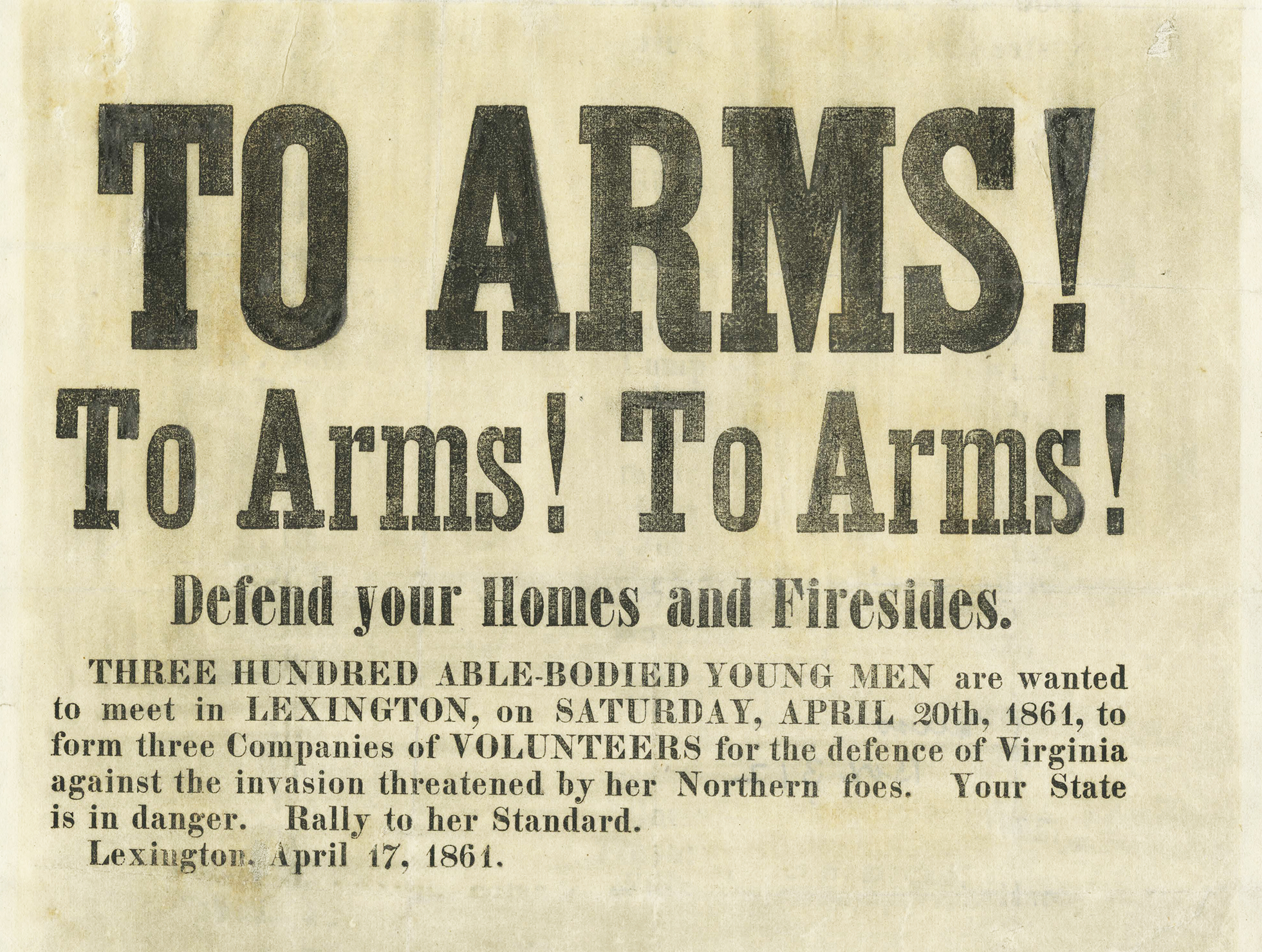
On April 15, 1861, two days after the surrender of Fort Sumter, Abraham Lincoln issued a call for 75,000 men to be raised to put down the ‘rebellion.’ This pushed many unionists’ in the upper South to embrace secession. Events moved quickly. On April 17, 1861, Virginia’s Secession Convention in Richmond passed an Ordinance of Secession. In Lexington the flag wars continued. Students once again hoisted a Confederate flag on campus, this time on president Junkin’s classroom. Junkin, a native Pennsylvanian and unionist, was deeply offended. Faculty members assured him that the flag was not meant as an insult, but by this time Junkin had had enough and resigned. He shortly afterwards moved with his family to Pennsylvania and there remained throughout the coming war. [3]
The students at Washington College were not only raising flags, they were also raising a company of volunteers. Early in April the Liberty Hall Volunteers were formed. The name was taken from the ruins of Liberty Hall Academy, the colonial forbearer of Washington College, as well as the name of the company of students sent out to confront Banastre Tarleton in 1781. Upon its initial organization, many parents of the boy soldiers preferred the professors of the school to lead them.
Thus, in early May, 1861 the company was reorganized and Professor James J. White was elected Captain. White, nicknamed ‘Old Zeus’ by his student soldiers due to his age (he was thirty-three at the time) was a Professor of Greek. Of the original complement of 73 volunteers, 57 were students at Washington College. [4] What were these students motivated to volunteer for? The primary motivation was the defense of Virginia and the South. Like many of the citizens in Lexington and Rockbridge County, the LHVs themselves were split in their opinions on war, but united in their willingness to serve. One member of the company, a Washington College alumni named Hugh White, brother of Captain James J. White, was a 20-year-old Seminary student. Their father was the Presbyterian minister in Lexington. Hugh White returned to town to join the LHV. His father, however, begged him to stay in seminary and join the service later, perhaps as a chaplain.
In a letter to his father, April 22, White responded, “what you say has much force, but this is to be no ordinary war, and for young men like me to hold back will have a very bad moral effect…I have thought and prayed much over this question for two months and the result is as firm a conviction that I ought at once to take part in the defense of my native State, and especially of you and mother, as I ever felt that I ought to preach the Gospel.”[5]
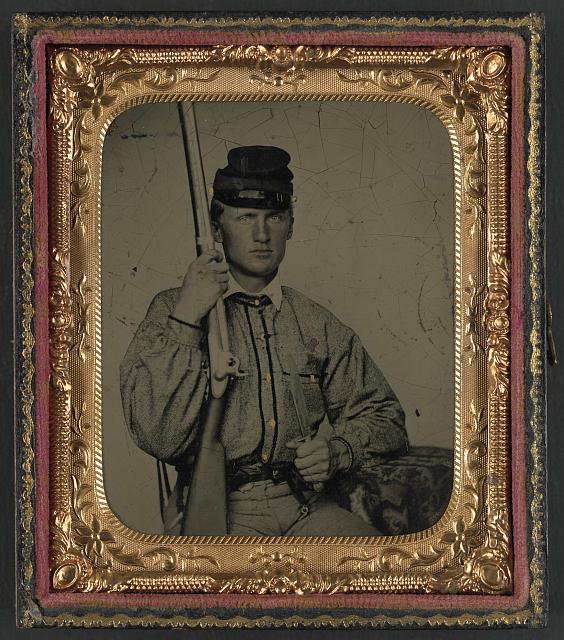
Another 20-year-old student, John P. Lightner, was not as caught up in the war fever as many of his classmates. Writing on May 18 to a friend, Lightner shared, “…you hear nothing but war, war, war, all the time. People are entirely too much taken up with the excitement. Their minds should be elevated above it…I never saw such a time since my existence, & never want to again, as was in the streets of Lexington when the first companies were called out.”[6] White and Lightner are a great example of the varied motivations and concerns pertaining to the coming war.
Now that the company was organized it was time to begin the process of becoming volunteer soldiers. Reverend William Nelson Pendleton was the LHV’s first drillmaster.[7] Pendleton soon left to command the Rockbridge Artillery and ultimately became General Robert E. Lee’s Chief of Artillery. The neighboring institution in Lexington was the Virginia Military Institute and it provided a 22-year-old professor of Mathematics and Tactics, William H. Morgan, to drill the company. The company spent each day drilling and “courting the girls in the evening.” It was high times for the erstwhile students not having to attend classes or study Greek.
While the company was drilling the ladies of Lexington and Rockbridge formed sewing groups and made cotton-linen havelocks (worn over hats to protect the neck), gaiters (cotton covers for shoes), red flannel waistbands, and housewives (sewing kits). Gray cloth from a wool factory on Whistle Creek was sourced to make battleshirts and trousers. The state issued them, via VMI, blue forage caps (a style of kepi), some having brass L.H.V. letters on them. White cross belts were issued for their “old and indifferent” cartridge boxes and bayonet scabbards, of which they had none. Finally, the company was armed from the VMI arsenal with 1851 Springfield Cadet muskets.[8] By the time the company departed Lexington on June 8, 1861, it was considered expertly drilled and proficient.
By June 3, 1861, the time had come to send the Liberty Hall Volunteers to Harper’s Ferry, where units throughout western Virginia were assembling and organizing under Joseph E. Johnston. Fifty-four students were in the ranks, 71 total enlisted men and 3 officers. Before departing Lexington on June 8, the company was assembled in front of the colonnade and marched to Main Street in front of the courthouse. Surrounding them were hundreds of town and county residents, white and black. The ladies from the Falling Springs Presbyterian Church presented a silk flag they had made to the company. It was the new Confederate ‘Stars and Bars’ and had ‘Pro Aris et Focis’ sewn on the middle bar, meaning, “For hearth and home.”
Speeches and a prayer of blessing were made. The company left for Staunton in stagecoaches. Newly elected Lieutenant John Newton Lyle remembered, “As we passed the College, standing a few hundred yards to the left of the Valley Turnpike along which we were moving, it was with regret that I gave it a farewell.”[9] Many of the company would return to Lexington in a casket.
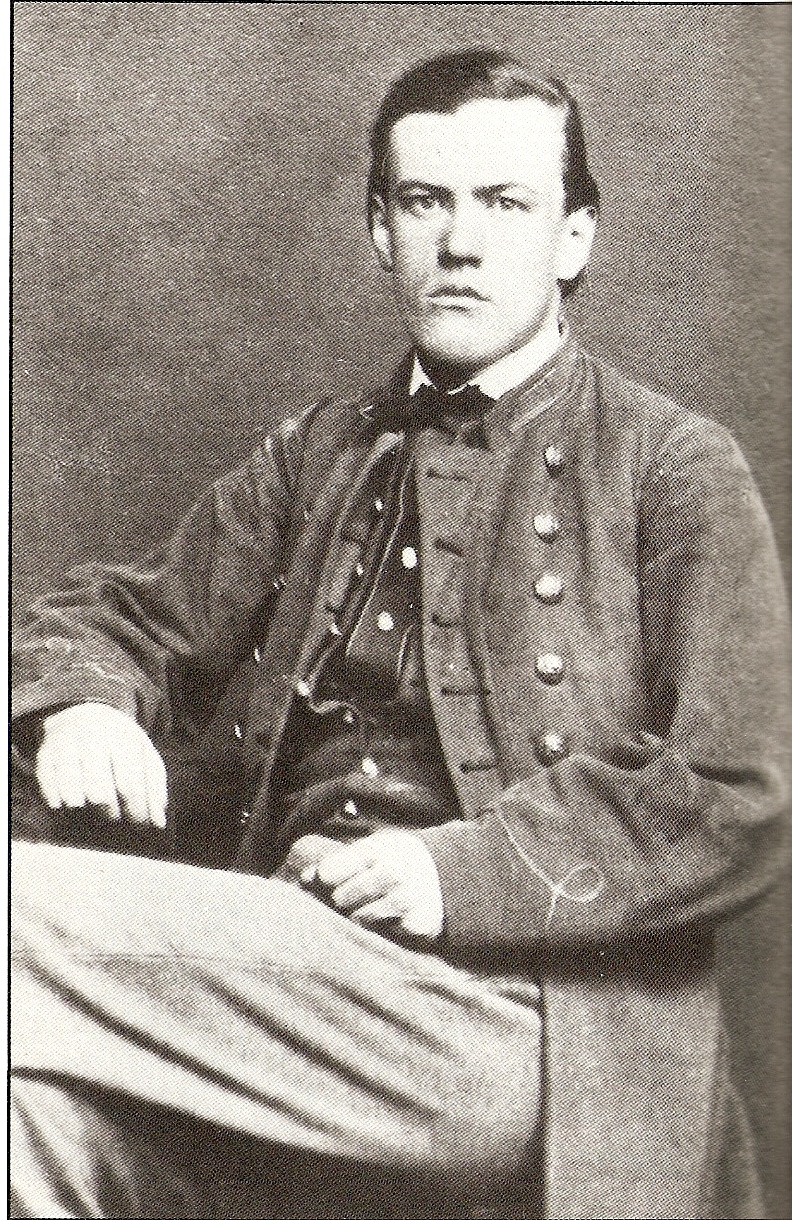
Winchester was now the destination. Harper’s Ferry had been abandoned and General Joseph E. Johnston’s assembling army was now headquartered in Winchester. Once the company reached Staunton they were mustered into Virginia service for one year. While in Staunton, local residents cheered and feted them with strawberries and many other delicacies. Seventeen-year-old member of the LHV, Alexander Tedford Barclay, described their fare to his sister as “wheat bread, beef and coffee.” He made sure to mention with pride that “we are considered the best company down here.”[10]
The company’s next stop was Gordonsville on the Virginia Central Railroad. The hamlet was also known as “Snackville” to the LHV, as black farmers would stand along the wayside selling snacks of chicken and other eatables.[11] All along their journey from Lexington to Winchester, the student-soldiers were cheered, with banners waving and bouquets of flowers being tossed at them. According to one member of the company, even some slaves “bid us ‘go and kill ‘dem Yankees.’”[12]
After responding to a false alarm near Newtown, the LHV reached Winchester on June 13. Once in the camps around Winchester the company joined the 4th Virginia Infantry as Company I. This regiment, along with the 2nd, 5th, 27th, and 33rd Virginia Regiments would constitute what would soon be called the Stonewall Brigade. Thomas J. Jackson, a resident of Lexington and professor at VMI, commanded the brigade. He was no stranger to the rank and file of the LHV. Captain White wrote his wife that Jackson was so strict as to be borderline tyrannical but admitted that he was already gaining the confidence of his men.[13]
Upon arriving around the camps, the LHV was mocked due to their youth. Playful comments like, “hello there cherubs, do your mammies know you’re out?” and “who tucked you in bed last night?” filled the student soldier’s ears as they settled into their new routine of camp life and drilling six hours a day.[14]
For the next two weeks the company was posted around Martinsburg and Falling Waters, helping to guard the new border between Virginia and the United States. Called Camp Stephens in honor of the Confederate Vice President, Alexander Stephens, the LHV grew accustomed to cooking, camp life, and constant drill. The men also spent time tearing up the railroad around Martinsburg. Unlike Lexington, Staunton, and Winchester, the citizens of Martinsburg were not pro-Confederate. Ted Barclay described the area as, “Berkeley County, the meanest Abolition hole on the face of the earth, Martinsburg especially.” Confederate officers distrusted the local population so much that soldiers were warned not to drink from any wells due to the fear of them being poisoned.
Mostly, however, the men had positive experiences at this stage of the war. Seeing old friends, family, and acquaintances around various camps, singing camp songs, and even laughing at ‘Old Zeus.’ James J. White was six feet, three inches tall. On June 25th while out on drill, Ted Barclay felt that Captain White was getting a little too big headed. “Today whilst out drilling, he was walking so big and his head so high that when he came across a ledge of rocks, he could not see them and fell head over heels and great was the fall thereof…I reckon he won’t walk so big hereafter.”[15]
However, some, like John Lightner, preferred not to have to fight at all, but was strongly held to his convictions about the war. Referring to other soldiers he wrote on the 29th, “they all seem very cheerful & lively, and most too anxious to come into deadly conflict with their enemy. I know I don’t want to fight. I’m a great lover of peace…But this war is certainly a holy & great one, on our side; the other is none else then unconstitutional, brought on by wicked usurpation of power…”[16] The Liberty Hall Volunteers would not have long to wait to get into a fight. On July 21st on the rolling hills around Mrs. Henry’s farm near Manassas Junction, the LHV would lose seven of their number killed at the Battle of First Manassas.
About the Author
Jeffrey A. Felton is an historian and archivist with his M.A. in History from Virginia Tech. He has worked or volunteered in the public history and preservation fields for over fifteen years at a variety of organizations including the Shenandoah Valley Battlefields Foundation, National Park Service, Washington & Lee University, and the Virginia Center for Civil War Studies at Virginia Tech. A native of North Carolina, Jeff has resided in the Shenandoah Valley region of Virginia since 2011.
[1] Robertson, James I., 4th Virginia Infantry, (Lynchburg: H.E.Howard, 1982) 1.
[2] Turner, Charles W., ed., Old Zeus: Life and Letters (1860-’62) of James J. White, (Verona: McClure Press, 1983) 38.
[3] Turner, Charles W., ed., A Reminiscence of Lieutenant John Newton Lyle of the Liberty Hall Volunteers (Verona: Virginia Lithography, 1987) 4; Bean, W.G., The Liberty Hall Volunteers: Stonewall’s College Boys, (Charlottesville: University of Virginia Press, 1964) 6-7.
[4] Turner, A Reminiscence of Lieutenant John Newton Lyle of the Liberty Hall Volunteers, 6-7.
[5] White, William S., Sketches in the Life of Captain Hugh A. White of the Stonewall Brigade, (Columbia: South Carolina Steam Press, 1864) 46-47.
[6] John P. Lightner letter to friend, May 18, 1861, in William Francis Brand Papers, Albert and Shirley Small Special Collections, University of Virginia.
[7] Turner, A Reminiscence of Lieutenant John Newton Lyle, 7.
[8] McMurry, Richard M., Virginia Military Institute Alumni in the Civil War, (Lynchburg: H.E. Howard, 1999) 176; Turner, A Reminiscence of Lieutenant John Newton Lyle, 7-8; Bean, The Liberty Hall Volunteers, 9-11. Company Records, Compiled Service Records, National Archives and Records Administration, Publication Number M324, Group 109.
[9] Turner, A Reminiscence of Lieutenant John Newton Lyle, 10-12; Turner, Old Zeus, 41.
[10] Turner, Ted Barclay, Liberty Hall Volunteers: Letters from the Stonewall Brigade, (Natural Bridge Station: Rockbridge Publishing, 1992), 13.
[11] Turner, A Reminiscence of Lieutenant John Newton Lyle, 27.
[12] Letter from “L.H.V.,” Lexington Gazette, June 27, 1861.
[13] Turner, Old Zeus, 43.
[14] Turner, A Reminiscence of Lieutenant John Newton Lyle, 37.
[15] Turner, Letters from the Stonewall Brigade, 15-18.
[16] John P. Lightner to friend, June 29, 1861, in William Francis Brand Papers, UVA.
Sources
Bean, W.G., The Liberty Hall Volunteers: Stonewall’s College Boys, Charlottesville: University of Virginia Press, 1964.
Letter from “L.H.V.” to editor, Lexington Gazette, June 27, 1861.
Lightner, John P., to friend, May 18, 1861, letter, William Francis Brand Papers, Albert and Shirley Small Special Collections, University of Virginia.
Lightner, John P., to friend, June 29, 1861, letter, William Francis Brand Papers, Albert and Shirley Small Special Collections, University of Virginia.
McMurry, Richard M., Virginia Military Institute Alumni in the Civil War, Lynchburg: H.E. Howard, 1999.
Turner, Charles W., ed., A Reminiscence of Lieutenant John Newton Lyle of the Liberty Hall Volunteers, Verona: Virginia Lithography, 1987.
Turner, Charles W., ed., Ted Barclay, Liberty Hall Volunteers:Letters from the Stonewall Brigade, Natural Bridge Station: Rockbridge Publishing, 1992.
Turner, Charles W., ed., Old Zeus: Life and Letters (1860-’62) of James J. White, Verona: McClure Press, 1983.
Robertson, James I., 4th Virginia Infantry, Lynchburg: H.E. Howard, 1982.
White, William S., Sketches in the Life of Captain Hugh A. White of the Stonewall Brigade, Columbia: South Carolina Steam Press, 1864.


