Morris, Garnett, and the Fight for Belington, July 7-11, 1861

In July 1861, Union forces under Brig. Gen. Thomas A. Morris spent five days skirmishing with Robert S. Garnett’s Confederates around the small hamlet of Belington, fixing them in place while George B. McClellan struck at Rich Mountain. Though largely indecisive on its own, the fighting helped set the stage for the campaign’s decisive turning…

Powder and Politics: The Skirmish at Bowman’s Place

In late June 1861, Union troops guarding the B&O Railroad clashed with Confederate cavalry near Bowman’s Place in Tucker County as they attempted to disrupt elections for Virginia’s Restored Government. The brief but deadly skirmish, tied to control of the Cheat River corridor, revealed how quickly political conflict in northwestern Virginia could turn violent. More…

Divided Ground: Buckhannon’s Unionists Face a Confederate Incursion

On June 27, 1861, a Confederate foraging expedition descended on the unionist town of Buckhannon, scattering civilians and briefly seizing vital supplies along the Staunton-Parkersburg Turnpike. Though a small clash, the raid and the rumors it sparked pushed George B. McClellan to launch his campaign against Robert S. Garnett, setting the stage for the fight…

The Union, Right or Wrong: Preston and Monongalia Counties Choose a Side

During the critical period of April-May 1861, Preston and Monongalia counties, in what was then northwestern Virginia, remained firmly in the Union camp. Both counties shared a northern border with Pennsylvania and, unlike their southern neighbors, organized no Confederate volunteer companies, though a few individuals may have enlisted in the Southern cause. Slavery was rare,…

Irregular War in Northwestern Virginia: Captain Cable’s Raid on Righter’s House

In June 1861, as Union forces secured the B&O Railroad after the rout at Philippi, a nighttime raid on a secessionist militia at Righter’s House erupted into violence and fiery retribution. The clash at Coon Run reveals how the fight for strategic ground in northwestern Virginia quickly devolved into a bitter war between neighbors. Following…

The Philippi Races: How a Rain-Soaked Surprise Secured Northwestern Virginia

In a rain-soaked dawn attack at Philippi, Union columns under Benjamin Kelley and Ebenezer Dumont scattered Col. George A. Porterfield’s inexperienced command, sending it fleeing in what became known as the “Philippi Races.” The brief fight secured the B&O lifeline and shattered secessionist momentum in northwestern Virginia at the very outset of the war. Events…

The Road to Philippi: Glover’s Gap and the Fight for the B&O Railroad in Northwestern Virginia

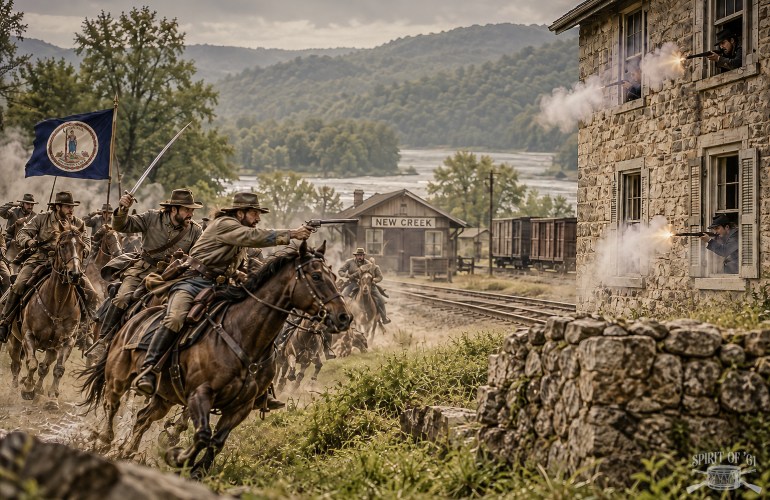
In the tense weeks following Virginia’s secession vote, rival unionist and secessionist forces in northwestern Virginia maneuvered for control of the Baltimore & Ohio Railroad. Skirmishes at Fetterman and Glover’s Gap produced some of the war’s earliest casualties and set the stage for the opening of McClellan's campaign in the region. On April 17, 1861,…

Photo by M.A. Kleen, Spirit61.info

First Blood in Western Virginia: Secession, Divided Loyalties, and the Death of Thornsbury Bailey Brown

In the tense weeks following the April 17, 1861 secession vote, communities across northwestern Virginia divided sharply as unionists and secessionists began organizing. The killing of Thornsbury Bailey Brown at Fetterman Bridge in May, often considered the first Union soldier killed in combat during the Civil War, showed how quickly the political crisis was spiraling…

Virginia’s Path to Secession

One hundred sixty-five years ago, the Commonwealth of Virginia set itself on a course that would alter its history forever. The decision placed the state on the losing side of a devastating war that claimed hundreds of thousands of American lives, displaced families, split the commonwealth in two, and left farms, villages, and towns in…

What’s in a Name? Secessionist, Southern, or Confederate?

In the spring of 1861, Virginia was in an ambiguous position. Although its Secession Convention had voted to secede, the state had not yet officially joined the Confederacy. During this period, volunteers rushed to form armed companies, regiments, and batteries, sometimes clashing with federal troops and naval ships. What, then, should we call these state…