In July 1861, George B. McClellan launched a coordinated offensive in western Virginia, using a diversion at Laurel Hill and a daring flank march over Rich Mountain to break Robert S. Garnett’s defensive line. The resulting Union victory not only shattered Confederate control of the region but propelled McClellan into national prominence at a critical moment in the war.
At the beginning of July 1861, Maj. Gen. George B. McClellan had everything in place to finally confront his Confederate counterpart, Brig. Gen. Robert S. Garnett, whose 5,400-man force blocked the two main routes through the Alleghenies into the Shenandoah Valley. McClellan arrived in Grafton, Virginia, on June 23 and remained there for nearly a week, addressing the supply and logistical challenges of the coming offensive.
To confront Garnett, McClellan organized his Army of the West into five brigades under Brig. Gens. William S. Rosecrans, Thomas A. Morris, Charles W. Hill, Newton Schleich, and Col. Robert L. McCook. In all, he commanded more than 20,000 men, though roughly half were 90-day volunteers whose enlistments would expire by late July. Hill’s brigade was assigned to guard the Baltimore & Ohio Railroad, while Morris was ordered to create a diversion at Laurel Hill as McClellan moved against Rich Mountain with the rest of his force.
In mid-June, Garnett assigned Lt. Col. Jonathan M. Heck and the 25th Virginia Infantry to a strong position on the western face of Rich Mountain along the Staunton-Parkersburg Turnpike. There, Heck established Camp Garnett with the Churchville Cavalry and the Lee Battery, which fielded four 6-pounder guns. Garnett also sent his topographical engineer, Jedediah Hotchkiss, and his chief of artillery, Capt. Julius A. DeLagnel, to help secure the position.
On July 1, Garnett ordered Maj. Nathaniel Tyler, with seven companies of the 20th Virginia Infantry, to reinforce Rich Mountain. They arrived the next day. At the same time, McClellan’s main body occupied the strategically placed town of Buckhannon in Upshur County, about 23 miles west of the Confederate camp on Rich Mountain.
Between the two positions, the turnpike crossed the Middle Fork River over a large covered bridge, which the Confederates used as a picket post. On July 6, without consulting McClellan, Brig. Gen. Schleich sent a scouting party from the 3rd Ohio to reconnoiter the bridge, sparking a brief but deadly skirmish. The following day, McCook’s brigade secured the bridge as ordered.
Seeking information on the Union advance, Heck sent Maj. Tyler with a small composite force from the 20th and 25th Virginia to reconnoiter the Middle Fork Bridge. Near the crossing, they encountered the 4th and 9th Ohio Infantry and Capt. Cyrus O. Loomis’ battery in a prepared position. After a brief exchange of volleys, Tyler prudently withdrew to the fortified line on Rich Mountain. Neither side reported casualties.
On his return, Tyler found that Lt. Col. John Pegram had arrived with the remaining three companies of the 20th Virginia. Pegram assumed command of the post, his Confederate commission superseding Heck’s Virginia state commission. The Confederates now had roughly 1,780 men and four guns to defend the mountain.
Garnett misjudged McClellan’s intentions. On July 6, he wrote to Robert E. Lee, stating his belief that the Union general had seized “as much of northwestern country as he probably wants.” A few days later, Lee replied skeptically that McClellan would likely try to dislodge him and, if possible, advance on Staunton. Lee’s assessment proved correct, but by then it was too late. The same day Garnett dispatched his letter, Morris arrived in front of Laurel Hill, touching off five days of skirmishing designed to distract the Confederates from McClellan’s main effort.
By the evening of July 9, McClellan had advanced to Roaring Creek at the base of Rich Mountain. With him were nine infantry regiments, one cavalry company, and three artillery batteries, totaling about 9,150 men and 16 guns.
The next day, McClellan ordered McCook’s brigade to conduct a reconnaissance in force of the Confederate works, led by Lt. Orlando M. Poe of the U.S. Topographical Engineers. The 9th Ohio, composed almost entirely of German immigrants except for its colonel, the Irish American McCook, deployed flankers who traded fire with Confederate pickets. The Lee Battery joined the action with canister and shell, to little effect.
Poe succeeded in assessing the strength and extent of the enemy’s fortifications, and the expedition returned to Roaring Creek with two prisoners. “I saw that we could probably carry the work by storm, but it would be with heavy loss, as the enemy’s position was naturally a strong one,” he later reported. The 9th Ohio lost one killed and at least one wounded.
Fortune intervened when David Hart, a young man and devoted unionist whose family farm lay near the summit of Rich Mountain, told Rosecrans he could guide a column across the heavily wooded heights to the rear of the Confederate camp. McClellan authorized Rosecrans to lead his brigade on a flanking march, with the intent of coordinating an attack from front and rear. They were to move out before dawn on July 11.
Pegram had his own concerns that the Federals might try to turn his position, a fear confirmed when his pickets wounded and captured 1st Sgt. David A. Wolcott of Burdsall’s Dragoons, a courier who had accidentally ridden into their lines. In response, Pegram sent Capt. Julius DeLagnel with five infantry companies and a single cannon to the Hart farm. The detachment, numbering roughly 310 to 350 men, hastily threw up log barricades under orders to “defend it to the last extremity.”
He also dashed off a note to Col. William C. Scott, whose 44th Virginia Infantry had spent the night in Beverly after a long march over the mountains to reinforce Garnett. That morning, Scott received conflicting orders. Garnett called for support at Laurel Hill, while Pegram urgently requested he post his regiment along the Staunton-Parkersburg Turnpike on the eastern side of Rich Mountain, anticipating a Federal flanking move. Scott chose to place his 570-man regiment there, and later received word from Garnett to remain in position.
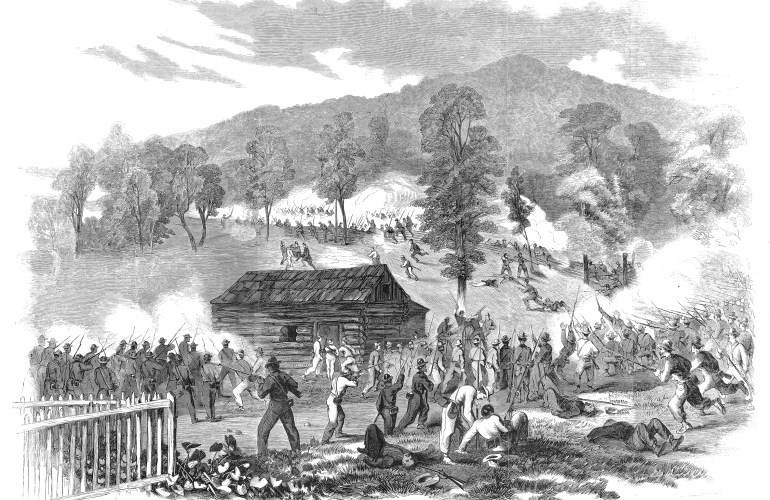
Meanwhile, Rosecrans’ brigade groped its way through the dark mountain forest in a driving rain, taking a longer route than expected. After eight hours of marching, the column halted about a mile south of the Hart house. When they moved again, they went the wrong way and had to countermarch, losing more time. Not until about 2:30 in the afternoon did the 10th Indiana strike Confederate pickets. In the sharp fight that followed, Capt. Christian Miller and two sergeants went down. Another rainstorm soon rolled in and drenched the men.
Rosecrans made three direct attacks on the Confederate line along the turnpike just north of the Hart House, pausing after the first two to reposition his regiments. Col. Mahlon D. Manson of the 10th Indiana later reported, “… we came to within 350 yards of the enemy’s batteries and infantry, when we formed a line of battle and opened fire upon the enemy, which they returned with great spirit from their batteries and infantry, throwing from their batteries shrapnel, shot, ball, &c., with rapidity and force.”
The Confederates repelled the first two attacks with the help of a second gun brought up in support. Before long, however, most of the gunners and their horses were shot down. One team bolted and careened down the mountain, still hitched to its caisson. Capt. Julius DeLagnel personally loaded and fired one of the pieces until he, too, was severely wounded. Hearing the firing, Pegram raced to the scene just in time to try, and fail, to rally his men as they gave way under the weight of Rosecrans’ third and final assault.
During the fighting, Lt. James Cochrane of the Churchville Cavalry rode down to where Col. Scott and the 44th Virginia were waiting and persuaded him to come to Pegram’s aid. When they came within half a mile of the Hart House, however, they heard cheering and realized they were already too late. Scott withdrew to Beverly and, and learning that Garnett had retreated from Laurel Hill, he decided to remove the Confederate supplies from Beverly and withdraw south to the Greenbrier River.
McClellan never launched his part of the plan. At the critical moment, when the sound of fighting reached him, he hesitated. His men spent most of the day cutting a path through the woods to position artillery, and by the time word arrived of Rosecrans’ success, the Confederates had already begun to slip away. Disorganization and the onset of darkness prevented the Federals from pressing their victory. Early the next morning, Rosecrans’ advance entered Camp Garnett and captured over 60 men left behind as sick, five camp slaves, and the remaining two cannon.
The Confederates on Rich Mountain escaped in several groups, the largest under Pegram. On the night of July 12, after an exhausting march to the Tygart Valley River, his men demoralized and starving, he sent a note to McClellan, whose forces had occupied Beverly that afternoon, offering to surrender. The next morning, as Garnett’s wing struggled to escape across Shaver’s Fork, Pegram surrendered more than 600 men. In the fighting at Rich Mountain, the Confederates lost 32 killed and 38 wounded, eight of them mortally.
Rich Mountain was a hard-fought but unequivocal Union victory. McClellan’s losses were 14 killed, 59 wounded (five mortally), and one missing. He not only cleared the way to the strategic stronghold at Cheat Mountain but also ended any hope of the Confederates retaking northwestern Virginia. The victory catapulted him into the national spotlight. Within weeks, he would be recalled to Washington, D.C., to command the principal Union army in the Eastern Theater. Garnett, meanwhile, was killed on July 13 while directing his men across Shaver’s Fork of the Cheat River, becoming the first general officer to die in the war.
Sources
Beatty, John. The Citizen-Soldier, or Memoirs of a Volunteer. Cincinnati: Wilstach, Baldwin & Co., 1879.
Grebner, Constantin. “We Were the Ninth”: A History of the Ninth Regiment, Ohio Volunteer Infantry, April 17, 1861 to June 7, 1864. Translated by Frederic Trautmann. Kent: Kent State University Press, 1987.
Haselberger, Fritz. Yanks from the South! The First Land Campaign of the Civil War. Baltimore: Past Glories, 1987.
Keifer, J. Warren. The Battle of Rich Mountain and Some Incidents. Cincinnati: The Ohio Commandery of the Loyal Legion, 1911.
Lesser, W. Hunter. Rebels at the Gate: Lee and McClellan on the Front Line of a Nation Divided. Naperville: Sourcebooks, Inc, 2004.
McClellan, George B. Report of the Organization and Campaigns of the Army of the Potomac: to Which is Added an Account of the Campaign in Western Virginia. New York: Sheldon & Company, 1864.
Moore, Robert H. The Charlottesville, Lee Lynchburg, and Johnson’s Bedford Artillery. Lynchburg: H.E. Howard, Inc., 1990.
Rohrbacher, Walter. “A History of the Letcher Guards and the Twenty-Fifth Virginia Infantry Regiment.” M.A. thesis. Eberly College of Arts and Sciences at West Virginia University, 2005.
Rosecrans, William S. “The Battle of Rich Mountain” in Battles and Leaders of the Civil War, Vol. 6. Champaign: University of Illinois Press, 2004.
Sears, Stephen W. George B. McClellan: The Young Napoleon. New York: Ticknor & Fields, 1988.
Thompson, William E. First in War: The Hampden-Sydney Boys (20th Virginia Infantry Rgt., Co. G). Farmville: Zebrabooks, 2013.
The War of the Rebellion: A Compilation of the Official Records of the Union and Confederate Armies. Series I, Vol. II. With additions and corrections. Washington: Government Printing Office, 1902.
Woodley, Willis H. “Woodley’s Reminiscence of Rich Mountain” in A History of Randolph County West Virginia, by Albert Squire Bosworth. Elkins: By the author, 1916.


The myth of David Hart is still alive. David Hart may or may not have been a Unionist but he was also paid $100 in gold to lead the path up the mountain. According to Frederick Fout (7th Indiana) David Hart was “captured” and taken to McClellan. “The boy, being bright, thought he could lead a column by a round-about way to his father’s farm, and was to receive one hundred dollars in gold for the job.” Randolph County leaned secessionist and Hart had to leave the area. To explain his sudden wealth his family said he received the money from his father. He went to Kentucky and joined the Union army, later dying of disease.
Frederick Fout, The Dark Days of the Civil War, pg. 74
LikeLike