
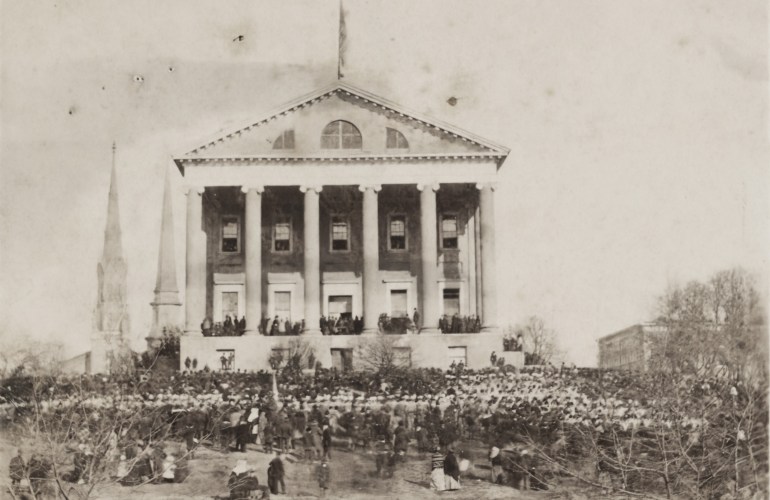
On Tuesday, April 16, 1861, the Virginia Convention in Richmond entered secret session to debate secession and a potential alliance with the Confederate States. The next day, delegates voted 88 to 55 in favor of secession, pending a popular referendum set for May 23. Ten days into the session, on April 25, they approved ordinances ratifying the covenant between Virginia and the Confederacy and adopting the Confederate Constitution. That same day, Delegate Jeremiah Morton of Green and Orange counties invited the Confederate government to move its capital to Richmond.
The following primary sources detail the immediate, practical steps Virginia took to align its military, finances, and government with the Confederacy, even before the citizens of Virginia had the chance to officially vote on the secession ordinance.
AN ORDINANCE ratifying and confirming the Convention entered into between the “Commissioner of the Confederate States and the Commissioners of the State of Virginia.”
“Be it ordained, That the Convention entered into on the twenty-fourth of April, eighteen hundred and sixty-one, between Alexander H. Stephens, Commissioner of the Confederate States, and John Tyler, Wm. Ballard Preston, S. McD. Moore, James P. Holcombe, James C. Bruce, and Lewis E. Harvie, Commissioners of Virginia, for a temporary union of Virginia with said Confederate States, under the provisional government, adopted by the said Confederate States, be, and the same is hereby ratified and confirmed on the terms agreed upon by said Commissioners.”
“The Commonwealth of Virginia, looking to a speedy union of said Commonwealth and the other slave States with the Confederate States of America, according to the provisions of the Constitution for the Provisional Government of said States, enters into the following temporary convention and agreement with said States for the purpose of meeting pressing exigencies affecting the common rights, interests and safety of said Commonwealth and said Confederacy.
“1st. Until the union of said Commonwealth with said Confederacy shall be perfected, and said Commonwealth shall become a member of said Confederacy according to the Constitutions of both powers, the whole military force and military operations, offensive and defensive, of said Commonwealth, in the impending conflict with the United States, shall be under the chief control and direction of the President of said Confederate States, upon the same principles, basis and footing as if said Commonwealth were now, and during the interval, a member of said Confederacy.
“2d. The Commonwealth of Virginia will, after the consummation of the union contemplated in this convention, and her adoption of the Constitution for a permanent government of said Confederate States, and she shall become a member of said Confederacy, under said permanent Constitution, if the same occur, turn over to said Confederate States all the public property, naval stores and munitions of war, etc., she may then be in possession of, acquired from the United States, on the same terms and in like manner as the other States of said Confederacy have done in like cases.
“3d. Whatever expenditures of money, if any, said Commonwealth of Virginia shall make before the union under the Provisional Government, as above contemplated, shall be consummated, shall be met and provided for by said Confederate States.
“This convention, entered into and agreed to in the city of Richmond, Virginia, on the twenty-fourth day of April, eighteen hundred and sixty-one, by Alexander H. Stephens, the duly authorized Commissioner to act in the matter for the said Confederate States, and John Tyler, William Ballard Preston, Samuel McD. Moore, James P. Holcombe, James C. Bruce and Lewis E. Harvie, parties duly authorized to act in like manner for said Commonwealth of Virginia the whole subject to the approval and ratification of the proper authorities of both Governments respectively.
“In testimony whereof, the parties aforesaid have hereto set their hands and seals, the day and year aforesaid, and at the place aforesaid, in duplicate originals.
JOHN TYLER, [Seal.]
WM. BALLARD PRESTON, [Seal.]
S. McD. MOORE, [Seal.]
JAMES P. HOLCOMBE, [Seal.]
JAMES C. BRUCE, [Seal.]
LEWIS E. HARVIE, [Seal.]
Committee of the Convention.ALEXANDER H. STEPHENS, [Seal.]
Commissioner of the Confederate States.”
After a lengthy objection from unionist John B. Baldwin, the ordinance passed 80 to 16.
“AN ORDINANCE for the adoption of the Constitution of the Provisional Government of the Confederate States of America.
“We, the delegates of the people of Virginia, in Convention assembled, solemnly impressed with the perils which surround the Commonwealth, and appealing to the Searcher of Hearts for the rectitude of our intentions in assuming the grave responsibility of this act, do, by this ordinance, adopt and ratify the Constitution of the Provisional Government of the Confederate States of America, ordained and established at Montgomery, Alabama, on the eighth day of February, eighteen hundred and sixty-one: Provided, That this ordinance shall cease to have any legal operation or effect if the people of this Commonwealth, upon the vote directed to be taken on the ordinance of secession passed by this Convention on the seventeenth day of April, eighteen hundred and sixty-one, shall reject the same.”
The ordinance passed 76 to 19.
Before recess, Delegate Jeremiah Morton of Green and Orange counties submitted the following resolution:
“Resolved by this Convention, That the President of the Confederate States, and the constituted authorities of the Confederacy, be, and they are hereby cordially and respectfully invited, whenever, in their opinion, the public interest or convenience may require it, to make the city of Richmond, or some other city in this State, the temporary seat of Government.”
Discussion
The document explicitly notes that Virginia is looking forward to a “speedy union of said Commonwealth and the other slave States.” How does this direct language help historians evaluate the primary causes of secession?
What major condition did the delegates attach to the adoption of the Confederate Constitution? What does this condition reveal about the legislative process and the power of the voting public at the time?
What specific agreements are made regarding public property, naval stores, and financial expenditures once Virginia officially joins the Confederacy? Who bears the financial burden of Virginia’s early military preparations?
Delegate Morton formally invites the Confederate government to move its capital to Richmond. Strategically, economically, and symbolically, why would moving the capital to Virginia be a significant advantage for the Confederacy?
Sources
Reese, George H., ed. Proceedings of the Virginia State Convention of 1861, Vol. 4. Richmond: Virginia State Library, 1965.


One thought on “165 Years Ago: Virginia Convention Calls for Alliance with the Confederate States”