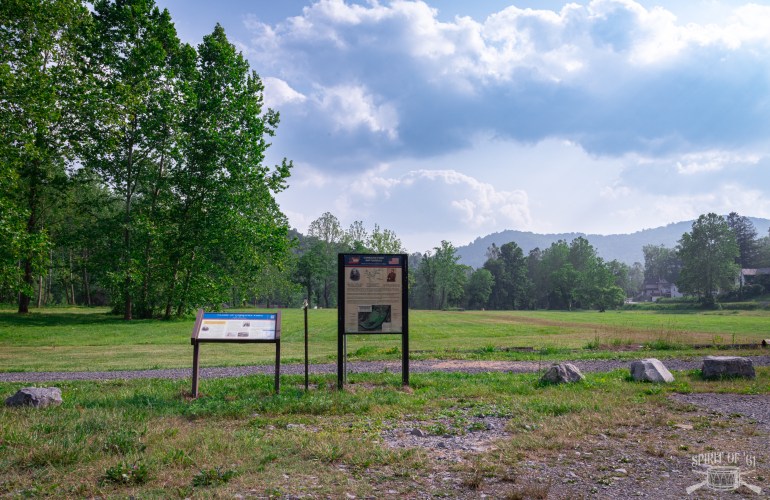
Fought on July 13, 1861, the Battle of Corrick’s Ford (often misspelled Carrick’s) marked the climax of the Tygart Valley–Cheat River campaign. It ended in the complete rout of Brig. Gen. Robert S. Garnett’s remaining army and his death. Remarkably, the victory was won by a relatively small Union force, only part of Thomas A. Morris’ brigade, led in the field by an aide.
Connecticut-born Henry Washington Benham (1813–1884) graduated from the United States Military Academy in 1837 and served in the Mexican-American War. An officer in the Army’s Engineer Corps, he was appointed engineer of the Department of the Ohio on May 14 at the outbreak of the Civil War and served as an aide to Maj. Gen. George B. McClellan. He was 48 years old in June–July 1861 and held the rank of captain.
In Virginia, he worked closely with Brig. Gen. Morris of the Indiana volunteers. After the occupation of Philippi, Morris left Benham to supervise the regiments there for several weeks. Benham later accompanied Morris on the advance to Belington and Laurel Hill and led the pursuit of Garnett after the Confederate evacuation.
On July 12, after five days of intermittent skirmishing, Union pickets cautiously advanced toward the Confederate works and reported the enemy gone. Benham rode forward with a small party to inspect the abandoned fortifications. He and the 9th Indiana soon set off in pursuit, but on the far side of Laurel Mountain, Morris ordered them to halt. Indecision and delay cost valuable time, and the chase did not begin in earnest until the following day.
Colonel Robert H. Milroy of the 9th Indiana was an impetuous commander, always eager to press the attack. According to Benham, Milroy acted on his own, against explicit orders, and attempted to continue the pursuit on the 12th. Benham had to intervene in person, even lying down in the road, to stop him. As punishment, Morris placed the 9th Indiana at the rear of the pursuing column.
In his memoir of the campaign, Benham wrote that he pursued Garnett on July 13 with “Col. Steedman (Fourteenth Ohio) leading, then two guns of Col. Barnett’s Cleveland (Ohio) Artillery, then Col. Dumont (Seventh Indiana), a battalion of the Sixteenth Ohio (Lieut.-Col. Irvine), and last Col. Milroy (19th Indiana).”
In his July 13 report to Morris, however, he described a different composition, stating that the advance column consisted “of the Fourteenth Ohio, Colonel Steedman, with one section of Colonel Barnett’s artillery, the Seventh Indiana, under Colonel Dumont, and the Ninth Indiana, Colonel Milroy, in all about 1,800 men…”
Benham was likely mistaken in his postwar account when he included the 16th Ohio. Three companies had been at Belington, but no other source places them in the fighting at Corrick’s Ford. A letter from Pvt. Oscar Derostus Ladley of Company E, 16th Ohio, suggests they arrived only after the battle had ended. Morris did bring up the rest of his brigade later that day, with the 6th Indiana the first to reach the field after the fighting.
It is therefore reasonable to conclude that the pursuing column consisted of the 14th Ohio, the 7th and 9th Indiana, and two guns of the 1st Ohio Light Artillery.
Benham’s estimate of 1,800 men is often cited, but it does not hold up. By all accounts, he had three full regiments at his disposal. The 14th Ohio fielded more than 1,000 men, and though understrength, the two Indiana regiments likely numbered around 780 each. A section of artillery would have added roughly 50 men to serve the two guns. Even allowing for the light losses at Belington, the pursuing column must have totaled at least 2,600 men.
The 14th Ohio formed the vanguard, did most of the fighting, and sustained the only casualties. Given the ferocity of the action and its duration, about 30 minutes by some accounts, it is difficult to explain how Union losses remained so light, with just two killed and roughly six or seven wounded.
The 7th Indiana ranged across the field that day, working to turn the Confederate flank at Corrick’s Ford. After the withdrawal, a small party from Company E was the first to push forward and reach the crossing where Robert S. Garnett fell. First Sgt. Benjamin F. Burlingame of Company E was credited with firing the fatal shot. We have previously transcribed eyewitness accounts published in the veterans’ newspaper National Tribune, available here and here.
The following order of battle details the strength and losses of the Union forces engaged at the Battle of Corrick’s Ford.
| Unit | Commander(s) | Strength | KIA | MW | WIA | MIA |
|---|---|---|---|---|---|---|
| 14th Ohio Inf. Regiment | Col. James B. Steedman | 1,009 | 2 | 0 | 6 | 0 |
| 7th Indiana Inf. Regiment | Col. Ebenezer Dumont | 781 | 0 | 0 | 0 | 0 |
| 9th Indiana Inf. Regiment | Col. Robert H. Milroy | 780 | 0 | 0 | 0 | 0 |
| 1st Ohio Light Artillery | Col. James Barnett | 2 guns, 50 men* | 0 | 0 | 0 | 0 |
| 2,620 | 2 | 0 | 6 | 0 |
Sources
Benham, Henry Washington. Recollections of West Virginia Campaign with ‘The Three Months Troops’. Boston: Privately Printed, 1873.
Chase, J.A. History of the Fourteenth Ohio Regiment, O.V.V.I. Toledo: St. John Printing House, 1881.
Heselberger, Fritz. Yanks from the South! The First Land Campaign of the Civil War: Rich Mountain, West Virginia. Baltimore: Past Glories, 1987.
Kemper, G. W. H. The Seventh Regiment Indiana Volunteers Three Months Enlistment. Muncie: R. H. Cowan Printing Co., 1903.
Noyalas, Jonathan A. “My Will is Absolute Law”: A Biography of Union General Robert H. Milroy. Jefferson: McFarland & Company, Inc., 2006.
Official Roster of the Soldiers of the State of Ohio in the War of the Rebellion, 1861-1866, Vol. 1. Akron: The Werner Company, 1893.
Reminiscences of the Cleveland Light Artillery. Cleveland: Cleveland Printing Co., 1906.
Report of the Adjutant General of the State of Indiana, 1861-1865, Vol. 2. Indianapolis: W. R. Holloway, State Printer, 1865.
Report of the Adjutant General of the State of Indiana, 1861-1865, Vol. 4. Indianapolis: Samual M. Douglass, State Printer, 1866.
Skidmore, Richard S., ed., The Civil War Journal of Billy Davis from Hopewell, Indiana to Port Republic, Virginia. Greencastle: The Nugget Publishers, 1989.
The War of the Rebellion: A Compilation of the Official Records of the Union and Confederate Armies. Series I, Vol. II. With additions and corrections. Washington: Government Printing Office, 1902.


One thought on “What Federal Units were at the Battle of Corrick’s Ford?”