Few places shaped the early American Civil War more than Virginia, where the opening months of 1861 were complex, uncertain, and widely misunderstood.
In the spring of 1861, Virginians were forced to pick a side. Loyalties were divided and the future remained uncertain. Before the first large battles were fought, Virginia was already living through a political, military, and social crisis that would shape the course of the war.
Spirit of ’61 exists to document that story.
The goal of this website is to provide Civil War historians, academics, researchers, and enthusiasts with a comprehensive, accurate guide to Civil War Virginia prior to the First Battle of Manassas (Bull Run). The site takes a facts-first approach, supported by transparent sourcing and documentation.
The seven months between South Carolina’s secession on December 20, 1860, the firing on Fort Sumter on April 12, 1861, Virginia’s referendum ratifying secession on May 23, and the First Battle of Manassas on July 21 were marked by high-stakes drama and decisive events. Yet much of this early Civil War history is glossed over or marginalized in both scholarly works and popular accounts.
Most narratives of the war move quickly from the firing on Fort Sumter to the First Battle of Manassas. Yet the months in between were anything but uneventful. Consider:
- On April 4, 1861, Virginia’s Secession Convention initially voted against leaving the Union.
- On April 23, 1861, Robert E. Lee was appointed commander of Virginia’s militia forces, not the Confederate Army. He was not commissioned a general in the Confederate regular army until May 14.
- Virginia initially regarded itself as “in alliance with,” rather than formally part of, the Confederate States of America, and the Confederate Congress did not convene in Richmond until July 20, 1861.
- The first shots exchanged between Virginia militia and Union forces occurred on May 7, 1861, before Virginia voters ratified secession.
- On May 13, pro-Union delegates met in what was then Wheeling, Virginia, to consider a response to secession, laying the groundwork for the creation of West Virginia.
- Virginia operated with two state governments during the war: one pro-Union based in Wheeling and one pro-Confederate.
- Many Virginians, including Winfield Scott, George Henry Thomas, David Farragut, Jesse L. Reno, Martin Delany, and more than 20,000 others, chose to fight for the Union.
- Col. Elmer E. Ellsworth, the first Union officer killed in the war, was shot by a hotel proprietor in Alexandria, Virginia.
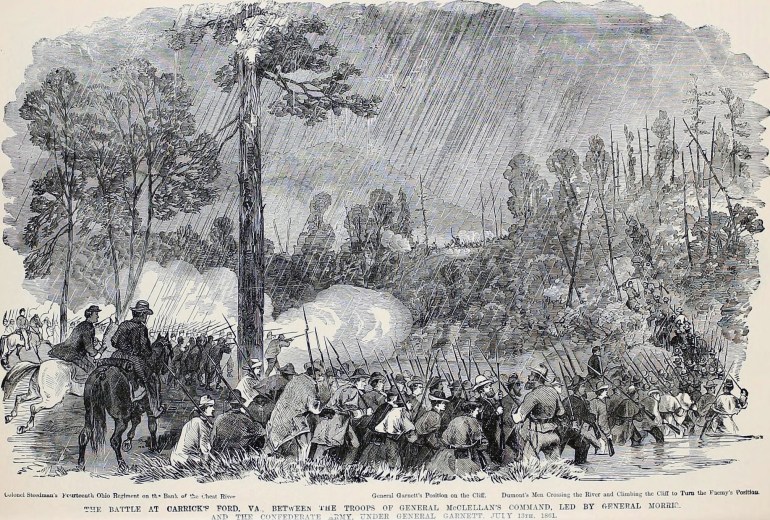
- Union Gen. George B. McClellan gained national attention for his successful campaign in western Virginia prior to the First Battle of Manassas.
Here you will find chronological narratives, primary-sources, maps, and articles that restore clarity to this formative period, treating early-war Virginia as a story worth understanding on its own terms.