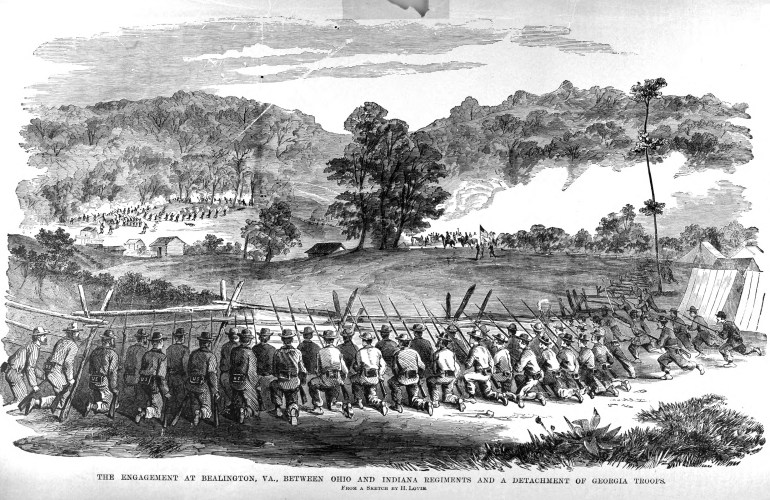
In July 1861, Union forces under Brig. Gen. Thomas A. Morris spent five days skirmishing with Robert S. Garnett’s Confederates around the small hamlet of Belington, fixing them in place while George B. McClellan struck at Rich Mountain. Though largely indecisive on its own, the fighting helped set the stage for the campaign’s decisive turning point in the mountains of western Virginia.
On arriving to command the Confederate forces in northwestern Virginia, Brig. Gen. Robert S. Garnett spent three weeks preparing his small army for an inevitable confrontation with Maj. Gen. George B. McClellan’s 20,000 volunteers. McClellan had already seized over 2,000 square miles of territory, securing the vital Baltimore & Ohio (B&O) Railroad and sheltering the Virginia unionists who were setting up a separate state government in Wheeling.
Garnett established his headquarters and main camp on the James Musto farm, in a triangular saddle behind two hills at the foot of Laurel Mountain astride the Beverly-Fairmont Turnpike. As a former major in the Regular Army, Garnett understood the importance of blocking the two main routes through the Alleghenies to the Shenandoah Valley. Accordingly, he sent Lt. Col. Jonathan M. Heck with the 25th Virginia Infantry to fortify Rich Mountain, which overlooked the Staunton-Parkersburg Turnpike.
Garnett’s command, which already included the 31st Virginia Infantry and Hansbrough’s Battalion, was bolstered by the arrival of the 20th, 23rd, and 37th Virginia Infantry regiments, the 1st Georgia Infantry (Ramsey’s), six cavalry companies, and three artillery batteries (one without guns). From these forces, he dispatched Hansbrough’s Battalion and the Greenbrier Cavalry to guard his rear at Leedsville and sent the 20th Virginia, the Lee Battery, and the Churchville Cavalry to reinforce Heck on Rich Mountain.
Despite supply shortages and primitive conditions, morale improved under Garnett’s leadership. Nevertheless, the lack of adequate shelter, combined with unusually rainy weather and cold evenings, led to a measles outbreak. The spreading sickness thinned the ranks and killed several men.
On July 6, misjudging McClellan’s intentions, Garnett wrote to Robert E. Lee, stating his belief that the Union general had seized “as much of northwestern country as he probably wants.” A few days later, Lee skeptically replied that McClellan would likely try to dislodge him and, if possible, advance on Staunton. Lee’s assessment proved correct, but by then it was too late.
On the same day Garnett wrote to Lee expressing his optimism, McClellan ordered an advance. He directed Brig. Gen. Thomas A. Morris in Philippi to create a diversion while he moved against Rich Mountain with a separate force. “Make extended reconnaissances,” McClellan instructed Morris, “calculated to give the impression that the main attack is to be made by you, and use all efforts to retain them in their present position.”
Garnett’s defense relied on mutually supporting positions, designed so that if one was threatened, the other could come to its aid. McClellan’s plan, however, threatened both simultaneously, which would leave Garnett’s forces isolated and vulnerable. Morris’ role was to pin Garnett in place while McClellan made the main attack across Rich Mountain to Beverly, cutting off the Confederates’ retreat.
To carry out his part of the plan, Morris took the 6th, 7th, and 9th Indiana Infantry; the 6th and 14th Ohio; detachments from the 15th and 16th Ohio and the 1st Virginia (U.S.); the Grafton Guards; and the 1st Ohio Light Artillery with eight guns (two held in reserve), for a total of more than 5,700 men. Opposing them were just over 3,200 Confederates in a formidable defensive position, though their camp had been ravaged by illness.
Morris’ force left Philippi before sunrise on Sunday, July 7, and reached its assigned position about 2.5 miles northwest of Garnett’s camp after a brief clash with Confederate pickets. He established his headquarters at the home of William Elliott, a known secessionist whose son served in the 31st Virginia, on a ridge called Elliott’s Hill at the junction of the Beverly-Fairmont Turnpike and the Morgantown Road.
The 9th Indiana, led by its energetic colonel, Robert H. Milroy, raced up the turnpike toward Belington (or Bealington), “a miserable little village” of five or six houses and a store. They climbed a forested, cone-shaped hill on the southwest side of the road beside the town. At the same time, Ramsey’s Georgia regiment charged up the slope. After a sharp clash, the Hoosiers fell back, leaving behind the body of Pvt. William T. Girard of Company G. The Georgians lost a man as well when his musket discharged accidentally.
From that point on, the Federals called the hill “Girard Hill.”
For five days, the two sides skirmished across the hills and the small hamlet of Belington between their lines, the fighting broken at intervals by passing rainstorms. Garnett chose an aggressive defense, pushing his men forward to contest the heights rather than remain behind their fortifications. In doing so, he played into Morris’ hands. Morris, for his part, took a laissez-faire approach, giving his subordinates wide latitude so long as they avoided a general assault. Both sides seemed content to feel each other out, rarely committing more than one or two regiments at a time.
Accounts of the fight vary. A Confederate soldier wrote to the Richmond Daily Dispatch: “The company had no sooner taken their proper place, when they opened briskly on the foe, which was returned as briskly; but few of the return shots did any execution…,” and “During the latter part of the day the enemy fired a number of bomb shells, grape-shots and balls in the direction of our troops, playing havoc with the trees and shrubbery…”
Ambrose Bierce, a Union soldier in the 9th Indiana Infantry and later an accomplished author, recalled: “A few dozen of us, who had been swapping shots with the enemies’ skirmishers, grew tired of the resultless battle, and by a common impulse – and I think without orders or officers – ran forward into the woods and attacked the Confederate works. We did well enough considering the hopeless folly of the movement, but we came out of the woods faster than we went in – a good deal.”
On the evening of July 11, a courier brought word that McClellan had outmaneuvered and overwhelmed the garrison at Rich Mountain, leaving Garnett in danger of being cut off and surrounded. He made preparations to withdraw while feigning an intention to continue the fight. After nightfall, in a driving rainstorm, Garnett’s small army followed the turnpike as it zigzagged across Laurel Mountain.
The next morning, Union pickets cautiously probed toward the Confederate works and sent back word that the enemy was gone. Capt. Henry W. Benham, a civil engineer and volunteer aide, rode forward with a small party to examine the abandoned fortifications. Benham and the 9th Indiana soon set off in pursuit, but on the far side of Laurel Mountain, Morris ordered them to halt. Indecision and delay cost valuable time, and the chase did not begin in earnest until the following day.
Casualty estimates from the five days of fighting around Belington are difficult to determine, but the number of killed, wounded, and captured may have reached two dozen on either side. Morris also took several prisoners, men too sick to move who had been left behind with a note asking that they be cared for. The fighting proved indecisive, but it served McClellan’s purpose of fixing Garnett in place while he cleared the way over Rich Mountain. The decisive blow would come a few days later at a ford on Shavers Fork of the Cheat River.
Sources
Ashcraft, John M. 31st Virginia Infantry. Lynchburg: H.E. Howard, Inc., 1988.
Benham, Henry Washington. Recollections of West Virginia Campaign with ‘The Three Months Troops’. Boston: Privately Printed, 1873.
Burton, Matthew W. The River of Blood and the Valley of Death: The Lives of Robert Selden Garnett and Richard Brooke Garnett, C.S.A. Columbus: The General’s Books, 1998.
Carnes, Eva Margaret. The Tygarts Valley Line, June-July 1861. Philippi: First Land Battle of the Civil War Centennial Commemoration, Inc., 1961. Parsons: McClain Printing Company, 2003.
Cleveland Daily Leader (Cleveland, OH) 11 July 1861.
Haselberger, Fritz. Yanks from the South! The First Land Campaign of the Civil War. Baltimore: Past Glories, 1987.
Kemper, G. W. H. The Seventh Regiment Indiana Volunteers Three Months Enlistment. Muncie: R. H. Cowan Printing Co., 1903.
Lesser, W. Hunter. Rebels at the Gate: Lee and McClellan on the Front Line of a Nation Divided. Naperville: Sourcebooks, Inc., 2004.
Martin, George Winston. “I Will Give Them One More Shot”: Ramsey’s First Regiment Georgia Volunteers. Macon: Mercer University Press, 2011.
Merrill, Catharine. The Soldier of Indiana in the War for the Union. Indianapolis: Merrill and Company, 1866.
Moore, Robert H. The Danville, Eight Star New Market and Dixie Artillery. Lynchburg: H.E. Howard, Inc., 1989.
Noyalas, Jonathan A. “My Will is Absolute Law”: A Biography of Union General Robert H. Milroy. Jefferson: McFarland & Company, Inc., 2006.
Reminiscences of the Cleveland Light Artillery. Cleveland: Cleveland Printing Co., 1906.
Richmond Dispatch (Richmond, VA) 15 July 1861.
Skidmore, Richard S., ed., The Civil War Journal of Billy Davis from Hopewell, Indiana to Port Republic, Virginia. Greencastle: The Nugget Publishers, 1989.
Taliaferro, William B. “Folly and Fiasco in West Virginia” in Battles and Leaders of the Civil War, Vol. 5. Champaign: University of Illinois Press, 2002.
The War of the Rebellion: A Compilation of the Official Records of the Union and Confederate Armies. Series I, Vol. II. With additions and corrections. Washington: Government Printing Office, 1902.


