John Beauchamp Jones (1810–1866) served as a senior clerk in the Confederate War Department, having spent much of his earlier life in Missouri and Maryland. A novelist and newspaper publisher, he owned the pro-Southern Southern Monitor in Philadelphia before the war. In Richmond, he witnessed many of the Confederacy’s defining moments and recorded them in a diary published in 1866 as A Rebel War Clerk’s Diary at the Confederate States Capital, shortly before his death.
In the aftermath of the Confederate bombardment of Battle of Fort Sumter in South Carolina, fire-eaters in Virginia’s Secession Convention organized a separate “Spontaneous People’s Convention,” also called the “Southern Rights Convention.” In those tense days, secessionists plotted and nearly carried out a violent coup to force Virginia out of the Union. The convention met on Tuesday, April 16, 1861, at Metropolitan Hall in Richmond.
The following is an excerpt from Jones’ diary for April 15–16.
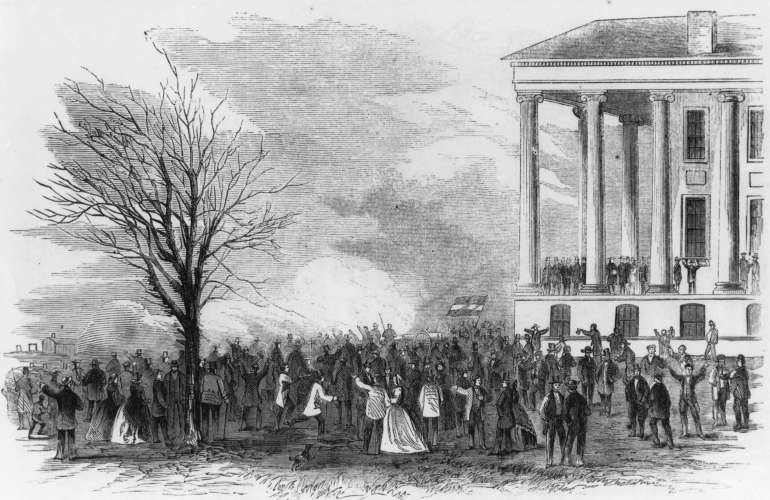
April 15th.—To-day the secession fires assumed a whiter heat. In the Convention the Union men no longer utter denunciations against the disunionists. They merely resort to pretexts and quibbles to stave off the inevitable ordinance. They had sent a deputation to Washington to make a final appeal to Seward and Lincoln to vouchsafe them such guarantees as would enable them to keep Virginia to her moorings. But in vain. They could not obtain even a promise of concession. And now the Union members as they walk the streets, and even Gov. Letcher himself, hear the indignant mutterings of the impassioned storm which threatens every hour to sweep them from existence. Business is generally suspended, and men run together in great crowds to listen to the news from the North, where it is said many outrages are committed on Southern men and those who sympathize with them. Many arrests are made, and the victims thrown into Fort Lafayette. These crowds are addressed by the most inflamed members of the Convention, and never did I hear more hearty responses from the people.
April 16th.—This day the Spontaneous People’s Convention met and organized in Metropolitan Hall. The door-keeper stood with a drawn sword in his hand. But the scene was orderly. The assembly was full, nearly every county being represented, and the members were the representatives of the most ancient and respectable families in the State. David Chalmers, of Halifax County, I believe, was the President, and Willoughby Newton, a life-long Whig, among the Vice-Presidents. P. H. Aylett, a grandson of Patrick Henry, was the first speaker. And his eloquence indicated that the spirit of his ancestor survived in him. But he was for moderation and delay, still hoping that the other Convention would yield to the pressure of public sentiment, and place the State in the attitude now manifestly desired by an overwhelming majority of the people. He was answered by the gallant Capt. Wise, who thrilled every breast with his intrepid bearing and electric bursts of oratory. He advocated action, without reference to the other Convention, as the best means of bringing the Unionists to their senses. And the so-called Demosthenean Seddon, and G. W. Randolph (grandson of Thomas Jefferson), Lieut.-Gov. Montague, James Lyons, Judge Robertson, etc., were there. Never, never did I hear more exalted and effective bursts of oratory. And it was apparent that messages were constantly received from the other Convention. What they were, I did not learn at the moment; but it was evident that the Unionists were shaking in their shoes, and they certainly begged one—just one—day’s delay, which was accorded them. The People’s Convention agreed to adjourn till 10 o’clock a.m. the next day. But before we separated a commotion was observed on the stage, and the next moment a Mr. P., from Gov. Wise’s old district, rushed forward and announced that he had just arrived from Norfolk, where, under instructions, and with the acquiescence of Gov. Letcher, he had succeeded in blocking the channel of the river; and this would either secure to us, or render useless to the United States, certain ships of the navy, stores, armament, etc., of the value of millions of dollars. This announcement was received with the wildest shouts of joy. Young men threw up their hats, and old men buttoned their coats and clapped their hands most vigorously. It was next hinted by some one who seemed to know something of the matter, that before another day elapsed, Harper’s Ferry would fall into the hands of the secessionists.
At night the enthusiasm increases in intensity, and no further opposition is to be apprehended from the influence of Tim Rives, Baldwin, Clemens, etc. etc. It was quite apparent, indeed, that if an ordinance of secession were passed by the new Convention, its validity would be recognized and acted upon by the majority of the people. But this would be a complication of the civil war, now the decree of fate.
Perhaps the occurrence which has attracted most attention is the raising of the Southern flag on the capitol. It was hailed with the most deafening shouts of applause. But at a quiet hour of the night, the governor had it taken down, for the Convention had not yet passed the ordinance of secession. Yet the stars and stripes did not float in its stead; it was replaced by the flag of Virginia.
Discussion
What does John Beauchamp Jones suggest about the mood in Richmond on April 15–16, 1861? What words or phrases stand out to you, and why?
The excerpt describes large crowds reacting to news and speeches. How might public gatherings like these influence political decisions during a crisis?
Compare the arguments of those who wanted immediate action (like Capt. Wise) with those who favored delay and moderation. Which position do you find more convincing, and why?
What does this excerpt reveal about how quickly events were unfolding in April 1861? How might that pace have affected decision-making?
Sources
Freehling, William W. and Craig M. Simpson, ed. Showdown in Virginia: The 1861 Convention and the Fate of the Union. Charlottesville, VA: University of Virginia Press, 2010.
Jones, John B. A Rebel War Clerk’s Diary at the Confederate States Capital, Vol. 1. Philadelphia: J. B. Lippincott & Co., 1866.
Shanks, Henry T. The Secession Movement in Virginia, 1847–1861. Richmond: Garret & Massie, 1934.


