Beginning in late April 1861, unionists in western Virginia agitated for the creation of a state government that would remain loyal to the United States. Their efforts culminated in the election of 47-year-old attorney Francis Harrison Pierpont (1814-1899) as governor of the Reorganized State of Virginia on June 20, 1861.
The nascent state government, centered in Wheeling along the Ohio River, was protected by Maj. Gen. George B. McClellan’s army, made up of volunteer regiments from Ohio and Indiana. With Pierpont installed as governor, Virginia’s unionists had created a political edifice but had little funding to carry out state functions or pay their own soldiers.
To solve this problem, Pierpont eyed $27,000 in gold (worth over $5.2 million today) at a bank in the town of Weston, Lewis County, earmarked for construction of the Trans-Allegheny Lunatic Asylum. In consultation with McClellan, Pierpont sent John List of the Northwestern Bank of Virginia to Weston to seize the gold in the name of the new government.
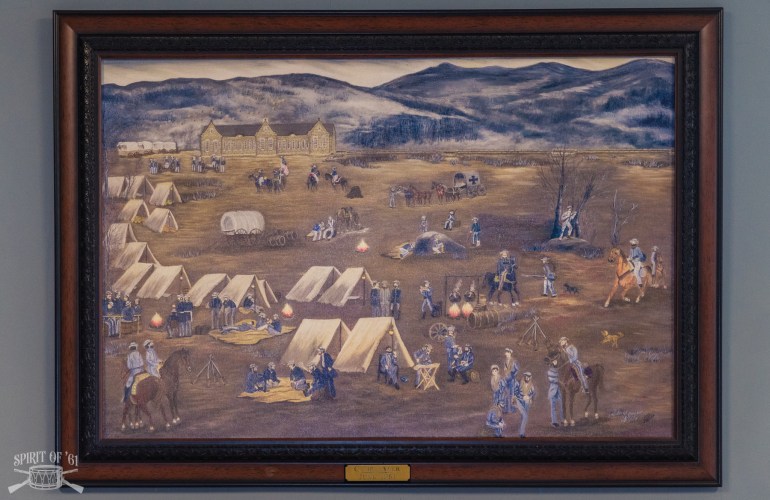
To ensure his mission was successful, McClellan sent Col. Erastus B. Tyler and the 7th Ohio Infantry Regiment. They arrived in Weston on the morning of June 30. Afterwards, the Ohio soldiers established Camp Tyler on the grounds of the partially completed asylum.
The following article about the heist appeared in the Wheeling Daily Intelligencer on July 3, 1861.
“AN EXPEDITION TO WESTON—TWENTY-SEVEN THOUSAND DOLLARS IN GOLD CAPTURED.—Capt. John List returned to this city last evening, having in charge twenty-seven thousand dollars in gold, taken from the bank at Weston, Va., where it had been placed to the credit of the Western Lunatic Asylum, by the State authorities. Capt. List was commissioned by Gov. Peirpoint to go and take charge of this money, the work on the Asylum having been stopped, and there being reasonable apprehension that the gold might fall into the hands of Letcher’s government. The Captain proceeded to Grafton, and upon making known his object to General McClellan, in less than twenty-four hours a regiment of men, under Col. Tyler were on the march. The expedition left Clarksburg on Sunday evening, and marching all night, reached Weston on Sunday morning about 5 o’clock. The people were all asleep, but the fine band which accompanied the expedition aroused the drowsy population by playing the Star Spangled Banner. Col. Tyler took possession of the place, and Capt. List went down and demanded the money in the name of the State of Virginia. No resistance was made, and the money was soon forked over. Some of the bank men thought the amount ought to have been taken in currency, but Capt. List said he didn’t think so, and that was all of it. The troops captured some twenty odd prisoners, all of whom were released upon examination, except the following, who were brought up to Grafton and placed under guard: Jas. T. Jackson, Geo. J. Butcher, W. E. Live’y, John Kearns, Jr., and J. Summit. Against these there are special charges. A guard of six men accompanied the money to this city, and last night it was safely deposited in the Northwestern Bank, and will be used by those to whom it truly belongs—the true State government.”
Wheeling Daily Intelligencer (Wheeling, VA) 3 July 1861.
The Staunton Spectator wrote the following editorial introduction to its reprint of the Intelligencer’s article on List’s gold heist:
“The following, from the Wheeling Intelligencer, a Black Republican paper, gives the details of another feat of the brave Lincoln army. The achievement has been briefly noted by telegraph. The robbery was committed in the name of the State of Virginia, through the bogus Governor of the “Pan Handle” and his convenient tools. If the Wheeling paper reports the facts in the case, it is the most infamous transaction we have yet heard of …”
Staunton Spectator (Staunton, VA) 16 July 1861.
Discussion
Why did Capt. John List and the Wheeling government believe they had the legal right to seize the gold?
What message was the Union expedition sending by entering Weston while playing “The Star-Spangled Banner”?
Why did Capt. List insist on taking the gold rather than paper currency?
Compare the language used by the Wheeling Daily Intelligencer and the Staunton Spectator. Which words or phrases reveal each newspaper’s political bias?
If you were writing a neutral newspaper article about this event in 1861, what information would you include that is missing from these two accounts?
Sources
Cook, Roy Bird. Lewis County in the Civil War 1861-1865. Jarrett Printing Co., 1924.
Staunton Spectator (Staunton, VA) 16 July 1861.
Wheeling Daily Intelligencer (Wheeling, VA) 3 July 1861.


