The Action at Glover’s Gap occurred on Tuesday, May 28, 1861 between irregular secessionist militia commanded by Stephen Roberts and a detachment of Company A, 2nd Virginia Infantry (U.S.) commanded by 2nd Lt. Oliver R. West in Marion County, West Virginia. Maj. Gen. George B. McClellan’s two-pronged invasion of northeastern Virginia began on May 26, 1861 and proceeded along the B&O and Northwestern Virginia railroads. The two columns were to converge at Grafton after repairing bridges that had been destroyed by secessionists.
In Marion County, 65-year-old Capt. Stephen Roberts, sometimes misnamed Christian, organized an irregular band that cut telegraph lines and threatened further disruption of the railroad behind the Union line of advance. Roberts’ small company caused enough mischief that Col. Benjamin F. Kelley, commanding the First Virginia (U.S.) and the Federal expedition, detailed the Washington Rifle Guards to guard Glover’s Gap Tunnel, seven and a half miles north of Mannington.
Few accounts survive of what happened next. One appears in a memoir published by Charles Lieb about his time as an assistant quartermaster for George McClellan.
Dr. Charles Lieb was a friend of both McClellan and newly elected President Abraham Lincoln. During the 1860 presidential campaign, he published the pro-Lincoln newspaper The Rail Splitter in Chicago. After the outbreak of the Civil War, Lieb requested assignment to the Department of the Ohio and Cairo, Illinois. Upon arriving in Cincinnati, however, he learned that McClellan had already advanced into northwestern Virginia and established headquarters at Clarksburg. McClellan then ordered Lieb south to assist the quartermaster department.
Lieb’s memoir, Nine Months in the Quartermaster’s Department; or, the Chances for Making a Million (1862), contains one of the few narratives of the action at Glover’s Gap on May 28, 1861. Yet Lieb did not arrive in northwestern Virginia until sometime after June 23, when McClellan was already at Grafton. His account of the campaign’s opening phase therefore rests entirely on secondhand information. Even so, it remains one of the best surviving descriptions of what occurred at Glover’s Gap.
“As the train passed the different railroad stations, the excitement became intense; and at Glover’s Gap the Secessionists boldly threatened, that no more trains loaded with soldiers should pass that point. …
“Hardly had the troops lain down, until an order came from Colonel Kelley, directing Company A, of the Second Regiment, to proceed to Glover’s Gap, to protect the railroad bridge, which the rebels threatened to burn the next day. They had already cut the telegraph wire, and torn up a portion of the track.
“In a few moments the men were ready to move, and at two o’clock arrived there, arrested the participators in the outrage, and early in the morning six men were detailed under command of Lieutenant O. R. West, to arrest other parties who were implicated.
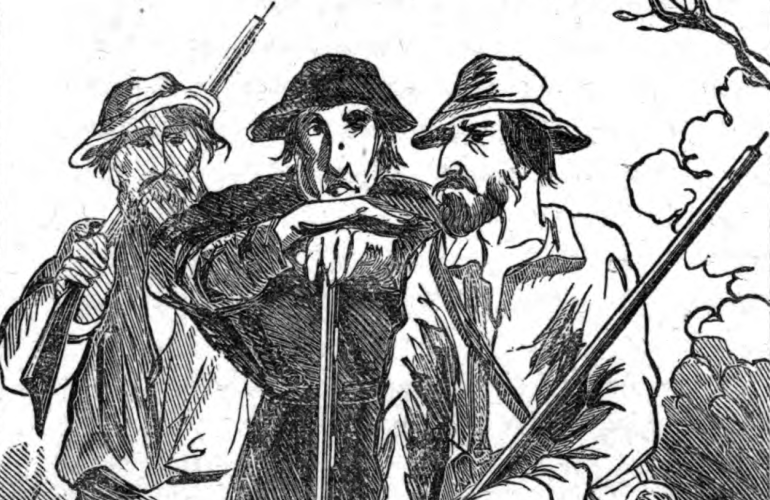
“Among these was one Stephen Roberts, a notorious character, noted for his bullying propensities, who had made bold threats against the few Union men in that locality. Coming suddenly upon him in company with other rebels, he swore he would not, and could not, be taken by all the Federal troops in Western Virginia, leveled his rifle at the Lieutenant, but fortunately it snapped, when he ordered his men to fire, and in a moment Roberts was a corpse.
“Thus fell the first rebel in Western Virginia. The death of Roberts was the death-knell of their hopes in that locality, for the news spreading rapidly, in less than two days, nearly all the Secessionists came in and voluntarily took the oath.
“This had been an infected district. A company organized there was ready to join the rebel forces, and would have done so within a few days, but the death of their trusted leader caused them to disband.”
Charles Leib, Nine Months in the Quartermaster’s Department, pg. 9-11.
Not much is known about Stephen Roberts, and his status as a combatant is disputed. According to some sources, he was the first Confederate officer killed during the Civil War. At a time when volunteer officers were elected by their units, Roberts may well have considered himself captain of a company. Author Fritz Haselberger indicated that Col. George A. Porterfield, in command of Virginia’s secessionist volunteers in the region, had overall control of Roberts and his men.
Discussion
Why were railroads and telegraph lines so important during the opening months of the Civil War?
How does the conflict at Glover’s Gap demonstrate the difference between regular armies and irregular or guerrilla-style forces?
Charles Lieb described the area as an “infected district.” What does this language reveal about Union attitudes toward secessionists?
Lieb never personally witnessed the action at Glover’s Gap. How should that affect the way historians evaluate his account?
Why are small actions like Glover’s Gap important for understanding the broader story of the Civil War?
Sources
Haselberger, Fritz. Yanks from the South! The First Land Campaign of the Civil War. Baltimore: Past Glories, 1987.
Lang, Theodore F. Loyal West Virginia from 1861 to 1865. Baltimore: Deutsch Publishing Co., 1895.
Leib, Charles. Nine Months in the Quartermaster’s Department; or the Chances for Making a Million. Cincinnati: Moore, Wilstach, Keys & Co., 1862.
Reader, Frank S. History of the Fifth West Virginia Cavalry, formerly the Second Virginia Infantry, and of Battery G, First West Va. Light Artillery. New Brighton: Daily News, 1890.
Wheeling Daily Intelligencer (Wheeling) 29 May 1861.
York Gazette (York) 4 June 1861.
Zanesville Daily Courier (Zanesville) 30 May 1861.


