In early July 1861, following Lewis “Lew” Wallace’s departure from Cumberland, Maryland, the 13th and 5th Pennsylvania Reserve Regiments and Battery A, 1st Pennsylvania Artillery, advanced to protect this vital transportation hub on the Potomac River. On July 12, Confederate cavalry destroyed railroad cars and two trestle bridges over George’s Creek on the Maryland side of the river, north of Piedmont, Virginia, forcing the Pennsylvanians to respond.
On Sunday, July 14, three infantry companies occupied Piedmont. The following evening, an unseen enemy attacked their picket posts for several hours. The inconclusive skirmish ended as abruptly as it began, and history has nearly forgotten it. Who were the attackers, and why was this Appalachian railroad town in their crosshairs?
Piedmont, then part of Hampshire County, had recently emerged as an important station on the Baltimore and Ohio (B&O) Railroad, complete with a roundhouse and railyard. By 1860, its population exceeded 900, many of them Scottish and Irish immigrants employed by the railroad. A network of industrial railroads connected Cumberland and Piedmont with western Maryland’s coalfields west of Dans Mountain.
The town occupied a bend in the North Branch of the Potomac, opposite the mouth of Georges Creek. Across the river stood Westernport, Maryland, so named because it marked the westernmost navigable port on the Potomac.
On Friday, July 12, Lt. Col. Thomas L. Kane of the 13th Pennsylvania Reserve Regiment, nicknamed the “Bucktails” for the deer tails its soldiers wore on their hats, led sixty dismounted scouts from Cumberland to Piedmont and then to New Creek Depot. There, they clashed with Confederate cavalry from Col. Angus W. McDonald’s 7th Virginia Cavalry.
On Sunday afternoon, while Kane’s scouts pursued Confederate cavalry south of New Creek, Col. Charles J. Biddle sent Capt. Andrew J. Trout with Companies A and F of the 5th Pennsylvania Reserves and Company B of the Bucktails to occupy Piedmont. They arrived shortly afterward and took possession of the town’s brick market house.
Among them was Robert W. Sturrock, orderly sergeant of Company F and, back home in Pennsylvania, an editor of The Bradford Reporter. Finding A. S. Trowbridge’s newspaper office abandoned, Sturrock seized the opportunity to publish a regimental broadsheet titled The Pennsylvania Reserve. It’s thanks to Sturrock and his newspaper that we know anything about this skirmish at all.
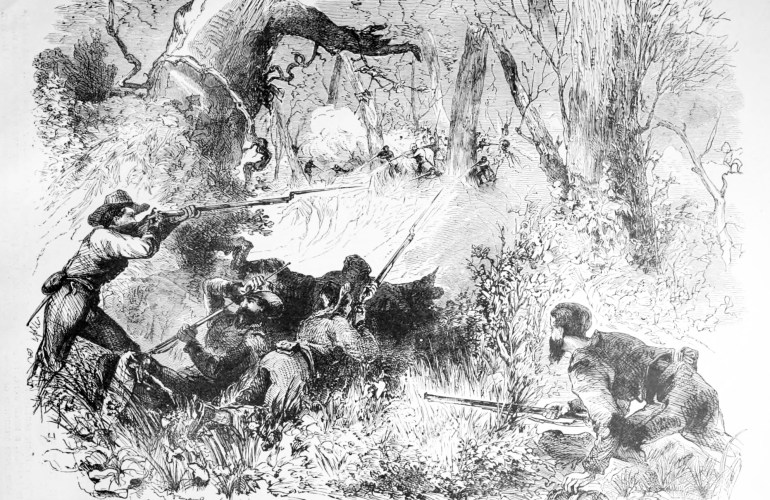
Their first night in Piedmont passed quietly. Shortly after nightfall on Monday, however, pickets stationed on the hill southeast of town fired at figures moving through the darkness and were answered by the report of rifles. Sturrock recalled:
“At about nine o’clock p. m., soon after the pickets were stationed an attack was made upon those stationed upon the hill east of the town. The crack of a musket from the hill brought every one to their feet, and when it was followed by a general alarm from all the pickets, the boys realized for the first time a sense of the danger and responsibility of their position. For an hour they stood at their posts while the firing continued on the hill and along the railroad. At length when our company was under way at double quick time to the scene of the action—having waited long enough to be attacked—the sound of approaching trains were heard and by the time we arrived at the depot, we were greeted by Col. Kane’s command, returning from New Creek, and by two regiments of Ohio volunteers from Laurel Hill on their way east. Of course the presence of so large a force blocked all the chances for a continuance of the skirmish. From the pickets that came in we learn that they had fired upon an approaching body of men and that the fight was kept up in an irregular manner till the approach of the trains frightened the rebels away. Not one of our party was injured, but several of the rebels were killed–it is thought four of them. Two of our boys followed them all night but did not accomplish anything.”
The Pennsylvania Reserve (Piedmont, VA) 18 July 1861.
The two unnamed Ohio regiments were detachments of the 20th and 22nd Ohio Infantry from Charles W. Hill’s brigade, sent in pursuit of Confederates retreating before Maj. Gen. George B. McClellan’s victorious army after the Battle of Corrick’s Ford. Their advance was part of a multipronged but ultimately unsuccessful effort to trap the remnants of the Confederate army.
The identity of the unseen attackers remains unknown, though they were almost certainly troopers from McDonald’s cavalry. It is unlikely that any were killed. Neither the memoirs associated with the 7th Virginia Cavalry nor the annotated roster in Richard L. Armstrong’s regimental history mentions casualties on July 15, 1861. Unfortunately, I have yet to find a firsthand Confederate account of the skirmish. Something happened that night, but with so few sources, it is impossible to say for certain what it was.
Sources
Armstrong, Richard L. 7th Virginia Cavalry. H.E. Howard, Inc., 1992.
Avirett, James B. The Memoirs of General Turner Ashby and His Compeers. Selby & Dulany, 1867.
Bates, Samuel P. History of Pennsylvania Volunteers, 1861-5. B. Singerly, State Printer, 1869.
The Bradford Reporter (Towanda, PA) 1 August 1861.
The Daily Express (Lancaster, PA) 31 July 1861.
Glover, Edward A. Bucktailed Wildcats: A Regiment of Civil War Volunteers. Thomas Yoseloff, 1960.
Haselberger, Fritz and Mark. “The Skirmishes at New Creek and Piedmont.” West Virginia History 27 (April 1966): 211-19.
The Pennsylvania Reserve (Piedmont, VA) 18 July 1861.
Scharf, J. Thomas. History of Western Maryland: Being a History of Frederick, Montgomery, Carroll, Washington, Allegany, and Garrett Counties, Vol. II. Louis H. Everts, 1882.
The Sunbury Gazette (Sunbury, PA) 27 July 1861.
Sypher, Josiah R. History of the Pennsylvania Reserve Corps. Elias Barr & Co., 1865.
Thomson, O.R. Howard and William H. Rauch. History of the “Bucktails” Kane Rifle Regiment of the Pennsylvania Reserve Corps (13th Pennsylvania Reserves, 42nd of the Line). Electric Printing Company, 1906.
The War of the Rebellion: A Compilation of the Official Records of the Union and Confederate Armies. Series I, Vol. II. With additions and corrections. Washington: Government Printing Office, 1902.


One thought on “What Happened at Piedmont?”