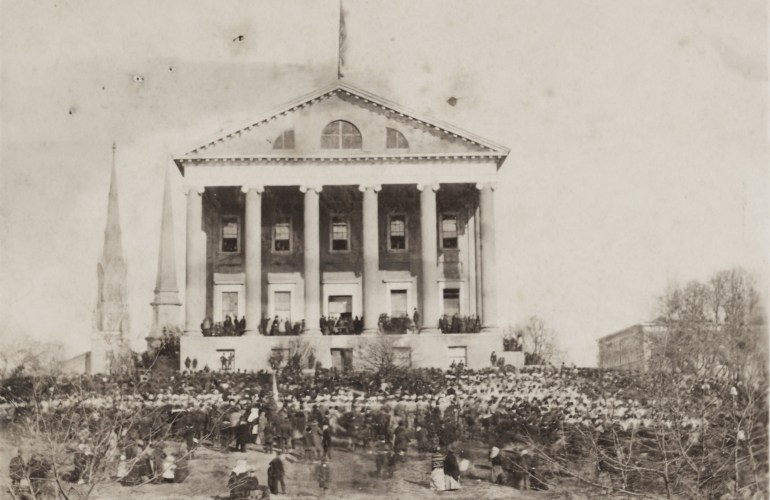
On November 15, 1860, Virginia Governor John Letcher called a special session of the state’s general assembly to convene at the capitol in Richmond on Monday, January 7, 1861. When senators and delegates took their seats, President-elect Abraham Lincoln had not yet assumed office, and only South Carolina had declared its secession. Mississippi, Florida, and Alabama would follow in the coming days.
As the general assembly convened, Governor Letcher delivered a lengthy address that painted a bleak picture. “The country is torn by dissension; fierce and angry excitement exhibits itself in all sections; passion and prejudice have taken absolute possession of the minds of the people throughout the land,” he said. “…the spirit of conciliation has been smothered and crushed, and the affections of the people, north and south, east and west, appear to have been entirely withdrawn from their government. The ties of brotherhood have been severed…”
Though he appealed for calm and moderation and called for a convention of states to resolve the crisis peacefully, he added, “I will regard an attempt to pass federal troops across the territory of Virginia, for the purpose of coercing a southern seceding state, as an act of invasion, which should be met and repelled. The allegiance of every citizen of Virginia is due to her; and when her flag is unfurled, it is his duty to rally to its support and defence.”
That evening, Wyndham Robertson, a Whig and former acting governor of Virginia representing Richmond in the House of Delegates, took up Letcher’s call by introducing what became known as the “Anti-Coercion Resolution.” Robertson was a Conditional Unionist, supporting Virginia’s continued place in the Union so long as the federal government did not attempt to keep seceding states in the Union by force.
The brief resolution read as follows:
“Resolved by the general assembly of Virginia, that the Union being formed by the assent of the sovereign states respectively, and being consistent only with freedom and the republican institutions guaranteed to each, cannot and ought not to be maintained by force.
“That the government of the Union has no power to declare or make war against any of the states which have been its constituent members.
“Resolved, that when any one or more of the states has determined or shall determine, under existing circumstances, to withdraw from the Union, we are unalterably opposed to any attempt on the part of the federal government to coerce the same into reunion or submission, and that we will resist the same by all the means in our power.”
The resolution passed, 112 to 5.
It became a line in the sand. When Lincoln called for an army of 75,000 volunteers on April 15, following the Confederate bombardment of Fort Sumter, many Conditional Unionists believed that line had been crossed and voted for secession two days later.
Sources
Journal of the House of Delegates of the State of Virginia, for the Extra Session, 1861. William F. Ritchie, Printer, 1861.
Richmond Whig (Richmond, VA) 8 January 1861.


