Though seldom remembered today, former Virginia governor Henry A. Wise played a key role in aligning Virginia with the Confederacy. He served as a Confederate general throughout the war, lost his eldest son, and surrendered with Lee at Appomattox Court House. A (sometimes reluctant) secessionist, he was nevertheless not an enthusiastic supporter of slavery, despite owning a plantation and around 20 slaves.
Wise led the secessionist faction at the 1861 Convention in Richmond and was, perhaps more than anyone else, responsible for galvanizing the final vote to repeal Virginia’s ratification of the U.S. Constitution. In the summer of 1861, he organized the “Wise Legion,” an unusual combined-arms force that operated in western Virginia. Sources are often vague, however, about how Wise obtained his commission and the authority to raise this unit.

During Virginia’s initial mobilization, officers were typically commissioned by the state and authorized by the governor to raise a regiment. The Wise Legion, however, was technically a brigade or demi-brigade, not a regiment. Units that joined the legion, including those later numbered the 46th and 59th Virginia Infantry, initially carried designations such as “1st Infantry, Wise Legion.”
As Virginia organized its provisional army and navy from late April into May 1861, it limited the number of general officers. Philip St. George Cocke and Daniel Ruggles, who had initially entered service as brigadier generals, were administratively reduced in rank to colonel. As a former governor, Wise may have felt entitled to a higher rank, despite having no military background.
On the 23rd of April, Wise wrote to Virginia’s sitting governor, John Letcher, asking to be appointed “in the highest military command you will confer on me.” Letcher, however, was a conservative moderate who likely had little enthusiasm for giving Wise a prominent role in the state’s military. Wise had organized the seizure of the Harper’s Ferry Arsenal behind Letcher’s back and his supporters threatened a coup if the Convention in Richmond did not vote to leave the Union.
Wise did have some support among Virginia’s leadership. Robert E. Lee, as overall commander of Virginia’s provisional army and navy, wrote to him on May 24, “Permit me to hope that you are relieved from your distressing attack of indisposition, and are able to give your powerful aid to your State in this time of peril. The services of no one, I am sure, will be more valuable to her.”
His exertions at the Richmond Convention took a toll (he was 54 at the time), and he returned to Rolleston Hall outside Norfolk to recover. Laid up in bed, he dispatched a flurry of letters requesting offices in the Confederate government for his friends and relatives.
On May 15, Wise wrote to provisional Confederate President Jefferson Davis, then in Montgomery, Alabama, requesting a brigadier general’s commission for himself and the appointment of James Lucius Davis as colonel to raise and lead a “partizan [sic] Legion of mounted men.” He also requested supplies and ammunition for the legion. Wise later described the undertaking: “Nearly a corpse I undertook, at your request, the extraordinary task of forming a little army to defend the Kanawha Departmt. in the act of marching to meet the enemy.” In fact, Wise himself had requested both the rank and the command.
He began recruiting for the brigade before receiving his commission. In a letter preserved among Governor Letcher’s papers, he wrote to Thomas P. McCandlish, a professor at the College of William and Mary on May 26: “President Davis has authorized me to raise a legionary Brigade, and I now tender to you, the opportunity of raising a company under my command. If you accept commence recruiting at once, to be commissioned when the Brigade is raised.” If Davis had indeed sent him such authorization in mid-to-late May, I have not seen it.
It wasn’t until after the Confederate government moved to Richmond and Jefferson Davis arrived that Wise received his long-sought commission. By then, he had regained his health and delivered a bellicose speech in the capital, declaring: “If the enemy’s guns reach further than yours, reduce the distance; meet them foot to foot, eye to eye, body to body, and when you strike a blow, strike home. Your trueblooded Yankee will never stand still in the presence of cold steel.”
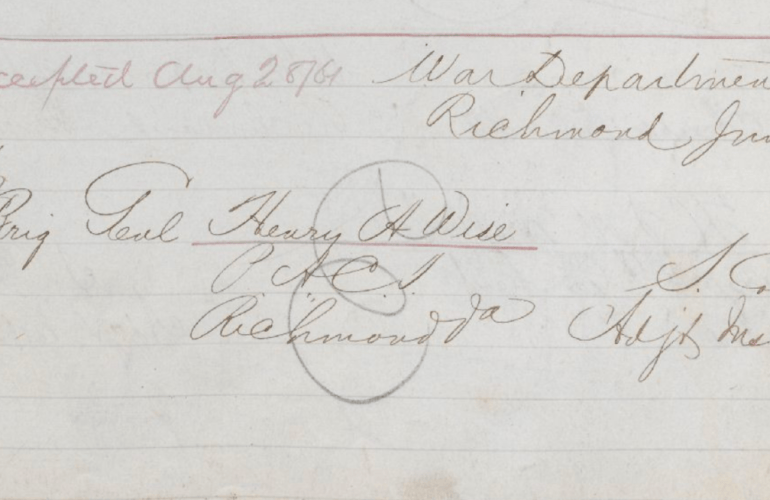
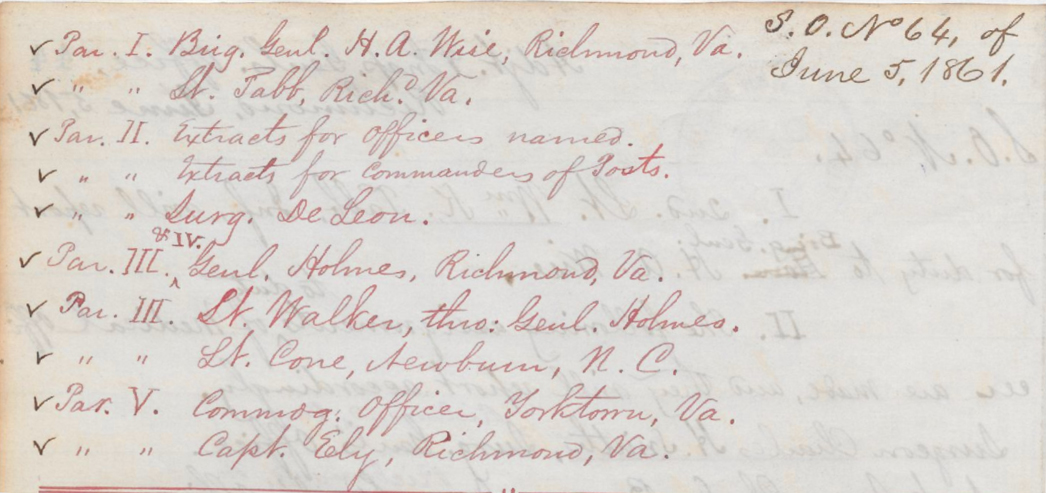
On June 3, Confederate Adjutant and Inspector General Samuel Cooper wrote to Wise “In relation to the legion proposed to be raised by you,” outlining the unit’s required composition, including the number of companies and officers. Wise’s appointment as brigadier general came two days later, June 5, 1861, as recorded in the Confederate Adjutant and Inspector General’s Office records.
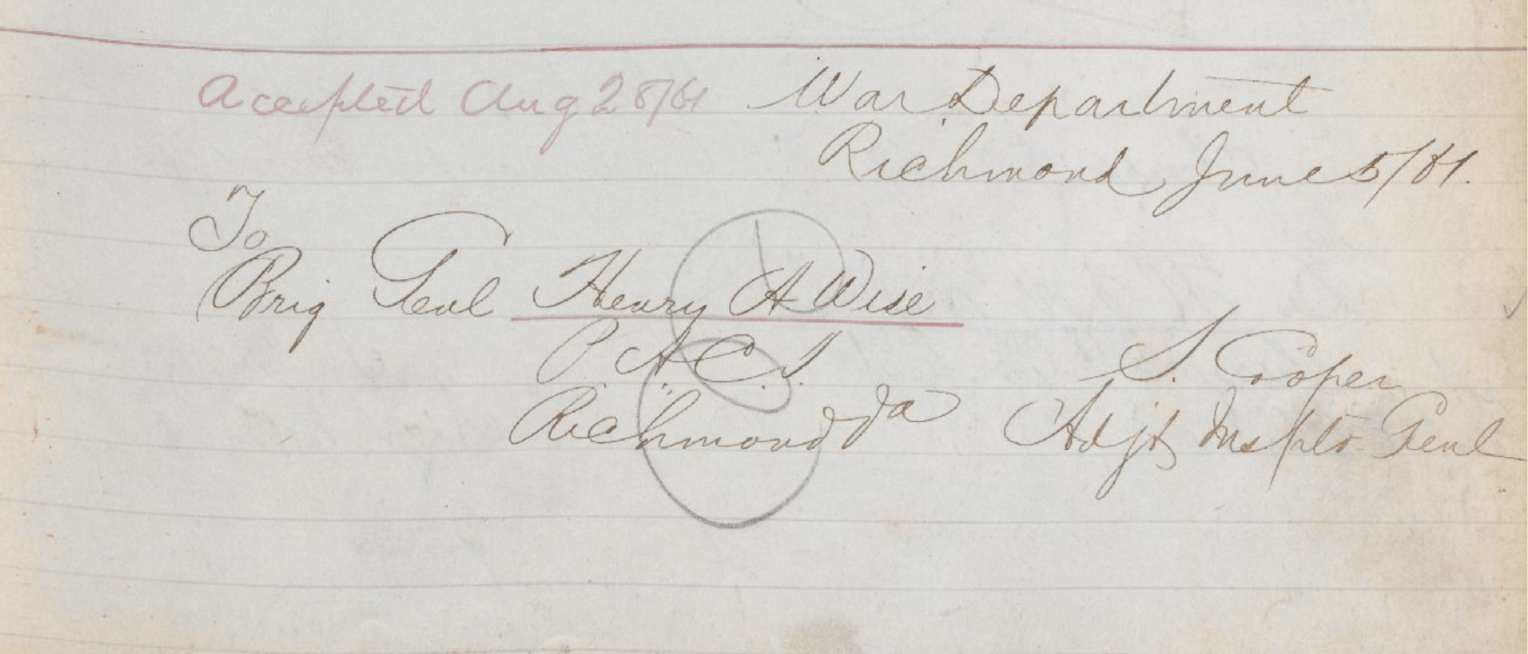
Finally, on June 6, Cooper wrote to Wise, “Having been appointed brigadier-general of Provisional Forces, you will proceed, with the force placed at your disposal, by the most speedy route of communication, to the valley of the Kanawha. You will, by such means and agencies as may be within your control, rally the people of that valley and the adjoining counties to resist and repel the invading army, which is reported to be on its march towards Lewisburg … The several officers of experience who have been directed to report to you will be assigned by you to such duties as the necessities of the case may require.”
The Provisional Forces referred to in Cooper’s orders were that of the Confederacy, not the Commonwealth of Virginia.
Barton H. Wise’s 1899 biography of his grandfather gave a somewhat more detailed and accurate account of how Wise was commissioned and sent into western Virginia than Craig M. Sampson’s A Good Southerner: The Life of Henry A. Wise of Virginia, published nearly a century later. Both, however, missed key details.
Wise’s letters and the sequence of events outlined above make clear that he was less than honest about how he became a Confederate brigadier general and formed his Wise Legion, creating confusion in subsequent histories. In truth, Wise petitioned Jefferson Davis for a commission and proposed the Legion himself, but received official authorization for neither until June 5–6, 1861.
This process bypassed state authorities, and his Legion was not considered part of Virginia’s provisional army in the spring and summer of 1861. In fact, Virginia’s paymaster general, Henry Hill, excluded both the Wise Legion and [John B.] Floyd’s brigade from his Statement Showing the Number, by Companies, of the Virginia Volunteers who Entered Service Prior to July 1, 1861. Both consisted of Virginia troops, but Hill omitted them “for the reason that they were commissioned by the confederate government, and not paid to the 30th of June 1861 by the state of Virginia.”
Wise sought his commission and proposed his Legion directly to the Confederate government, sidestepping Virginia’s authorities in a process later accounts muddled or mischaracterized. Hopefully this will clarify that record.
Sources
Crist, Lynda Lasswell and Mary Seaton Dix, eds. The Papers of Jefferson Davis, Vol. 7. Louisiana State University Press, 1992.
Hill, Henry. Statement Showing the Number, by Companies, of the Virginia Volunteers who Entered Service Prior to July 1, 1861. Paymaster General’s Office, Doc. No. 49, 1862.
Lowry, Terry. The Battle of Scary Creek: Military Operations in the Kanawha Valley April – July 1861. Charleston: Quarrier Press, 1982, 1998.
Simpson, Craig M. A Good Southerner: The Life of Henry A. Wise of Virginia. University of North Carolina Press, 1985.
The War of the Rebellion: A Compilation of the Official Records of the Union and Confederate Armies. Series I, Vol. II. With additions and corrections. Washington: Government Printing Office, 1902.
The War of the Rebellion: A Compilation of the Official Records of the Union and Confederate Armies. Series I, Vol. LI, Part II. Washington: Government Printing Office, 1897.
The War of the Rebellion: A Compilation of the Official Records of the Union and Confederate Armies. Series IV, Vol. I. With additions and corrections. Washington: Government Printing Office, 1902.
Wise, Barton H. The Life of Henry A. Wise of Virginia, 1806-1876. The Macmillan Company, 1899.
Wise, Henry A. to Thomas P. McCandlish, May 26, 1861. Governor’s Office (RG#3) John Letcher Executive Papers, Box 13, 1861 May 18-28, Accession 36787. State Records Collection. The Library of Virginia.


