As secession divides West Point’s cadets, Class of ’61 follows fractured friendships from the academy to the battlefield at Bull Run. But how well does its sprawling fictional drama capture the historical upheaval of the Civil War’s opening months?
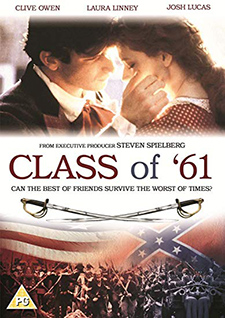
Written by Jonas McCord, directed by Gregory Hoblit, and produced by Steven Spielberg, Class of ’61 premiered on ABC in April 1993. This confusing drama follows members of West Point’s class of 1861 and their families as they take opposing sides in the war. It’s notable for an early appearance by Clive Owen, the only actor to stand out among the myriad stock characters.
As the film opens, three friends, Shelby Peyton (Dan Futterman), George Armstrong Custer (Josh Lucas), and Devin O’Neil (Clive Owen), are attending the United States Military Academy at West Point. Tensions are high as Confederate troops fire on Fort Sumter, leaving the cadets with divided loyalties. Peyton, a Virginian, decides to resign and head south to join the Confederacy despite his engagement to O’Neil’s sister, Shannon (Sophie Ward).
Back home in Maryland, Devin O’Neil learns his brother Terry (Christien Anholt) has joined pro-Southern partisans, upsetting his pro-Union Irish family. Things get complicated when O’Neil is unable to secure a commission in the Union Army. He rooms with George Custer in Washington, DC, where he falls in love with Lily Magraw (Laura Linney), who happens to be a Southern spy.
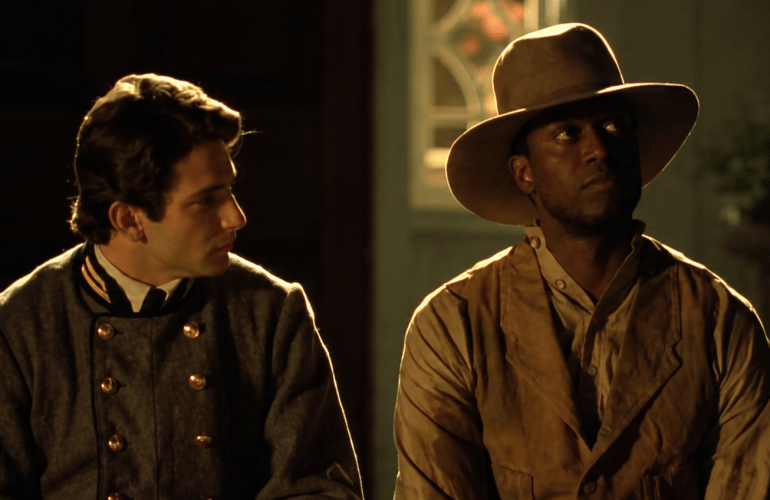
Things get even more complicated when Shelby Peyton returns to his plantation, where his favorite slave, Lucius (Andre Braugher), has killed two slave catchers during an escape attempt. Lucius is forced to flee north via the Underground Railroad, leaving his pregnant wife to an uncertain future. Will destiny reunite all these characters at the First Battle of Bull Run?
Dozens of characters, several interwoven but only marginally related subplots, and constantly changing settings make Class of ’61 a baffling and unenjoyable mess. The filmmakers were trying to present all sides of the Civil War through participants from a variety of backgrounds, but that is difficult to achieve in a 90-minute film. Productions like Roots (1977) and The Blue and the Gray (1982) took six to nine hours to weave such complex and compelling dramas.
Though several characters are fictional, with George Armstrong Custer an obvious exception, Class of ’61 does strive for some historical accuracy. In one dramatic scene, Southern cadets at West Point walk out before graduation after being told they must swear a loyalty oath to the Union. In fact, of the 26 cadets set to graduate in 1861 who would later fight for the Confederacy, 17 resigned before graduation.
The most notable cadet to resign in May 1861 was John Pelham, who, at age 22, joined Joseph E. Johnston’s Army of the Shenandoah as a lieutenant and drill master of the Wise Artillery. Pelham went on to command J.E.B. Stuart’s horse artillery and won fame before being mortally wounded at the Battle of Kelly’s Ford in early 1863.
As a historical subject, the American Civil War is a treasure trove of drama, tragedy, and unbelievable stories, but Class of ’61 lacks the focus needed for a compelling film. We don’t spend enough time with any of the characters to become invested in them. Clive Owen, the film’s strongest actor by far, is given a dead-end storyline that concludes with an eye-rolling contrivance: his character runs onto the Bull Run battlefield at just the right moment to reunite with his old friends.
The visitor center at Manassas National Battlefield Park displays a short film commissioned by the National Park Service about the First and Second Battles of Bull Run, which effectively portrays both battles while telling the stories of individual soldiers and civilians caught up in the conflict. That film was far more compelling and emotionally engaging than Class of ’61, which didn’t even try to get the battle right.


