
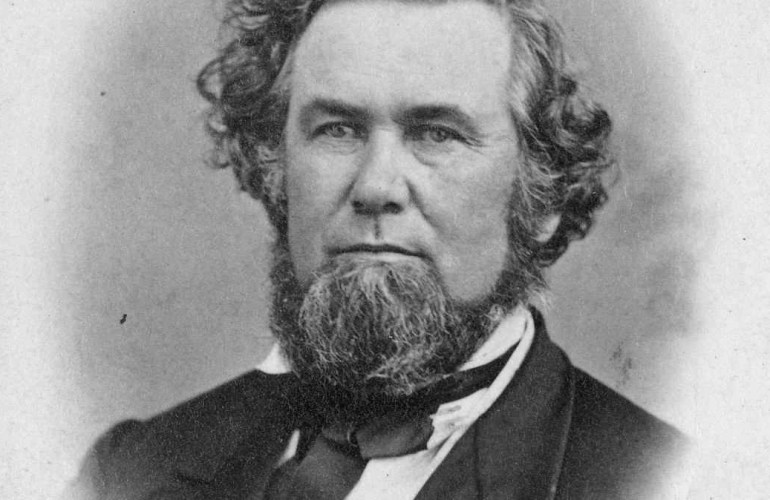
In July 1861, Francis H. Pierpont defended the Unionist government at Wheeling as Virginia’s lawful authority and denounced secession as a conspiracy that sacrificed the state to Confederate interests. His extraordinary-session address reveals how loyal Virginians made a constitutional, economic, and political case for restoring Virginia to the Union.
On June 20, 1861, in Wheeling, in Virginia’s northwestern panhandle, Francis Harrison Pierpont was unanimously elected governor of the Reorganized State of Virginia—a Unionist rump state that exercised authority in areas under Union military control. Its leaders maintained that Governor John Letcher and other state officials had forfeited their offices by embracing secession. President Abraham Lincoln agreed and recognized the new government’s legitimacy.
On July 2, the reorganized legislature convened in extraordinary session, and Pierpont delivered an address that was widely reprinted at the time but is largely forgotten today. He defended the restored Virginia government and condemned secession as a conspiracy imposed through intimidation and disregard for the public will. He argued that Virginia’s former leaders had betrayed their constitutional obligations, placed the state under Confederate military control, and exposed its people to war and economic ruin. The Wheeling Convention, he maintained, preserved lawful government and Virginians’ rights as citizens of the United States.
Pierpont also outlined practical legislative priorities: electing replacement U.S. senators, redistricting congressional seats, improving the courts, and protecting loyal citizens without undue harshness. He urged economical administration without higher taxes, supported the suspension of specie payments and the issuance of smaller banknotes, counseled caution on debtor relief, and called for abolishing the Board of Public Works. He closed by expressing hope for the return of peace and prosperity.
Pierpont characterized secession as a deliberate conspiracy against constitutional government, imposed through deception, intimidation, and violence. He argued that Virginia’s leaders misrepresented their intentions, transferred the state’s military forces to Confederate control before the May 23 referendum, and used threats to manufacture the appearance of popular support. In his account, secession replaced representative government with the prospect of oligarchy or military despotism.
He went further, dismissing secession’s stated justifications. The supposed danger to slavery, he said, was merely a pretext for stirring public feeling, while secession itself weakened the constitutional protections slavery already enjoyed. He argued that large slaveholders were not its principal advocates and that Virginia’s strongest slaveholding regions had previously supported the Union. He also rejected Lincoln’s call for volunteers as the underlying cause, pointing instead to earlier Confederate military preparations and threats against Washington.
Pierpont, of course, was wrong on this point. In general, counties with smaller slave populations voted to remain in the Union in the May 23 referendum, while the reverse was true in Virginia’s Tidewater and Piedmont counties. Though there were exceptions.
For Virginia, he portrayed secession as a disastrous bargain:
- Virginia would become a battlefield shielding the Gulf States, placing its homes, infrastructure, and economy at risk.
- Separation threatened access to markets through the Ohio River, Maryland, and Pennsylvania, while the Alleghenies impeded trade with the Confederacy.
- Confederate leaders would draw Virginia into enormous wartime expenditures.
- Richmond’s leaders had surrendered military control to the Confederacy and compromised Virginians’ constitutional rights.
His central accusation was that Virginia’s leaders sacrificed their own people’s interests to protect the Confederacy and its Southern partners.
Pierpont portrayed Virginia’s secessionist leaders as committed participants in a longstanding conspiracy to overthrow the Union. In his account, allegiance to that project took precedence over their obligations to Virginians. He called the protection of slavery a “mere pretext” but did not identify a specific alternative motive.
The Cotton States’ leaders, he argued, transferred the war to Virginia “to save their own people and property.” Virginia enabled that arrangement by surrendering military control to the Confederacy and becoming a defensive barrier. Pierpont thus explained how Virginia was sacrificed and who benefited, while treating its leaders’ willingness to cooperate chiefly as evidence of betrayal rather than examining why they chose it.
Pierpont’s address was designed to consolidate support for the restored government and translate its constitutional claims into action.
Having argued that secessionist officials had forfeited their authority, he urged the legislature to establish the institutions necessary to govern Unionist Virginia during the war: fill vacant federal offices, revise judicial and congressional arrangements, protect loyal communities, and address the state’s financial and administrative problems. At the same time, he presented Unionism as the course most consistent with Virginia’s material interests, political independence, and eventual return to peace and prosperity.


