In July 1861, Henry A. Wise sent Confederate detachments north from Charleston toward Ripley and Glenville. One turned back without a fight; the other traded shots with Ohio troops and briefly drew Union reinforcements away from Rich Mountain. What did the Wise Legion hope to accomplish, and why did both expeditions come to so little?
Western Virginia’s Kanawha Valley was a strategic but underdeveloped corridor, with the Kanawha River providing its main transportation route. The river runs 97 miles from the confluence of the New and Gauley rivers to the Ohio. In 1861, the valley’s largest town was Charleston, population 1,520. South of town, the Dickinson saltworks produced large quantities of salt, critical for preserving food and curing leather.
On May 3, 1861, Governor John Letcher commissioned Charleston businessman Christopher Q. Tompkins as a colonel and authorized him to raise a regiment in the Kanawha Valley. John McCausland, a professor at the Virginia Military Institute, was sent to help muster and train the troops. Tompkins, McCausland, and others, including George S. Patton, Sr. and recently resigned U.S. Congressman Albert Gallatin Jenkins, made some progress before Henry Alexander Wise, a planter from Virginia’s Eastern Shore, superseded them.
Henry A. Wise (1806–1876) served in the U.S. House of Representatives from 1833 to 1844 and as governor of Virginia from 1856 to 1860. As governor, he oversaw John Brown’s imprisonment, trial, and execution following the raid on the federal arsenal at Harpers Ferry. Amid rising sectional tensions, Wise also sent ordnance to western Virginia to menace the Ohio River. Virginia unionists and Ohio volunteers later seized most of it.
Wise led the secessionist faction at the 1861 convention in Richmond and played a key role in aligning Virginia with the Confederacy. Despite having no military experience, he was commissioned a brigadier general and authorized to raise a combined arms force to defend the Kanawha Valley, which became known as the Wise Legion. To compensate for his inexperience, he surrounded himself with veteran staff officers.
He established his headquarters at Charleston on June 26 and immediately used military force to suppress unionist sentiment. In a region where Union sympathies ran strong, his heavy-handed approach proved counterproductive. Meanwhile, Federal advances farther north were putting Confederate forces under pressure, and their commander began looking to Wise for help.
On May 26, Maj. Gen. George B. McClellan, Department of the Ohio, had ordered a multipronged advance into northwestern Virginia to secure and repair the Baltimore & Ohio and Northwestern Railroads. Two columns converged at Grafton, then turned south to attack secessionist militia gathering at Philippi. As Union reinforcements poured into the region, Robert E. Lee’s adjutant general, Robert S. Garnett, was promoted to brigadier general and given command of Confederate forces there.
Facing a much larger Federal force, Garnett suggested that a northward movement by Wise could provide an effective diversion. On July 1, he wrote to Richmond that “it is my opinion that General Wise’s command could be of more service to the cause by operating in the direction of Parkersburg and the Northwestern Railroad.” On July 6, he revised his proposal, recommending a more northeasterly advance that would threaten Weston and Buckhannon, where McClellan’s army was concentrating. Lee endorsed Garnett’s strategy and repeated it verbatim in a July 11 letter to Wise.
Wise, however, began his northward expeditions around the first of July, making it unlikely that he acted in concert with this suggestion. He organized two small detachments of several hundred men: one led by his eldest son, Obadiah Jennings Wise, captain of the Richmond Light Infantry Blues, and the other by Robert A. Caskie, a wealthy Richmond tobacco merchant and captain of Caskie’s Mounted Rangers.
Shortly after arriving in Charleston, O. Jennings Wise led his expedition north to Ripley, 40 miles away, departing on the night of June 29 with Capt. John P. Brock’s Rockingham Valley Rangers. They reached Ripley the next day, where Lt. Col. George S. Patton and another company joined them. Henry A. Wise arrived with reinforcements on July 4 and considered attacking the 21st Ohio Infantry Regiment at Ravenswood, on the Ohio River. He changed his mind, however, and began withdrawing toward Charleston. The expedition lasted ten days and accomplished little.
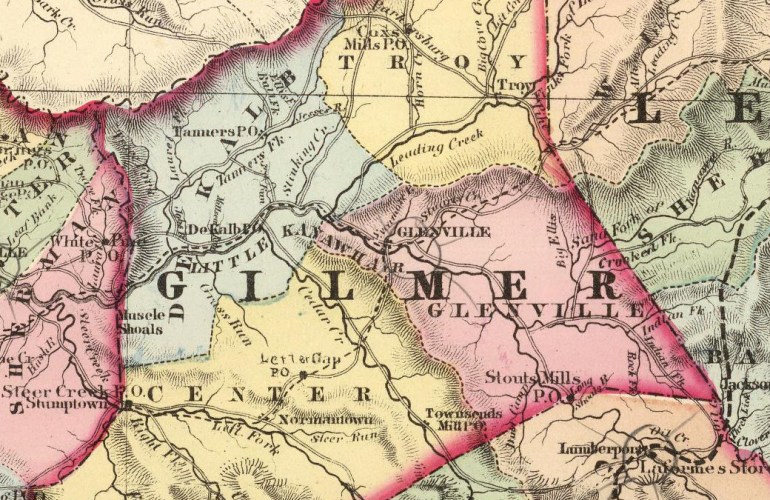
Around the first of July, Caskie and his Rangers, about 54 men under arms, rode north with several unidentified companies, a force totaling 160 to 260 men. With his devilish goatee, Capt. Caskie cut a dashing figure. They followed the road through Spencer and Arnoldsburg, now U.S. Route 119, toward Glenville, the seat of Gilmer County, some 89 miles away. The 178-mile round trip meant the expedition would be gone for at least a week and would need supply wagons, further slowing its progress through the remote, mountainous terrain.
Lack of Confederate primary sources makes Caskie’s mission difficult to determine. According to Edward A. Pollard, a wartime editor of the Richmond Examiner, “General Wise, anxious to give an assurance of support to the strong Southern sentiment reported to exist in Gilmer and Calhoun, sent an expedition into those counties to repress the excesses of the Union men.”
Indeed, newspaper reports indicate that the presence of Caskie’s expedition, and possibly local secessionist militia, was sowing panic among Gilmer County unionists and causing some to flee to neighboring Ritchie County. Following the secession vote, civil order broke down in Gilmer. Mail service stopped, and the court closed. On July 8, 1861, the Richmond Daily Dispatch noted, “We have nothing further from Gilmer, where at last accounts civil strife was going on very actively.”
Coincidentally, as Caskie’s expedition reached Gilmer County, McClellan was planning to send troops to secure its county seat. Four companies of the 17th Ohio Infantry, about 360 men under Lt. Col. Francis B. Pond, occupied the town. They hadn’t been there long before running into trouble.
On Sunday, July 7, Pond’s skirmishers clashed with Caskie’s men at Camden Flats, overlooking the Little Kanawha River just west of Glenville. Pond formed his battalion for battle on the courthouse grounds, but the outnumbered Confederates avoided a direct attack. Instead, Caskie’s men formed a loose ring around town and continued the low-intensity bush fight.
“My little son, about ten years of age, was with the pickets that were first fired on, at the time that they received a volley of forty or fifty shots,” wrote Dr. Thomas Maley Harris. “He says that the leaves that were cut from the bushes around them, fell in showers about him.” Harris later formed the 10th West Virginia Infantry (U.S.) and rose to the rank of brevet major general.
Pond managed to get a scout through to Buckhannon, prompting two companies of the 7th Ohio Infantry to rush to his relief. McClellan also ordered the 10th Ohio Regiment and the rest of the 7th forward. One member of the relief force later described events on the morning of July 8: “About fifty came upon five men on picket guard, and fired upon them a volley at only thirty paces; but not one of Col. Pond’s men was hurt. They coolly returned the fire and then retreated to the camp.”
As Capt. James T. Sterling approached Caskie’s pickets with Companies B and H of the 7th Ohio, about 50 Unionist Home Guards joined him. They soon realized the Confederates were retreating. Facing the prospect of overwhelming numbers and with no reinforcements in sight, Caskie and his men hastily withdrew toward Charleston. Neither side reported any casualties.
Pond and his men soon rejoined their regiment at Buckhannon. Like Wise’s expedition to Ripley, Caskie’s expedition to Gilmer County achieved little. It did, however, inadvertently draw two regiments away from McClellan’s operation against Rich Mountain, though their absence had no effect on the battle fought there three days later.
Sources
Caskie, Jaquelin A. The Caskie Family of Virginia. By the author, 1928.
Cincinnati Daily Commercial (Cincinnati, OH) 18 July 1861.
Cleveland Daily Plain Dealer (Cleveland, OH) 17 July 1861.
Cleveland Morning Leader (Cleveland, OH) 22 July 1861.
Cutchins, John A. A Famous Command: The Richmond Light Infantry Blues. Garrett & Massie Publishers, 1954.
Daily Intelligencer (Wheeling, VA) 18 July 1861.
Daily Intelligencer (Wheeling, VA) 22 July 1861.
Driver, Robert J. Jr. 10th Virginia Cavalry. H.E. Howard, Inc., 1992.
Gainer, Rosemary Layman. The Civil War in Gilmer County, West Virginia. Red Clay Press, 1991.
Lowry, Terry. The Battle of Scary Creek: Military Operations in the Kanawha Valley April – July 1861. Quarrier Press, 1998.
Matheny, Herman E. Major General Thomas Maley Harris. McClain Printing Company, 1963.
Richmond Dispatch (Richmond, VA) 5 July 1861.
Richmond Dispatch (Richmond, VA) 8 July 1861.
Simpson, Craig M. A Good Southerner: The Life of Henry A. Wise of Virginia. University of North Carolina Press, 1985.
Stutler, Boyd B. West Virginia in the Civil War. Education Foundation, Inc., 1966.
The War of the Rebellion: A Compilation of the Official Records of the Union and Confederate Armies. Series I, Vol. II. With additions and corrections. Washington: Government Printing Office, 1902.
The Weekly Lancaster Gazette (Lancaster, OH) 18 July 1861.
Wilson, Lawrence. Itinerary of the Seventh Ohio Volunteer Infantry, 1861-1864. The Neale Publishing Company, 1907.


