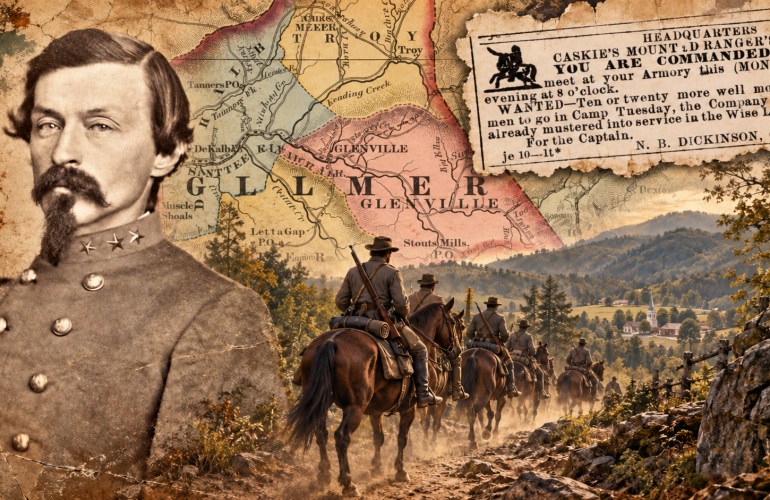
Captain Robert A. Caskie led his Mounted Rangers on a grueling expedition into Gilmer County in July 1861, where they spread alarm among local unionists and skirmished with Ohio troops outside Glenville. This overlooked episode of the Civil War in western Virginia reveals how this small company of Wise Legion cavalry gained its first campaign experience before joining the 10th Virginia Cavalry.
Caskie’s Mounted Rangers formed in the spring of 1861 under a different name. John J. Fry, superintendent of the City Gas Works, organized a cavalry company in Richmond in late April 1861, shortly after Virginia’s Secession Convention voted to repeal the state’s ratification of the U.S. Constitution. Calling themselves “Fry’s Mounted Rangers,” the men were sworn into state service at Richmond’s Broad Street Hotel. On May 3, however, they elected Robert A. Caskie captain in Fry’s place. Fry went on to become captain of the Gas Works Guard.
Robert Alexander Caskie was born in 1830 into a wealthy merchant family. His father, John Caskie, was a Scottish immigrant who made a fortune in the tobacco business and served as president of the Richmond Tobacco Exchange. Robert graduated from the University of Virginia and married Amanda Wallace Gregory, daughter of prominent jurist John Munford Gregory, who briefly served as acting governor of Virginia in 1842. The couple settled in Richmond, where Robert served as quartermaster of the antebellum militia company the Richmond Grays.
Caskie’s Mounted Rangers were mustered into Confederate service on June 9, 1861, as part of the Wise Legion. Henry Alexander Wise (1806–1876) was a Virginia lawyer and politician who served in the U.S. House of Representatives from 1833 to 1844 and as governor of Virginia from 1856 to 1860. As governor, Wise oversaw John Brown’s imprisonment, trial, and execution following his raid on the federal arsenal at Harpers Ferry.
As the Virginia Convention debated secession, Wise organized his own armed seizure of the arsenal by Virginia militia. Despite having no military experience, he was commissioned a brigadier general by Provisional Confederate President Jefferson Davis and authorized to raise a force to defend western Virginia’s Kanawha Valley. That force became known as the Wise Legion.
Among the troops accompanying Wise into the Kanawha Valley were Caskie’s Rangers and the Richmond Light Infantry Blues, commanded by Wise’s eldest son, Obadiah Jennings Wise (1831–1862). They reached Charleston on June 26. With his devilish goatee, Captain Caskie cut a dashing figure. He soon began helping Wise round up “traitors” to the Confederate cause, a policy that proved counterproductive in a region with a large unionist population.
At the beginning of July, Caskie’s Mounted Rangers numbered about 54 men under arms. Alongside Caskie, the company’s senior leadership included 1st Lt. Louis J. Hawley, 2nd Lt. William V. Mott, 3rd Lt. Mark A. Tyndall, and Sergeants James L. Capston, J. Shelly Van Horn, and John Doyle. Irish and German immigrants made up a large share of the company. In 1863, while serving as Confederate secretary of state, Judah P. Benjamin appointed Capston, then a lieutenant, as a special agent to Ireland.
Sometime around the first of July, Caskie and his rangers rode north with several unidentified companies, a force of 160-260 men in all. They followed the road through Spencer and Arnoldsburg, now U.S. Route 119, toward Glenville, the seat of Gilmer County, approximately 89 miles away. Obadiah Jennings Wise and the Richmond Light Infantry Blues departed on a separate mission to Ripley and Ravenswood.
The lack of Confederate sources makes Caskie’s mission difficult to determine. Was he trying to locate George McClellan’s army, which had recently occupied Buckhannon and was confronting Brig. Gen. Robert S. Garnett’s forces at Rich Mountain and Laurel Hill? Or was he there to support local secessionists against their unionist neighbors? Perhaps both? There was little a force of that size could be expected to accomplish.
The 178-mile round trip meant the expedition would be gone for at least a week and would need supply wagons, further slowing its progress through the remote, mountainous terrain.
One correspondent wrote in the Richmond Daily Dispatch:
“I must say, nothing has been said about them [Caskie’s Rangers] since their departure from Richmond; but I venture to say they have done more marching and stood more fatigue and hardship than any other company in the war … They led the expedition to Glenville with other companies, numbering in all 260 men, commanded by Capt Caskie. On their return to Charleston, they took an active part in harassing and annoying General Coxe’s outpost and pickets.”
Other newspaper reports indicate that the presence of Caskie’s expedition, and possibly local secessionist militia, was sowing panic among Gilmer County unionists and causing some to flee to neighboring Ritchie County. Following the Convention’s secession vote, civil order broke down in Gilmer. Mail service stopped, and the court closed. On July 8, 1861, the Richmond Daily Dispatch noted, “We have nothing further from Gilmer, where at last accounts civil strife was going on very actively.”
Coincidentally, around the time Caskie’s expedition reached Gilmer County, McClellan was making plans to send his own troops to secure the county seat. On July 6, he wrote from Buckhannon to headquarters: “Six companies are to occupy California, the county seat of Roane; four to hold Wirt County Court-House; six companies, Glenville; two, Weston; eight, Bulltown; four Frenchtown; two, French Creek.” Four companies from the 17th Ohio Infantry ultimately occupied Glenville under Lt. Col. Francis B. Pond.
On Sunday, July 7, Pond’s skirmishers clashed with Caskie’s men on the outskirts of Glenville. Because the Buckeyes outnumbered them, the Confederates avoided a direct attack. Caskie’s men instead formed a loose ring around the town and continued the low-intensity bush fight. Detailed and reliable accounts are difficult to find, but the fighting evidently continued into the next day.
Pond managed to get a scout through to Buckhannon, prompting McClellan to send the 7th and 10th Ohio regiments to relieve his command. Facing the prospect of overwhelming numbers and with no reinforcements in sight, the Confederates hastily withdrew. No casualties were reported on either side.
Although it is unclear when Caskie’s expedition returned to Charleston, the Mounted Rangers did not participate in the Battle of Scary Creek on July 17, despite some reports to the contrary.
Following McClellan’s victory over Garnett in northwestern Virginia and the occupation of Cheat Mountain, Robert E. Lee advised Wise to withdraw to Covington in Alleghany County. The Wise Legion began evacuating Charleston on July 24. According to at least one letter published in the Richmond Dispatch, Caskie’s Mounted Rangers served as the rearguard. They attempted to destroy the large wire suspension bridge spanning the Elk River west of town but managed only to damage it.
Two days later, the entire Confederate force encamped near Gauley Bridge before burning the bridge behind them as well. Caskie and his rangers were sent south across the Kanawha River to patrol the road to Fayette Court House. Though they did more marching than fighting during their first campaign, Caskie’s Mounted Rangers gained valuable experience that would serve them well as Company A of the 10th Virginia Cavalry. Despite suffering multiple wounds, Robert A. Caskie rose to the rank of colonel and survived the war.
Sources
Caskie, Jaquelin A. The Caskie Family of Virginia. By the author, 1928.
The Cleveland Leader (Cleveland, OH) 22 July 1861.
Daily Intelligencer (Wheeling, VA) 18 July 1861.
Driver, Robert J. Jr. 10th Virginia Cavalry. H.E. Howard, Inc., 1992.
Gainer, Rosemary Layman. The Civil War in Gilmer County, West Virginia. Red Clay Press, 1991.
Lowry, Terry. The Battle of Scary Creek: Military Operations in the Kanawha Valley April – July 1861. Quarrier Press, 1998.
Matheny, Herman E. Major General Thomas Maley Harris. McClain Printing Company, 1963.
Richmond Dispatch (Richmond, VA) 6 May 1861.
Richmond Dispatch (Richmond, VA) 5 July 1861.
Richmond Dispatch (Richmond, VA) 8 July 1861.
Richmond Dispatch (Richmond, VA) 8 August 1861.
Simpson, Craig M. A Good Southerner: The Life of Henry A. Wise of Virginia. University of North Carolina Press, 1985.
The War of the Rebellion: A Compilation of the Official Records of the Union and Confederate Armies. Series I, Vol. II. With additions and corrections. Washington: Government Printing Office, 1902.


One thought on “Caskie’s Mounted Rangers in the 1861 Kanawha Campaign”