
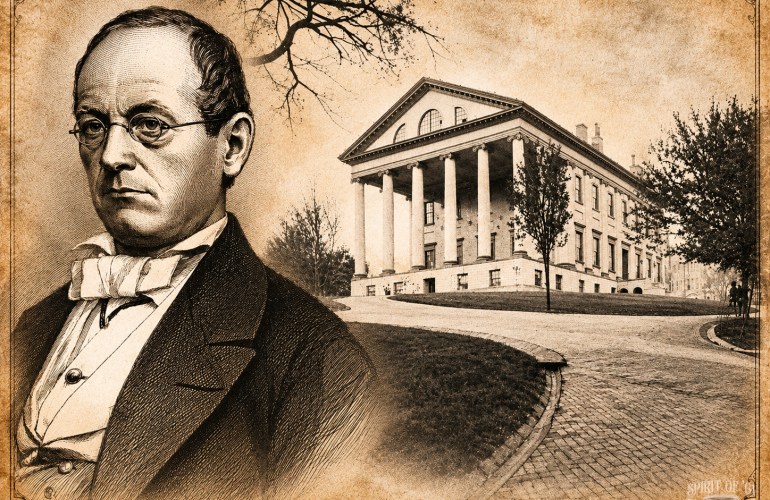
On January 7, 1861, with South Carolina declaring itself out of the Union and Abraham Lincoln not yet in office, Virginia Governor John Letcher addressed the General Assembly on the growing sectional crisis. He blamed Northern hostility to slavery for undermining constitutional obligations and destroying trust between the sections. “For the present condition of public affairs, the non-slaveholding states are chargeable,” he declared, insisting that they would bear responsibility if the Union collapsed.
Letcher’s complaints were specific. Northern states had obstructed the recovery of fugitive slaves, refused to surrender participants in the Harpers Ferry raid, and tolerated sympathy for John Brown. Efforts to exclude slavery from the territories threatened to weaken Southern influence in the federal government, while Lincoln’s election raised the prospect of an administration committed to slavery’s eventual extinction. Letcher saw these developments as evidence of a “systematic and persistent warfare upon the institution of domestic slavery.”
Virginia, however, had interests of her own and should not surrender her judgment to the cotton states. Letcher criticized South Carolina for seceding without first securing a common Southern policy. He also condemned proposals to restrict slave sales from border states that remained in the Union, recognizing them as an attempt to force Virginia and her neighbors into disunion. Shared interests in slavery did not entitle South Carolina to dictate Virginia’s course. “Our action should be based upon the wrongs done to our own people,” he insisted.
He believed Virginia’s position gave her an opportunity to mediate between the sections. With “immense interests, valuable and important, at stake,” the commonwealth should pursue a settlement that protected her citizens, property, and institutions. Letcher opposed calling a state convention at that time, seeing no immediate practical benefit. Instead, he recommended legislative action, commissioners to other states, and a national convention under Article V to negotiate constitutional amendments. The duty to exhaust constitutional remedies before resorting to “the ultimate remedy of secession,” he argued, was imperative.
The settlement he envisioned required extensive guarantees for slavery. Northern states should repeal laws obstructing the recovery of fugitive slaves and surrender fugitives from justice. Slavery must receive protection in the District of Columbia, and neither Congress nor territorial legislatures should be permitted to prohibit it in existing or future territories. “Our equality in the states and territories must be fully recognized,” he demanded, “and our rights of person and property adequately protected and secured.”
Letcher also sought protection for the transportation of slaves, punishment for Northerners who supported armed raids into slaveholding states, and restrictions on federal appointments that might encourage opposition to slavery within the South. He praised the Union’s growth and prosperity and presented these guarantees as a means of resolving the sectional controversy and restoring confidence in the federal government.
His preference for negotiation also had a firm limit. Letcher upheld secession as a right and rejected federal coercion of a seceded state. Any attempt to move federal troops across Virginia for that purpose would constitute “an act of invasion, which should be met and repelled.” The allegiance of Virginians belonged to their state, and he expected them to defend her when called upon.
Even as he urged constitutional remedies, Letcher contemplated a broader political reorganization. If the sections could not reconcile, a national convention could arrange a peaceful separation. He speculated that shared commerce and geography might draw border slave states and portions of the free North into a common confederacy. More pointedly, he proposed that New England and western New York “be sloughed off,” allowing the remaining states to reconstruct their union on terms that protected slavery and restored domestic peace.
Whatever political arrangement emerged, Virginia should strengthen her own position through direct trade between Norfolk and Europe and the expansion of her railroad connections. Her prosperity should not be sacrificed to sectional conflict. Letcher’s caution about immediate secession rested on an uncompromising defense of slavery and Virginia’s sovereignty. He remained willing to seek a settlement, but the Union he hoped to preserve, or reconstruct, would have to secure both.
Sources
Journal of the House of Delegates of the State of Virginia, for the Extra Session, 1861. William F. Ritchie, Printer, 1861.
Richmond Whig (Richmond, VA) 8 January 1861.
Pitcaithley, Dwight T. Virginia Secedes: A Documentary History. The University of Tennessee Press, 2024.


