
In the summer of 1861, Hampshire County, Virginia, became a battleground in the struggle to control the vital Baltimore & Ohio Railroad. Confederate cavalry raided bridges and rail lines from Romney to New Creek while Union troops fought to keep open this critical transportation link between Washington, DC, and the West.
On the eve of the Civil War, Hampshire County, Virginia, included the modern-day counties of Hampshire and Mineral, West Virginia. It stretched 974 square miles from Timber Ridge west to the North Branch of the Potomac River and the Maryland border. This sparsely populated corner of Virginia’s Potomac Highlands might have escaped the attention of Civil War armies altogether were it not for the important transportation routes that passed through and around it.
From May to July 1861, Confederates attempted to disrupt operations on the Baltimore & Ohio (B&O) Railroad and Chesapeake and Ohio Canal, hoping to isolate the U.S. capital from states west of Washington. Hampshire County took center stage in that effort.
The B&O Railroad had good reason to worry about the safety of its property. On May 28, secessionists burned the covered railroad bridges over Patterson’s Creek in northern Hampshire County, along with the pump house and the 131-foot span over the canal at North Branch. In response, a small company of Maryland Home Guard was sent to protect Bridge No. 21 over the North Branch of the Potomac River, opposite what was then known as Paddy Town, twenty miles southwest of Cumberland, Maryland.
Cumberland, population 4,078, marked the starting point of the National Road, America’s first east-west interstate toll road, and the terminus of the Chesapeake and Ohio Canal, which followed the Potomac River from Washington, DC. The town was also an important station on the B&O Railroad. Coal, iron, and other raw materials flowed from western Maryland and Virginia through Cumberland to cities along the eastern seaboard.
Winfield Scott tapped Colonel Lewis “Lew” Wallace and his 11th Indiana Volunteer Regiment to guard Cumberland and counter rebel activity in the area. On the night of June 11, Wallace and most of his regiment took a circuitous route to Romney, the Hampshire County seat, where Virginia Col. Arthur C. Cummings was gathering recruits for his own Confederate regiment. They arrived the following morning and routed Cummings and his volunteers in a bloodless victory.
June 6, 1861 Orders to Col. Lewis Wallace, 11th Indiana Infantry
“SIR: I am instructed by Major-General Patterson to direct you to halt your forces at Cumberland, securing the bridges over the Potomac and Green Spring Run, respectively, five and fifteen miles upon this side, and there to await further orders from him. … Should you gain information of the gathering, for offensive movements, of armed bodies of men not too powerful to be overcome by a force you can safely detach, capture or rout them by surprise, if possible, and seize and hold as prisoners of war all parties injuring the lines of communication, or arrayed or plotting against the peace of the United States …”
O.R., Vol. I, Part II, pg. 668
In response, Brig. Gen. Joseph E. Johnston, commanding Confederate forces in the Shenandoah Valley, sent Col. Ambrose Powell Hill with three infantry regiments to reoccupy Romney. In the early morning hours of Wednesday, June 19, a detachment from Hill’s brigade moved on Paddy Town, dispersed the Home Guard, destroyed Bridge No. 21, tore up the tracks, and cut the telegraph wires.
Earlier that month, General Robert E. Lee ordered Col. Angus W. McDonald to report to General Johnston with his cavalry regiment and tasked him with disrupting the B&O Railroad, including destroying the Tray Run Viaduct over the Cheat River near Rowlesburg. The 1852 wrought-iron bridge could not be replaced as easily as the smaller wooden bridges along the line. Success would secure Johnston’s left flank and sever the rail link between Washington, DC, and the northwestern states.
ADJUTANT AND INSPECTOR GENERAL’S OFFICE,
Richmond, June 4, 1861.Col. ANGUS W. MCDONALD, Richmond, Va.:
SIR: You will proceed to Harper’s Ferry, and report to General Joseph E. Johnston. With such troops of horse as he can spare from his command and such as you may raise as have not yet been mustered into service, you will then with this force proceed to the Cheat River Bridge, and if practicable destroy the same, and as much of the road, bridges, and tunnels as you can accomplish.
Very respectfully, your obedient servant,
S. COOPER,
O.R., Vol. I, Part II, pg. 904
Adjutant and Inspector General.
June 7, 1861 Letter from Robert E. Lee to Joseph E. Johnston
“General R. S. Garnett, C. S. Army, with a command of four thousand men, has been directed to Beverly, to arrest the progress of troops towards the Shenandoah Valley. Col. Angus W. McDonald has also been sent to interrupt the passage of troops over the Baltimore and Ohio Railroad. It is hoped by these means that you will be relieved from an attack in that direction, and will have merely to resist an attack in front from Pennsylvania.”
O.R., Vol. I, Part II, pg. 910
The same day Bridge No. 21 burned, McDonald’s Confederate cavalry arrived in Romney to relieve A.P. Hill. On the way, a detachment of McDonald’s regiment destroyed the unguarded railroad bridge over the Little Cacapon River in northeastern Hampshire County. Hill’s infantry departed two days later.
Their task would not be easy. Rowlesburg lay 67 miles west of Romney, was heavily guarded by Maj. Gen. George B. McClellan’s infantry, and sat in a predominantly unionist area.
In early July, Wallace and his regiment were ordered to join Maj. Gen. Robert Patterson’s army in the Shenandoah Valley north of Winchester. The 13th and 5th Pennsylvania Reserve Regiments, along with Battery A, 1st Pennsylvania Artillery, all under the command of Col. Charles J. Biddle, advanced to protect Cumberland and the surrounding area.
On Friday, July 12, Biddle received word that McDonald’s Confederates had destroyed train cars and two trestle bridges over George’s Creek on the Maryland side of the Potomac, north of Piedmont, Virginia. A network of industrial railroads linked Cumberland with Piedmont through western Maryland’s coal fields. Biddle advanced his regiments to the ruins of Bridge No. 21, then sent several companies to occupy Piedmont, preceded by Lt. Col. Thomas L. Kane and sixty dismounted scouts.
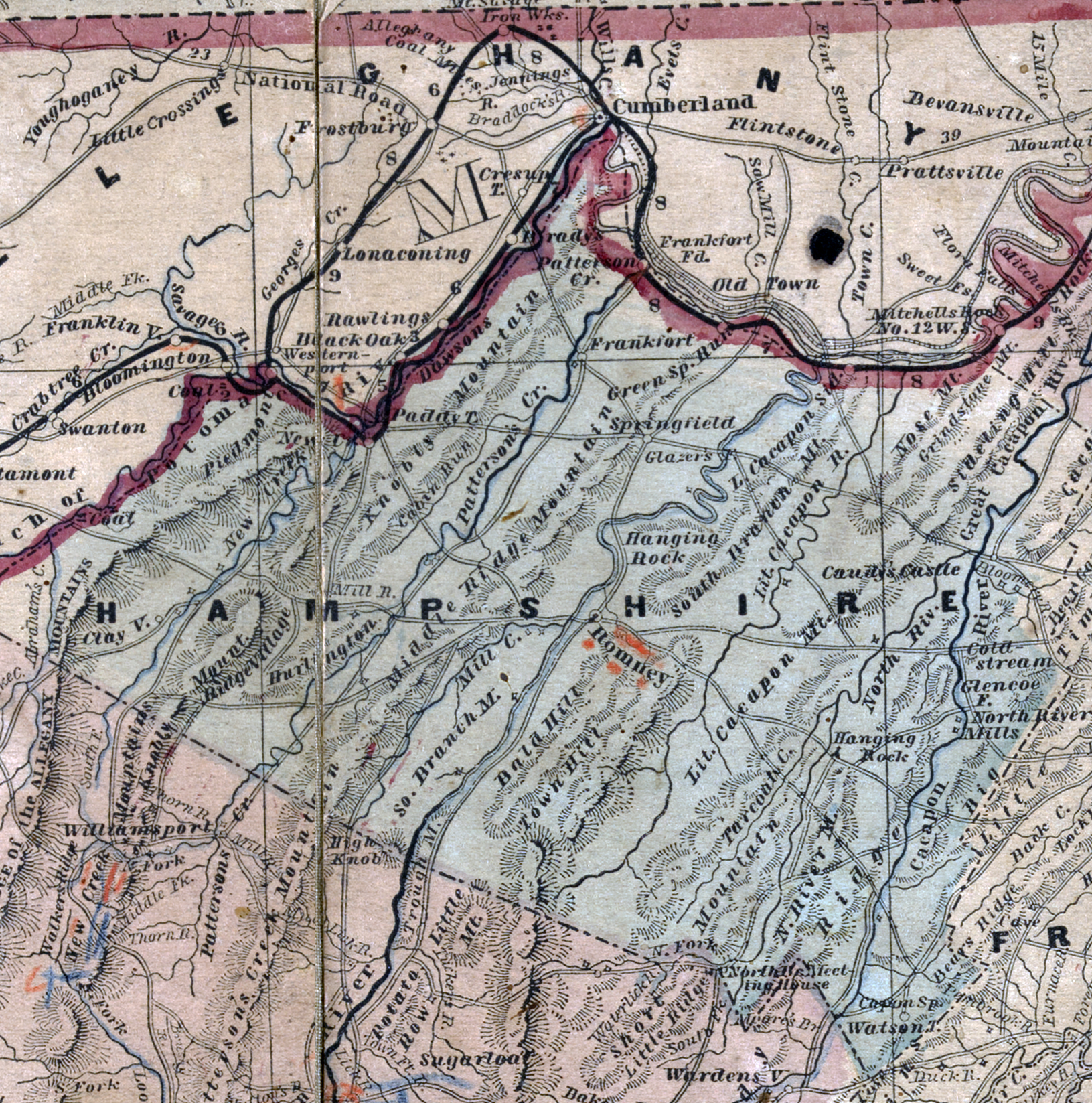
After passing through Piedmont, Kane and his scouts skirmished with a detachment of Confederate cavalry near New Creek Depot and pursued them along the Northwestern Turnpike toward Romney. Biddle hurried reinforcements to the scene, but rather than continue the advance on Romney, they withdrew to New Creek Station and then to Piedmont.
Confederate success in disrupting the B&O Railroad in the area proved short-lived. Between May and August, they destroyed or damaged several railroad bridges in and around Hampshire County, but most were quickly repaired. Bridge No. 21 reopened on July 25, restoring uninterrupted rail service between Wheeling and Cumberland.
By then, George B. McClellan had driven Confederate forces from northwestern Virginia, from the Ohio River to Cheat Mountain, while several regiments guarded the Tray Run Viaduct near Rowlesburg. With the viaduct securely protected, McDonald could no longer carry out his principal objective.
On July 17, Brig. Gen. Joseph E. Johnston ordered McDonald to withdraw his entire regiment to Winchester, abandoning the Romney area. McDonald’s cavalry screened Johnston’s march toward Manassas but did not take part in the battle there. Ten days later, Biddle’s brigade of Pennsylvania Reserves also departed, ordered back to Harrisburg in the aftermath of Bull Run. For the time being, at least until autumn, the B&O Railroad was no longer threatened.
Sources
Armstrong, Richard L. 7th Virginia Cavalry. H.E. Howard, Inc., 1992.
Avirett, James B. The Memoirs of General Turner Ashby and His Compeers. Selby & Dulany, 1867.
Bates, Samuel P. History of Pennsylvania Volunteers, 1861-5. B. Singerly, State Printer, 1869.
Haselberger, Fritz and Mark. “The Burning of the 21st Bridge at New Creek.” West Virginia History 27 (October 1965): 56-64.
Lowdermilk, William H. History of Cumberland, (Maryland) from the Time of the Indian Town, Caiuctucuc, in 1728, Up to the Present Day. James Anglim, 1878.
Sauers, Richard A. The Devastating Hand of War: Romney, West Virginia During the Civil War. Gauley Mount Press, 2000.
Scharf, J. Thomas. History of Western Maryland: Being a History of Frederick, Montgomery, Carroll, Washington, Allegany, and Garrett Counties, Vol. II. Louis H. Everts, 1882.
Stephens, Gail. Shadow of Shiloh: Major General Lew Wallace in the Civil War. Indiana Historical Society Press, 2010.
Stover, John F. History of the Baltimore and Ohio Railroad. Purdue University Press, 1995.
Summers, Festus P. The Baltimore and Ohio in the Civil War. Stan Clark Military Books, 1993.
Thirty-Fifth Annual Report of the President and Directors to the Stockholders of the Baltimore and Ohio Railroad Company, for the Year Ending September 30, 1861. William M. Innes, 1863.
Thomson, Osmund R. H. and William H. Rauch. History of the “Bucktails” Kane Rifle Regiment of the Pennsylvania Reserve Corps. Electric Printing Company, 1906.
The War of the Rebellion: A Compilation of the Official Records of the Union and Confederate Armies. Series I, Vol. II. With additions and corrections. Washington: Government Printing Office, 1902.


