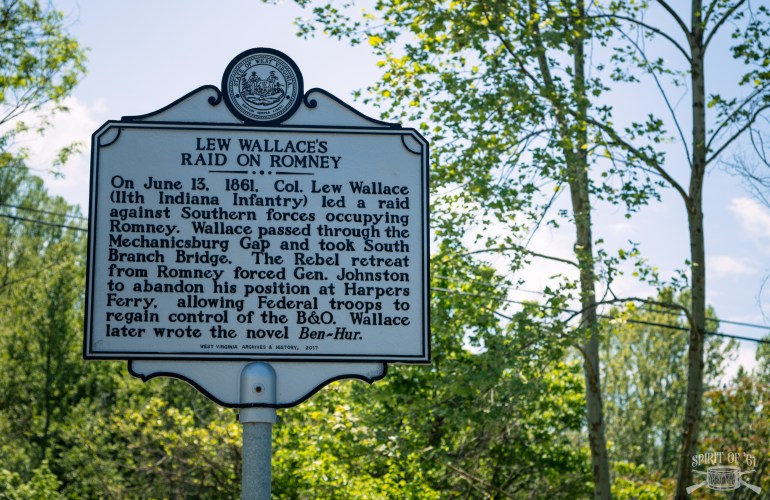
The story is one we are familiar with. Shortly after arriving at Cumberland, Maryland on the Potomac River and Baltimore & Ohio Railroad in June 1861, Col. Lewis “Lew” Wallace and his Eleventh Indiana Infantry Regiment marched all night to route a smaller Confederate force at what is today Romney, West Virginia in a bloodless victory.
I finally got my hands on Fritz Haselberger’s 1966 article “Wallace’s Raid on Romney in 1861” in the West Virginia History journal, and in it, he devotes several paragraphs to pinpointing the exact date Lew Wallace’s raid occurred. He contends it happened on Wednesday, June 12, 1861, not on Thursday, June 13 as widely reported.
After carefully reviewing the available sources, I conclude that Haselberger is correct.
The confusion was created by Wallace himself shortly after the event occurred. In his official report, dated June 14, he writes: “I left Cumberland at 10 o’clock on the night of the 12th instant … A little after 4 o’clock I started my men across the mountains, twenty-three miles off, intending to reach the town by 6 o’clock in the morning.” In other words, he left Cumberland the night of June 12 and reached Romney on the morning of the 13th.
However, in his memoir, published in 1906, Wallace unequivocally states that they began their trek to Romney the afternoon of their arrival in Cumberland, reaching the town the next morning.
In their June 13, 1861 issue, the Cumberland Civilian and Telegraph confusingly informs their readers that the Eleventh Indiana Regiment “arrived here early on Monday morning,” [June 10] then concludes “The whole Regiment, on Tuesday morning, marched down Baltimore street…” [June 11]
Wallace’s memoir explains that on arriving at Cumberland by rail, he and Lt. Col. George F. McGinnis joined the town’s mayor in looking for a suitable camp site. They left two companies in Cumberland, then the remainder of the regiment took the train back to New Creek Station that afternoon, where they began their foot march to Romney.
A letter from Lt. Col. McGinnis, dated June 13, appeared in the June 26 issue of the Indiana State Sentinel. He writes: “On Tuesday we went into camp … We started on Tuesday night [June 11] about 9 o’clock, traveled about 20 miles by rail and marched about 23 miles and got to the neighborhood of Romney about 7 ½ o’clock [June 12].”
A detailed letter from a “High Private” also published in the Indiana State Sentinel on the same day, also dated June 13, corroborates this timeline of events. After arriving in Cumberland, he wrote, “We had some difficulty in procuring a suitable camp and were engaged all day Monday [June 10] in searching for a place.” That night they slept in the train cars after detouring to “Newburg” [New Creek?] due to an erroneous report that secessionists were planning to burn the bridge. McGinnis also mentioned that detour.
He went on to say, “We came back to Cumberland, cooked our breakfast, and at 7 o’clock formed into battalion and marched through the city to a beautiful cedar and pine grove on the mountain side, overlooking the city, where we pitched our tents and prepared our camp.” Then, “On Tuesday evening while we were consoling ourselves with the sweet prospect of a good night’s rest, we were called into ranks and proceeded to march to the scene of our first skirmish.”
So the Cumberland Civilian and Telegraph was correct. The Eleventh Indiana did briefly enter Cumberland on Monday, June 10, but then detoured and returned the next day, Tuesday, June 11. The regiment marched through town, made camp, then eight companies boarded the train cars again and began their journey to New Creek and hence to Romney.
The Charleston Daily Courier, June 22, 1861, reprinting an article published in the Winchester Virginian, explained that William Harper, publisher of the Romney South Branch Intelligencer, came into Winchester Wednesday evening [June 12] “and communicated the startling intelligence that Lincoln’s troops … marched into Romney Wednesday morning and took possession of the town.”
We also have a report from Maj. Gen. Robert Patterson, dated June 12, 1861, stating “I yesterday notified you of the occupation of Cumberland by the Indiana regiment under Colonel Wallace,” and a report from Wallace, written in Cumberland on June 11, stating “Your dispatches, by hand of Jerome Closson, were delivered to me by him this morning, shortly after my arrival.”
So we can confidently conclude that Wallace and the Eleventh Indiana “officially” reached Cumberland on Tuesday, June 11, began their march to Romney that evening, and arrived the next morning, Wednesday, June 12. Wallace, who probably had gotten very little sleep over the preceding days, was mistaken in his report of the 14th, creating decades of confusion that has appeared in subsequent books and signage.
Sources
Charleston Daily Courier (Charleston, SC) 22 June 1861.
Civilian and Telegraph (Cumberland, MD) 13 June 1861.
Haselberger, Fritz. “Wallace’s Raid on Romney in 1861.” West Virginia History 27 (January 1966): 97-110.
Indiana State Sentinel (Indianapolis, IN) 26 June 1861.
Wallace, Lewis. Lew Wallace: An Autobiography, Vol. I. New York: Harper & Brothers, 1906.
The War of the Rebellion: A Compilation of the Official Records of the Union and Confederate Armies. Series I, Vol. II. With additions and corrections. Washington: Government Printing Office, 1902.


