Largely forgotten today, Thornsbury Bailey Brown, a Virginian, was among the first Union casualties of the Civil War.
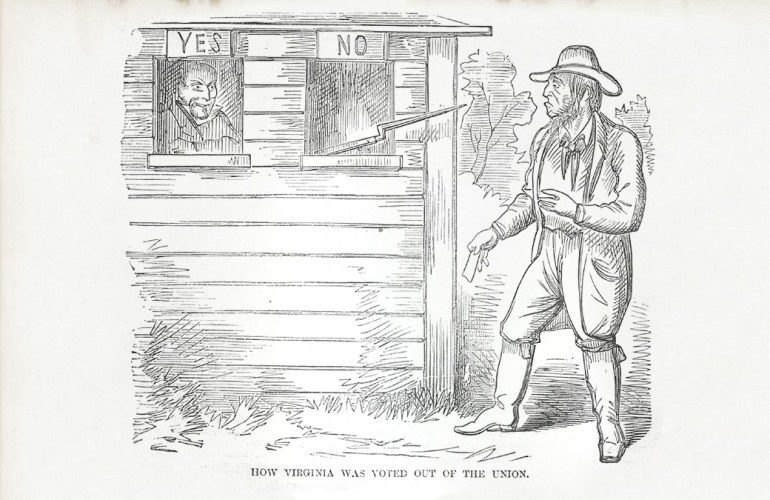
On April 17, 1861, delegates at the Virginia Secession Convention voted in favor of secession, 88 to 55, and set a date of May 23rd to hold a popular referendum on the issue. East of the Allegheny Mountains, popular sentiment was overwhelmingly in favor of secession, but west of the Alleghenies, a large percentage of the public wanted to remain with the Union.
In Taylor County, the Baltimore & Ohio Railroad and Northwestern Virginia Railroad strategically came together in the town of Grafton, along the Tygart Valley River. Taylor County’s population was so bitterly divided over the secession question that its young men formed opposing militias. Tensions threatened to boil over at any moment.
When Virginia Col. George A. Porterfield arrived in Grafton to organize state militia in northwestern Virginia on behalf of the secession government in Richmond, no one was there to greet him. He was directed to Fetterman, a small town north of Grafton.
It was there that John A. Robinson (1830-1898), a merchant and postmaster, organized the Letcher Guard, named after Virginia Governor John Letcher, in early May 1861. Thirty-two men mustered in at Fetterman for a period of one year on May 13, 1861.
Grafton was predominantly unionist in sentiment. Around the same time pro-secession forces were organizing in Fetterman, attorney and newspaper publisher George R. Latham (1832-1917) organized the Grafton Guards in answer to President Abraham Lincoln’s call for volunteers to put down the rebellion.
On the night of May 22, 1861, three members of the Letcher Guard: George E. Glenn, Daniel W. S. Knight, and William Reese, were on picket duty along the Northwestern Turnpike at Fetterman Bridge over the Tygart Valley River. Lt. Daniel Wilson and Thornsbury Bailey Brown were returning from a recruiting rally for the Grafton Guards in nearby Pruntytown when they attempted to cross the bridge.
The pickets ordered them to halt, but they ignored the warning. According to some accounts, Brown fired his pistol and struck Knight in the ear. The pickets returned fire, killing Brown. Daniel W. S. Knight was accused of firing the fatal shot, and was later formally charged with Brown’s murder, though he was acquitted.
Col. Porterfield at first refused to return Brown’s body, and Brown’s enraged comrades organized to take it by force. As they were marching toward Fetterman, however, they met a small party transporting Brown back to Grafton. Porterfield must have realized that his own militia was ill-prepared for a fight.
The Grafton Guards were not formally sworn into federal service until May 25th, but Thornsbury Bailey Brown is widely considered to be the first Union soldier killed in combat during the Civil War.
On the eve of the secession referendum, Brown’s death inflamed unionist sentiment in the northwestern Virginia. One newspaper editorialized:
“Are the people of Northwestern Virginia to stand this sort of thing? Are they to see their Union brethren shot down by marauding murderers, and forever remain powerless to avenge their blood? No! Never! Let the Union men prepare at once to meet the villainous traitors, and drive them from our midst.”
The Wheeling Daily Intelligencer, 25 May 1861.
And drive them they did, although the Grafton Guards were not among the initial push into Northwestern Virginia. They were attached to Brig. Gen. Thomas A. Morris as a bodyguard and fought at the battles of Laurel Hill and Corrick’s Ford.


