In July 1861, Union troops pushed south from Cumberland into Virginia to secure the vital B&O Railroad corridor around New Creek and Piedmont. Their advance erupted into a deadly clash at New Creek Station, where Confederate cavalry charged a fortified stone house before retreating into the mountains, setting off a pursuit that carried the fighting toward Romney.
Since early June 1861, Col. Lewis “Lew” Wallace and his 11th Indiana Infantry Regiment had been guarding the strategic transportation hub of Cumberland, Maryland. His regiment had skirmished with Confederate forces in the area without a decisive result. When Wallace’s regiment departed on July 7, Cumberland and key points along the Baltimore & Ohio Railroad were left dangerously exposed.
The 13th and 5th Pennsylvania Reserve Regiments, along with Battery A of the 1st Pennsylvania Artillery, were encamped at Camp Mason & Dixon just north of the Maryland border, unable to advance while state officials debated the constitutionality of Pennsylvania troops entering Maryland.
At the request of General Winfield Scott, Pennsylvania Governor Andrew Curtin finally ordered them to cross the border and protect Cumberland. Because they fell under the Military Department of Pennsylvania, Maj. Gen. Robert Patterson retroactively approved the move by issuing orders to Cumberland on July 8, after the Pennsylvania troops had already arrived.
The 13th Pennsylvania Reserve Regiment, nicknamed the “Bucktails” for the deer tails worn on their hats, was commanded by Col. Charles J. Biddle and was later redesignated the 42nd Pennsylvania Volunteer Infantry. They reached Cumberland late on the same evening Wallace’s regiment departed and slept on their arms, prepared for an attack that never came. The next morning, they occupied the Hoosiers’ former campsite.
Thirty-nine-year-old Thomas L. Kane organized the regiment during the spring and early summer of 1861. The men mustered into state service on June 21. Kane recruited heavily among the woodsmen of northwestern Pennsylvania’s “wildcat district.” The regiment initially elected Kane as colonel and Charles J. Biddle as lieutenant colonel, but Kane voluntarily exchanged ranks with Biddle in recognition of his previous military experience.
Shortly after arriving in Cumberland, Kane organized a corps of sixty dismounted scouts and placed himself at its head. Like Confederate cavalier Turner Ashby, Kane viewed himself as both a gentleman and a knightly Christian soldier, leading by personal example. The Bucktail scouts borrowed rifles from the Cumberland home guard because, in Harrisburg, they had been forced to exchange their often superior privately owned firearms for obsolete 1837 Harper’s Ferry muskets.
On Friday, July 12, Col. Biddle received word that Confederates had destroyed train cars and two trestle bridges over George’s Creek on the Maryland side of the Potomac, north of Piedmont, Virginia. A network of industrial railroads linked Cumberland with Piedmont through western Maryland’s coal fields, west of Dans Mountain. Biddle dispatched Kane and his scouts through the Cumberland Narrows aboard the Cumberland & Pennsylvania Railroad to the tunnel beneath Frostburg. From there, they followed the Georges Creek Railroad south, stopping a few miles north of Piedmont to spend a fitful night in an old stone grist mill.
Piedmont had recently emerged as an important station on the B&O Railroad, complete with a roundhouse and rail yard. The town occupied a bend in the North Branch of the Potomac opposite the mouth of Georges Creek. Across the river stood Westernport, Maryland, so named because it marked the westernmost navigable port on the Potomac. South of town, the foothills of the Allegheny Front rose more than 1,000 feet above the valley.
Early the next morning, Biddle moved his regiment and the 5th Pennsylvania Reserves, commanded by Col. Seneca G. Simmons, twenty miles south by rail along the B&O Railroad. The troops disembarked at the ruins of Bridge No. 21. From there, Companies H and I of the Bucktail Regiment marched to New Creek Station, where they captured a wagon loaded with provisions.
After crossing the river into Piedmont, Kane led about forty men, accompanied by a guide from Cumberland named William Kelly, five miles along the south bank of the Potomac to New Creek. As they advanced beneath the forested escarpments lining the narrow valley, many suspected Confederate cavalry lurked around every bend. Kane dispatched a sergeant on horseback back to Piedmont to summon Capt. Edward A. Irvin and ten men, leaving the sergeant and the remaining scouts to guard the town. Reinforced to fifty men, Kane entered New Creek and relieved Companies H and I, which then returned to their regiment.
That night, Kane and his men took shelter in a stone house owned by William Armstrong southwest of the train station, while their guide slept on the station platform. Armstrong’s house, a longtime local landmark, was located on the site of the old Keyser High School, just west of the intersection of Piedmont and Davis streets.
Armstrong’s son, Edward McCarty Armstrong, had been one of Hampshire County’s two delegates to the Virginia Convention in Richmond. Although he voted against secession, he cast his lot with the Confederacy once the issue was settled. He was captain of the pre-war Hampshire Riflemen militia, but when he called the company to muster, most of the men refused due to unionist sympathies. He disbanded the company, and its lieutenant, George F. Sheetz, organized a new company composed of men loyal to the Confederate cause.
Just before sunrise on July 14, Confederate Capt. Macon Jordan’s company, from Page County, Virginia, joined by detachments of the Letcher Brock’s Gap Rifles and Capt. Walter Bowen’s Mountain Rangers, rode into New Creek from the direction of Piedmont with a combined force of roughly eighty-five to one hundred men. They belonged to Col. Angus McDonald’s 7th Virginia Cavalry Regiment.
Private Richard Black of the Brock’s Gap Rifles dramatically spurred his horse onto the station platform, killed the civilian guide, William Kelly, and took another man prisoner.
Hearing the commotion, Kane sent a squad to investigate. The Bucktails concealed themselves in a meadow of tall grass, fired several shots at Jordan’s troopers, then fell back to the stone house. Describing the actions of a private from Company I, the McKean Rifles, commanded by Capt. William Blanchard, the Civilian and Telegraph reported: “Jim had fired and dropped his man, and after loading and taking aim found his piece would not go off. He therefore retreated a short distance, followed up by the enemy, and sat down to prick powder into the tube of his gun, while the bullets whistled round him.”
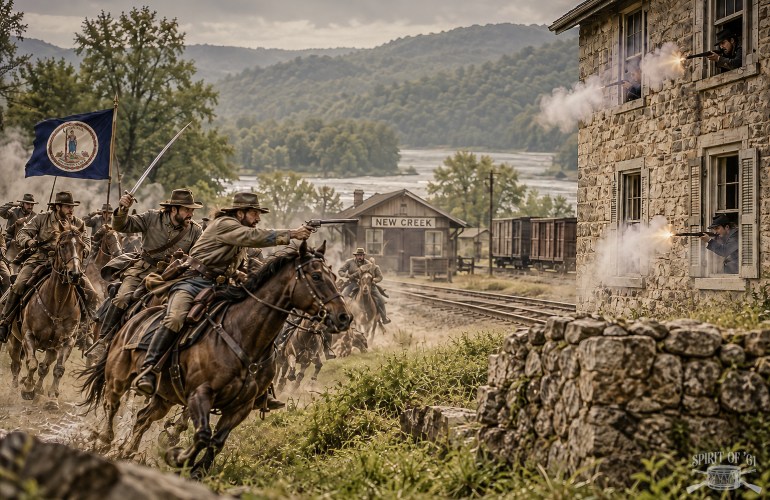
The Confederate cavalry formed up and charged, but the Bucktails, renowned for their marksmanship, unleashed a deadly volley from the windows. “The Page boys jumped the fence, charged, and drove them to a large brick house. From the doors, windows, and cupalo [sic], a deadly fire was directed at our brave fellows…” Lieutenant Reuben L. Booten, Pvt. William L. Miller, and two horses were killed, while an unknown number were wounded. A “Private Bosley” was also reportedly killed, but his identity has never been verified. The casualties were buried in Armstrong’s yard.
“They came up in fine order, but broke and ran on receiving a fire which was reserved till they were ready to dismount,” Kane later wrote. The Confederate raiders retreated south, with Kane and his men in pursuit. About eight miles down the Northwestern Turnpike towards Romney, east of the small village of Ridgeville, the two sides briefly exchanged fire again. Kane’s force then took shelter in a large stone house that night, erected barricades, and sent a messenger racing back to Colonel Biddle for reinforcements.
In the predawn hours of Tuesday, July 16, Kane’s messenger reached Col. Biddle, who immediately put the remainder of his regiments in motion, leaving two companies behind to guard the camp. To reach Kane, the men forded the North Branch of the Potomac with their arms and accoutrements held above their heads. After an exhausting march of ten to twelve miles through the mountains, they reached Kane’s outpost. Rather than advance on Romney, however, the Federals withdrew back to New Creek Station and then to Piedmont.
Maj. Gen. Robert Patterson’s advance in the Shenandoah Valley soon brought the fighting around New Creek to an end. On July 17, Brig. Gen. Joseph E. Johnston ordered Col. Angus McDonald to withdraw his entire cavalry regiment from the Romney area to Winchester. McDonald’s cavalry screened Johnston’s subsequent march toward Manassas but did not participate in the battle there. Ten days later, Biddle’s brigade of Pennsylvania Reserves also departed, returning to Harrisburg in the aftermath of Bull Run. With both forces gone, military activity in that corner of Virginia subsided until autumn.
Sources
Armstrong, Richard L. 7th Virginia Cavalry. H.E. Howard, Inc., 1992.
Avirett, James B. The Memoirs of General Turner Ashby and His Compeers. Selby & Dulany, 1867.
Bates, Samuel P. History of Pennsylvania Volunteers, 1861-5. Vol. 1. B. Singerly, State Printer, 1869.
Civilian and Telegraph (Cumberland, MD) 18 July 1861.
Civilian and Telegraph (Cumberland, MD) 25 July 1861.
The Daily Express (Lancaster, PA) 19 July 1861.
Glover, Edward A. Bucktailed Wildcats: A Regiment of Civil War Volunteers. Thomas Yoseloff, 1960.
Grow, Mathew J. “Liberty to the Downtrodden”: Thomas L. Kane, Romantic Reformer. Yale University Press, 2009.
Haselberger, Mark and Fritz Haselberger. “The Skirmishes at New Creek and Piedmont.” West Virginia History 27 (1966): 211-219.
Richmond Dispatch (Richmond, VA) 27 July 1861.
Rockingham Register and Advertiser (Harrisonburg, VA) 2 August 1861.
Scharf, J. Thomas. History of Western Maryland: Being a History of Frederick, Montgomery, Carroll, Washington, Allegany, and Garrett Counties. Vol. II. Louis H. Everts, 1882.
Stakem, Patrick H. Cumberland & Pennsylvania Railroad Revisited. Pats’ Railroad Books, 2002.
Sypher, Josiah R. History of the Pennsylvania Reserve Corps. Elias Barr & Co., 1865.
“Thirty-Fifth Annual Report of the President and Directors to the Stockholders of the Baltimore and Ohio Railroad Company, for the Year Ending September 30, 1861.” William M. Innes, 1863.
Thomson, Osmund R. Howard and William H. Rauch. History of the “Bucktails” Kane Rifle Regiment of the Pennsylvania Reserve Corps. Electric Printing Company, 1906.
The Tioga County Agitator (Wellsboro, PA) 24 July 1861.
Union County Star and Lewisburg Chronicle (Lewisburg, PA) 29 July 1861.
Wolfe, William W. History of Keyser, West Virginia 1737-1913. Keyprint, Inc., 1974.
Zobell, Albert L. Sentinel in the East: A Biography of Thomas L. Kane. Nicholas G. Morgan, Sr., 1965.


