On June 26, 1861, thirteen mounted scouts from Lew Wallace’s 11th Indiana collided with Confederate cavalry near Dan’s Run and Kelly’s Island along the Upper Potomac. What began as a reconnaissance quickly erupted into two savage, close-quarters skirmishes that mortally wounded Richard Ashby, left Turner Ashby wounded, and claimed the life of the first Indiana soldier killed in the Civil War.
In mid-June 1861, Confederate Col. Ambrose Powell Hill briefly arrived in Romney, Virginia, with a small brigade to counter the presence of Col. Lewis “Lew” Wallace’s regiment of Indiana Zouaves guarding Cumberland on the Maryland state line. On June 19, 1861, the day Confederate Col. John C. Vaughn of the 3rd Tennessee Infantry burned B&O Railroad Bridge No. 21, cavalry under Col. Angus W. McDonald arrived in Romney to relieve Hill. Hill’s infantry departed two days later.
McDonald, a sixty-two-year-old, barrel-chested Scottish American, was a West Point graduate in the class of 1817 who spent much of his youth surveying the western frontier. When the convention in Richmond voted to secede, he wasted no time reporting to Maj. Gen. Kenton Harper at Harpers Ferry, where he was assigned to oversee the region’s picket guards. That June, McDonald successfully petitioned the Confederate War Department for permission to raise a cavalry regiment, which became the 7th Virginia Cavalry.
The first company he recruited was Capt. Turner Ashby’s Mountain Rangers. Thirty-two-year-old Turner Ashby Jr. and his younger brother Richard, 29, were born at Rose Bank Plantation in Fauquier County, Virginia. They led a pre-war cavalry company known as the Mountain Rangers. Ashby and his Rangers joined McDonald’s command at Winchester on June 15. Two days later, he was promoted to lieutenant colonel of the 7th Virginia Cavalry, and Richard received a promotion to captain.
General Robert E. Lee tasked McDonald with disrupting the B&O Railroad, including the destruction of the Tray Run Viaduct over the Cheat River near Rowlesburg. The 1852 wrought iron bridge could not be replaced as easily as smaller, wooden bridges. Success would secure Brig. Gen. Joseph E. Johnston’s left flank and sever the rail link between Washington, DC, and the northwestern states.
Three of McDonald’s companies, the Mountain Rangers, Hampshire Riflemen, and the Howard Dragoons under Capt. George R. Gaither, established Camp Washington on a 700-acre property known as Washington Bottom Farm. Located along a bend in the South Branch of the Potomac River about five and a half miles north of Romney, the farm belonged to George W. Washington, a distant relative of our first president. His imposing three-story Greek Revival home, Ridgedale, still stands today. The Howard Dragoons, a Maryland unit, later transferred to the 1st Virginia Cavalry shortly before the First Battle of Bull Run.
Colonel Lew Wallace and his men were badly outnumbered and far from reinforcements. Their nearest support consisted of Pennsylvania Reserve units that had orders not to leave their state. Hoping to gather intelligence on the enemy, Wallace ordered his men to commandeer horses to form a scouting party, but they found only thirteen in “fair” condition. This small force, led by Cpl. David B. Hay, could do little besides patrol the roads and provide advanced warning.
Meanwhile, McDonald’s cavalry kept busy around Romney. On the morning of Wednesday, June 26, Turner and Richard Ashby rode out on separate missions. Turner took thirteen men on a reconnaissance toward Patterson’s Creek Depot along the Potomac River, twenty miles north of Romney. Richard, riding a jet-black steed, departed with twelve men and a local guide to arrest a unionist suspected of passing information to the enemy.
After dividing his command, Richard likely led the smaller detachment to Green Spring Depot, across the river from Oldtown, then west along the B&O Railroad in the direction of Patterson’s Depot. The larger party sent to carry out the arrest failed to find their suspect at home.
Corporal Hay and his scouts were also on the move that day. The thirteen mounted infantrymen rode south along the turnpike, now West Virginia Route 28, toward Frankfort (present-day Fort Ashby). Reaching high ground overlooking the village, they spotted several dozen Confederates packed tightly into the street. Hay later told Wallace he thought opening fire would be “too much like murder.”
Truthfully, even with the advantage of surprise, his small party was still badly outnumbered. Wallace later wrote that Hay’s scouts attempted to find an alternate route to Romney, but the country road they followed instead carried them away from the town and back toward the railroad in a northeasterly direction.
Somewhere along the road they encountered a woman watching the passing troopers from her porch. When Hay asked whether any “enemy” were nearby, she replied that they were only a few minutes up the road and exaggerated their numbers. The ruse had the opposite effect. “Boys, shall we fight or turn back?” Hay asked. “Fight!” his men answered. They spurred their horses forward and caught up with Richard Ashby’s detachment along the railroad tracks about a half mile east of Dan’s Run. There, the road narrowed between a steep rocky hillside and a deep railroad cut, leaving little room for mounted men to maneuver.
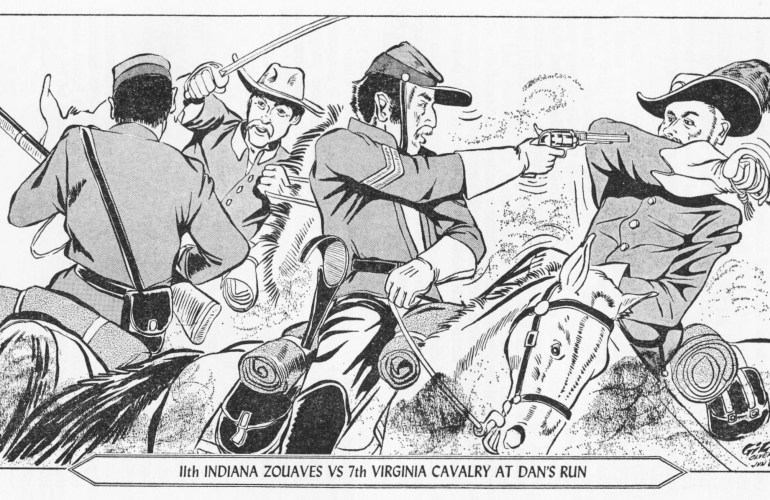
The Federals gave chase, firing as they rode. Accounts of what followed vary, but most agree that a cattle guard or culvert separated Richard Ashby and his men from the open ground west of Dan’s Run, where they could turn to face their pursuers. Most of the Confederates cleared the obstacle, but Richard’s exhausted horse stumbled and fell, throwing him to the ground. The fight quickly turned hand-to-hand. After a brief but savage struggle in which Corporal Hay suffered multiple wounds, the Confederates managed to break away and escape. Richard Ashby did not. Surrounded, he was beaten, shot, stabbed, and left for dead.
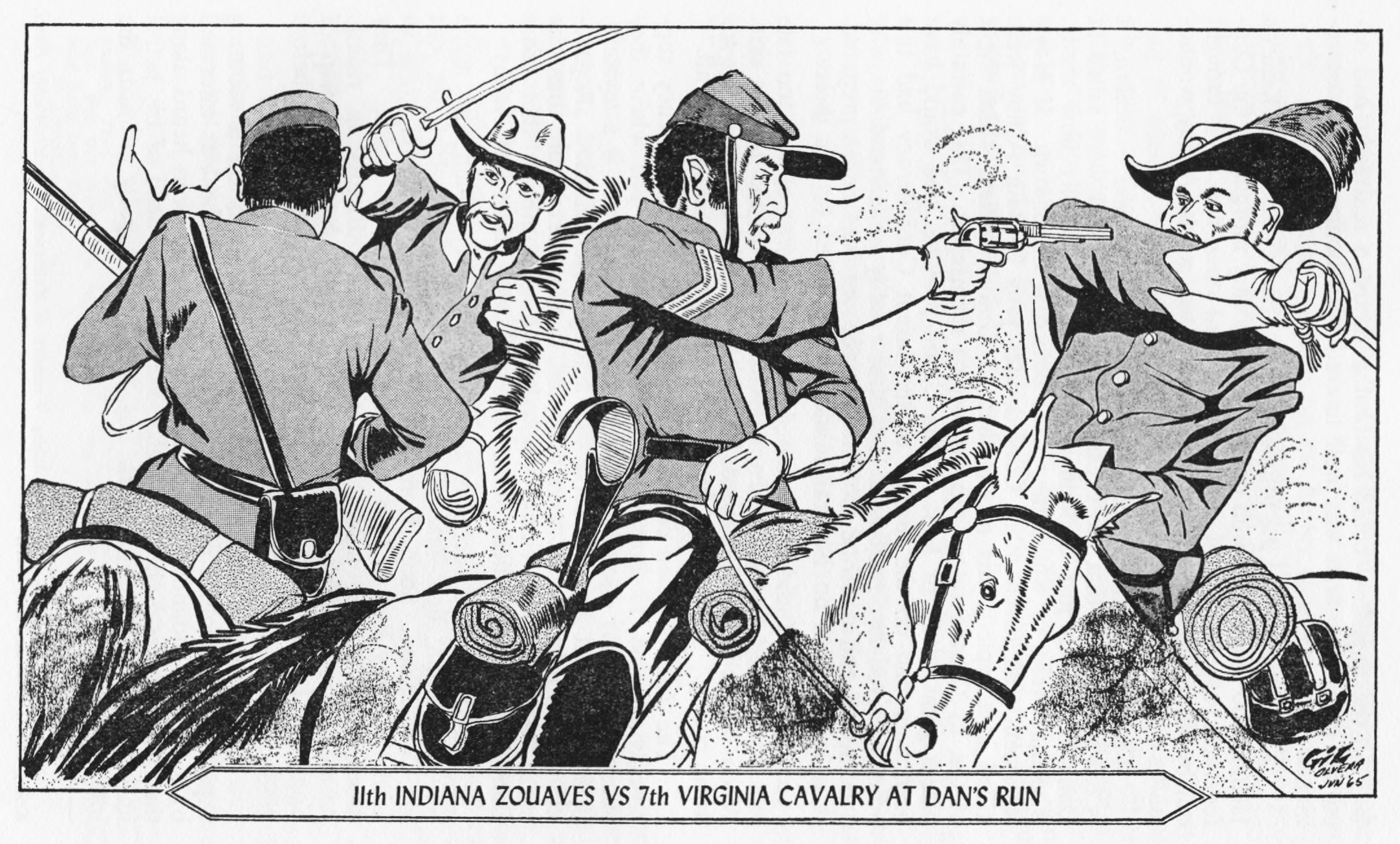
Corporal Hay and his scouts captured several Confederate horses and sought refuge on a forested, almond-shaped island in the North Branch of the Potomac known as Kelly’s Island, at the mouth of Dan’s Run, while two of their number rode off to find a wagon. Hay’s wounds had made it difficult for him to remain in the saddle. The island belonged to Maryland farmer Christopher Kelly, whom the Confederates had arrested and taken to Romney only a few days earlier. Lew Wallace and others misidentified the island as being located at the mouth of Patterson Creek.
By then, it was afternoon. Turner Ashby, alerted to the earlier fight, rode to the scene, where the signs of a bloody struggle were unmistakable. Dan’s Run entered the Potomac through a stone culvert beneath the railroad. Following fresh tracks through the culvert, Ashby and his thirteen companions emerged in full view of Kelly’s Island, where the Union scouts opened fire from behind brush and piles of driftwood.
Without hesitation and with a loud “whoop,” Ashby spurred his men into the river. According to a letter published in the Baltimore Daily Exchange, “The enemy commenced firing upon him when he ordered a charge, fording the river in the face of a destructive fire, and charging upon and completely routing them, they leaving all their horses behind them.”
The fight became another close-quarters brawl, neither as brief as the Confederates boasted nor as heroic as the Hoosiers imagined. Although their opponents ultimately fled, Ashby’s reckless charge proved costly. Two of his men were killed and five wounded, including Ashby himself, and they lost four horses, including his own. Both sides greatly exaggerated the size of the opposing force and its casualties, but in total, the Confederates got the worst of both engagements that day.
That night, Confederate reinforcements searched Kelly’s Island and found horses, weapons, jackets, and hats scattered across the ground. They also discovered Pvt. John C. Hollenbeck groaning in the brush. He was taken to a nearby farmhouse, where Ashby’s troopers gave him water and treated his wounds. Like Richard Ashby, Hollenbeck had been both shot and stabbed. One Virginia trooper, Thomas H. McArthur, also suffered a knife wound to the face. Such wounds were uncommon during the Civil War and testify to the ferocity of the fighting.
Hollenbeck died that night, and his body was left on the porch for his comrades to recover the following morning. Wallace and the 11th Indiana later accused the Confederates of bayoneting Hollenbeck after his capture, a charge they vigorously denied. Hollenbeck was the first Indiana soldier killed in the Civil War. William T. Girard of the 9th Indiana, killed at Belington, Virginia (now West Virginia), on July 7, 1861, is often credited as the first Indiana soldier to die in battle during the Civil War. However, Hollenbeck was killed more than a week earlier.
Ashby and his men found his brother by the roadside as they returned to Camp Washington. They carried him back to Ridgedale and placed him in a bed, where they hoped he might recover. After clinging to life for a week, Richard died on July 3. Turner took the loss especially hard, writing to his sister, “I had rather it had been myself.” Richard was initially buried in Romney, but the brothers were later reinterred together in Winchester’s Stonewall Confederate Cemetery.
The skirmishes at Dan’s Run and Kelly’s Island marked the 11th Indiana’s final action in Virginia. In early July, Wallace and his regiment were ordered to join Maj. Gen. Robert Patterson’s army north of Winchester. From there, they returned home to Indianapolis, where the regiment was mustered out and reorganized for three years’ service in early August.
Sources
Armstrong, Richard L. 7th Virginia Cavalry. H.E. Howard, Inc., 1992.
Ashby, Thomas A. Life of Turner Ashby. The Neale Publishing, Co., 1914.
Avirett, James B. The Memoirs of General Turner Ashby and His Compeers. Selby & Dulany, 1867.
The Baltimore Sun (Baltimore, MD) 11 July 1861.
Bushong, Millard K. General Turner Ashby and Stonewall’s Valley Campaign. McClure Printing Company, Inc., 1980.
Civilian and Telegraph (Cumberland, MD) 27 June 1861.
Civilian and Telegraph (Cumberland, MD) 4 July 1861.
Cunningham, Frank. Knight of the Confederacy: Gen. Turner Ashby. The Naylor Company, 1960.
The Daily Courier (Lafayette, IN) 5 July 1861.
The Daily Exchange (Baltimore, MD) 3 July 1861.
Driver, Robert J. Jr. 1st Virginia Cavalry. H.E. Howard, Inc., 1991.
Durham, Thomas W. Three Years with Wallace’s Zouaves: The Civil War Memoirs of Thomas Wise Durham. Ed. Jeffrey L. Patrick. Mercer University Press, 2003.
Richmond Enquirer (Richmond, VA) 2 July 1861.
Haselberger, Fritz and Mark Haselberger. “Skirmishes at Dan’s Run and Kelley’s Island.” West Virginia History 26 (1965): 220-233.
McDonald, Cornelia. A Diary with Reminiscences of the War and Refugee Life in the Shenandoah Valley, 1860-1865. Ed. Hunter McDonald. Cullom & Ghertner Co., 1934.
Merrill, Catharine. The Soldier of Indiana in the War for the Union. Merrill and Company, 1864.
Otis, George A. and D. L. Huntington. The Medical and Surgical History of the War of the Rebellion, Part III. Vol. II. Government Printing Office, 1883.
Richmond Whig (Richmond, VA) 2 July 1861.
Richmond Whig (Richmond, VA) 8 July 1861.
Riggs, David F. 13th Virginia Infantry. H.E. Howard, Inc., 1988.
Rockingham Register and Advertiser (Harrisonburg, VA) 5 July 1861.
The State Journal (Raleigh, NC) 20 July 1861.
“Thirty-Fifth Annual Report of the President and Directors to the Stockholders of the Baltimore and Ohio Railroad Company, for the Year Ending September 30, 1861.” William M. Innes, 1863.
Turner, George Edgar. Victory Rode the Rails: The Strategic Place of the Railroads in the Civil War. Bobbs-Merril Company, Inc., 1953.
Wallace, Lewis. Lew Wallace: An Autobiography. Vol. 1. Harper & Brothers, 1906.
The War of the Rebellion: A Compilation of the Official Records of the Union and Confederate Armies. Series I, Vol. II. With additions and corrections. Washington: Government Printing Office, 1902.
Weekly State Sentinel (Indianapolis, IN) 10 July 1861.
Wheelock, Perry Carpenter. Farming Along the Chesapeake and Ohio Canal, 1828-1971: A Study of Agricultural Sites in the C&O Canal National Historical Park. United States Department of Interior, 2007.
Williams, Flora McDonald. The Glengarry McDonalds of Virginia. Geo. G. Fetter Company, 1911.


