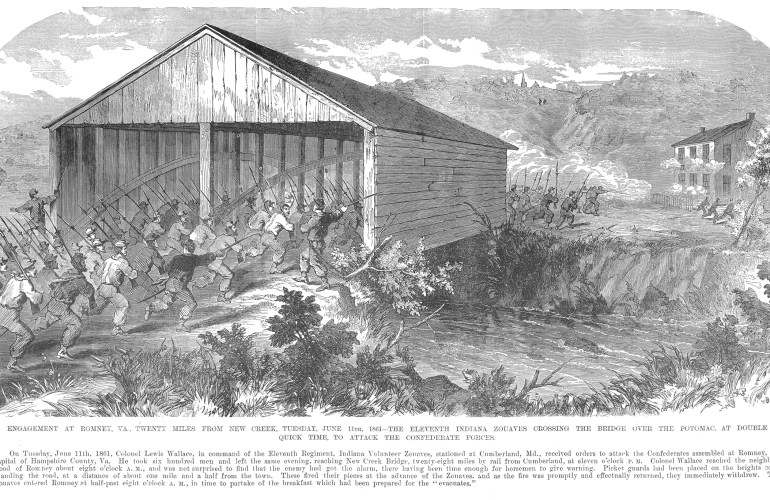
In June 1861, Lew Wallace and the 11th Indiana launched a grueling overnight march from Cumberland, Maryland, to surprise Confederate troops at Romney, Virginia, in one of the Civil War’s earliest actions. The resulting skirmish sent Confederate defenders fleeing, left Romney briefly in Union hands, and helped convince Gen. Joseph E. Johnston to abandon Harpers Ferry for Winchester.
In 1861, Hampshire County, Virginia, stretched from Timber Ridge west to the North Branch of the Potomac River and the Maryland border. Its 974 square miles encompassed forested ridges cut by gurgling streams, narrow valleys, and rocky outcroppings. The county seat was Romney, population 569. Established in 1762, Romney was one of the two oldest towns in what would later become West Virginia.
Unlike their neighbors across the state line in western Maryland, who overwhelmingly favored the Union, Hampshire County residents were divided over secession, though a slight majority supported it. At the convention in Richmond, the county’s two delegates twice voted against secession before reversing themselves and signing the Ordinance of Secession. In the May 23 referendum, 1,188 residents voted to leave the Union, while 788 opposed it. Although Hampshire County would eventually become part of West Virginia, secessionist sentiment remained strong, particularly in the county’s eastern two-thirds.
Laid out on a flat terrace overlooking the South Branch of the Potomac River, Romney was connected to Winchester by the Northwestern Turnpike, which continued west to Parkersburg on the Ohio River. The Confederate force in town consisted of the Potomac Guards and Independent Greys, which later became Companies A and F of the 33rd Virginia Infantry Regiment.
Their commander, Col. Arthur C. Cummings, was an attorney, Virginia Military Institute graduate, and Mexican War veteran who was in the process of organizing the 33rd into a full regiment. Also present were the Hampshire Riflemen, led by Capt. George F. Sheetz, that later became Company F of the 7th Virginia Cavalry.
Before reaching Cumberland, Col. Lewis “Lew” Wallace of the 11th Indiana Infantry Regiment learned that these secessionist troops were at Romney. He resolved to confront them as soon as possible. On the night of June 11, he left two companies behind to complete their camp and amuse the public while the remainder boarded train cars for New Creek Station, avoiding the direct route watched by Confederate cavalry. What should have been a twenty-seven-mile journey became a grueling ten hour, thirty-five-mile slog, much of it over a weather-beaten mountain road that crossed “high bluffs, and narrow passes.”
Wallace’s estimate of twenty-one miles by rail and twenty-three miles on foot, for a total of forty-four miles, appears to be overstated by roughly nine miles. Wallace’s official report, stating that they left the night of June 12, is also incorrect. William Harper, publisher of the Romney South Branch Intelligencer, came into Winchester Wednesday evening [June 12] “and communicated the startling intelligence that Lincoln’s troops … marched into Romney Wednesday morning and took possession of the town.”
In the predawn darkness, midway between New Creek Depot and Romney near the hamlet of Sheetz’s Mill (later Headsville) along Patterson Creek, “Uncle” Jimmy Parker was awakened by the barking of his dog. Stepping outside, he heard the heavy footfalls and metallic clatter of a long column of gray-clad Hoosiers marching four abreast through the night. Wearing loose trousers with red-trimmed jackets and carrying rifled muskets on their shoulders, they advanced steadily past Postmaster Henry Head’s newly built store and post office. The Headsville post office and general store, built by Postmaster Henry Head c. 1860, later found its way to the Smithsonian and then American Philatelic Center in Bellefonte, Pennsylvania.
A woman screamed. Alarmed, Parker grabbed his shoes and slipped out the back door, not stopping to put them on until he thought he was safely away. The sexagenarian made his way on foot to Mechanicsburg Gap, where a friend loaned him a horse for the final three miles into Romney. Wallace corroborates this in his official report, writing: “I afterwards learned that they had notice of my coming full an hour before my arrival.”
This Appalachian Paul Revere reached Romney shortly after sunrise and raised the alarm. Colonel Cummings hastily formed his poorly armed men into a line of battle and marched them to the bluff overlooking the turnpike bridge across the South Branch of the Potomac, just west of town. There he positioned two obsolete 4-pounder cannon that had been sent to Romney after the John Brown raid. Whether the guns had any ammunition is uncertain. When Cummings saw Wallace’s column emerging from the gap, he realized he was badly outnumbered. There was little to do but order a retreat and join the stream of civilians fleeing eastward.
Sheetz’s Hampshire Riflemen served as a rearguard. Just south of the turnpike on South Branch River Road stood Sycamore Dale, a two-story Greek Revival plantation house owned by David Gibson. While mounted Riflemen exchanged shots with Wallace’s skirmishers near the bridge, others occupied the brick home and fired from its windows. They were armed with 1841 Mississippi rifles.
Wallace’s skirmishers pushed across the covered bridge, followed by Companies A and C, which spread out in a semicircle around the house. During the exchange, a bullet ricocheted off the ground and struck 1st Sgt. Moses Grooms on the buckle of his suspenders, leaving him with a bruised chest. He was the regiment’s only casualty. Wallace then personally led a detachment up the hill to the right to turn the enemy’s flank. He reported, “Hardly had my companies deployed and started forward, and got within rifle range, before the rebels limbered up [their artillery] and put off over the bluff in hottest haste.”
Realizing they were about to be surrounded, the Confederates abandoned their position and fell back toward town, pausing occasionally to fire at their pursuers. An elderly resident named Busby was wounded. Lt. Col. George F. McGinnis later recalled, “We had a lively time for about half-an-hour in skirmishing and getting into town, having a few shots fired at us, when we found the rebels … in full flight, going pell mell, some on horse back and some on foot, and their cannon with them.”
Although Wallace pledged not to harass unarmed civilians, his men destroyed the printing press and offices of the South Branch Intelligencer, a newspaper that had openly supported secession. He also ordered Sycamore Dale burned, but the owner successfully persuaded him to spare the house. That did not prevent the soldiers from ransacking it. “I was in it a few hours after the Yankees left,” Lt. John M. Blue, later of Company D, 11th Virginia Cavalry, recalled. “Bureaus and wardrobes had been broken open and contents scattered over the floor and many things of value taken away.”
Romney was then largely deserted, save for a handful of African Americans who appeared unfazed by the soldiers’ presence. The women prepared a generous home-cooked meal with what Wallace later described as “the famous old Virginia flavor,” ensuring that no one went hungry. According to the 1860 census, the town was home to 28 free and 84 enslaved blacks. Countywide, slaves made up just 8.9 percent of Hampshire County’s population. While hardly an insignificant figure, it was far lower than in Virginia’s plantation-dominated Piedmont and Tidewater regions.
That afternoon, the weary Hoosiers began the long march back to Cumberland, their three wagons loaded with captured guns and equipment and exhausted men dropping along the roadside whenever the column halted. Wallace’s brief occupation of Romney, combined with the threat of Maj. Gen. George B. McClellan’s army advancing over the mountains from the west, convinced Confederate Brig. Gen. Joseph E. Johnston that his small Army of the Shenandoah was in danger of being enveloped. He withdrew from Harpers Ferry to Winchester.
Sources
Casler, John O. Four Years in the Stonewall Brigade. State Capital Print, Co., 1893.
Charleston Daily Courier (Charleston, SC) 22 June 1861.
Haselberger, Fritz. “Wallace’s Raid on Romney in 1861.” West Virginia History 27 (1966): 97-110.
Oates, Dan, ed. Hanging Rock Rebel: Lt. John Blue’s War in West Virginia and the Shenandoah Valley. Burd Street Press, 1994.
Reidenbaugh, Lowell. 33rd Virginia Infantry. H.E. Howard, Inc., 1987.
Sauers, Richard A. The Devastating Hand of War: Romney, West Virginia During the Civil War. Gauley Mount Press, 2000.
Wallace, Lewis. Lew Wallace: An Autobiography. Vol. 1. Harper & Brothers, 1906.
The War of the Rebellion: A Compilation of the Official Records of the Union and Confederate Armies. Series I, Vol. II. With additions and corrections. Washington: Government Printing Office, 1902.
Williams, Flora McDonald. The Glengarry McDonalds of Virginia. Geo. G. Fetter Company, 1911.
Weekly State Sentinel (Indianapolis, IN) 26 June 1861.


