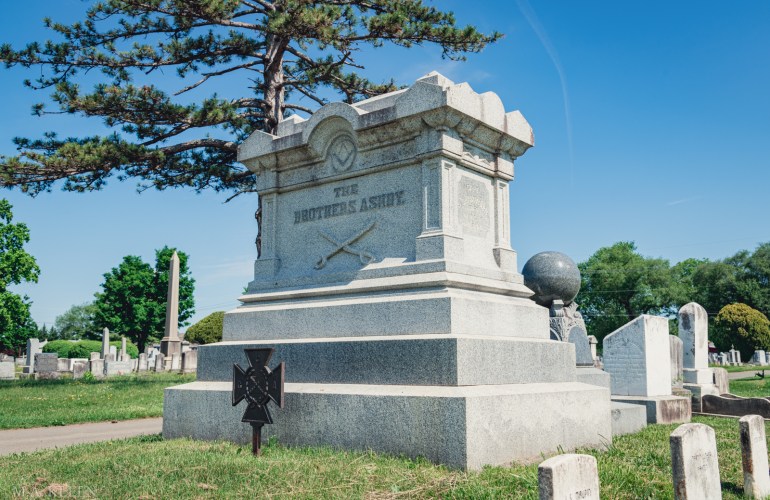
In June 1861, Col. Angus W. McDonald successfully petitioned the Confederate War Department for permission to raise a cavalry regiment, which became the 7th Virginia Cavalry. The first company he recruited was Capt. Turner Ashby’s Mountain Rangers. Thirty-two-year-old Turner Ashby Jr. and his younger brother Richard, 29, were born at Rose Bank Plantation in Fauquier County, Virginia. Their father served as a colonel during the War of 1812, and their grandfather fought in the American Revolution.
That martial heritage influenced Turner Ashby’s decision to organize a cavalry company known as the Mountain Rangers, which performed guard duty at Charles Town during John Brown’s trial and execution following the 1859 raid on Harpers Ferry.
The Ashby brothers were both bachelors and strongly devoted to one another. Turner’s black hair and beard, dark eyes, and swarthy complexion earned him the nickname “the Black Knight of the Confederacy.” Turner was accompanied by his slave named George Jackson. Having grown up together, the two shared a longstanding and close relationship. Not much is known about George Jackson, but he was likely married to a woman named Betsy and lived a long life, dying in 1905. Turner Ashby’s letters home often included a closing line like “George sends his love to his wife.”
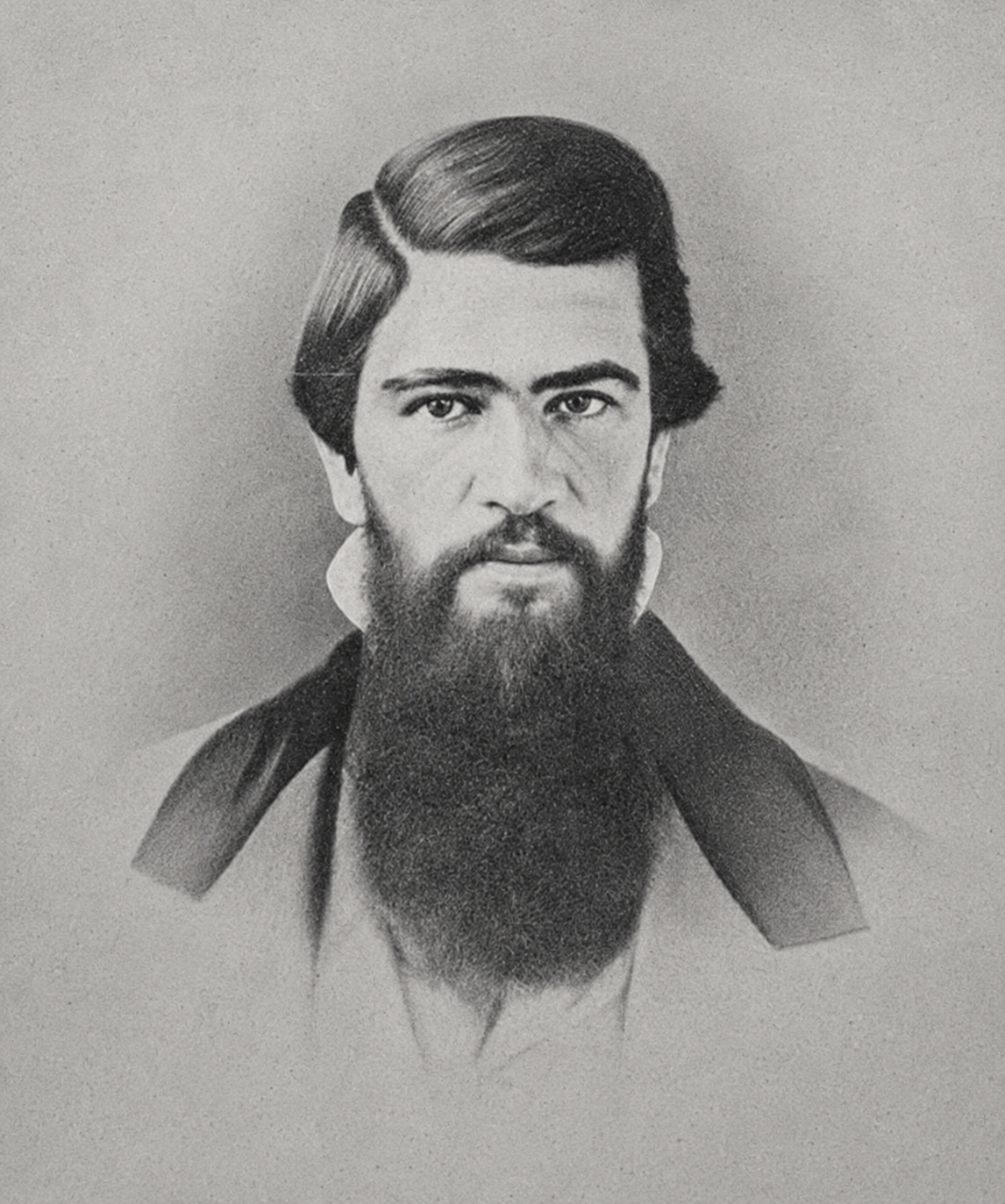
Ashby and the Mountain Rangers played a prominent role in the seizure of Harpers Ferry in April 1861. As Virginia volunteers continued to gather and organize there, the company was assigned to guard the Leesburg Bridge over the Potomac River opposite Point of Rocks and patrol the surrounding area. They joined McDonald’s command at Winchester on June 15. Two days later, Ashby was promoted to lieutenant colonel of the 7th Virginia Cavalry, and Richard received a promotion to captain.
General Robert E. Lee ordered McDonald to report to Brig. Gen. Joseph E. Johnston and tasked him with disrupting the B&O Railroad, including the destruction of the Tray Run Viaduct over the Cheat River near Rowlesburg. After arriving in Romney, several of McDonald’s companies, including the Mountain Rangers, established Camp Washington on a 700-acre property known as Washington Bottom Farm. Located along a bend in the South Branch of the Potomac River about five and a half miles north of Romney, the farm belonged to George W. Washington, a distant relative of our first president. His imposing three-story Greek Revival home, Ridgedale, still stands today.
On the fateful morning of Wednesday, June 26, Turner and Richard Ashby rode out on separate missions. Turner took thirteen men on a reconnaissance toward Patterson’s Creek Depot along the Potomac River, twenty miles north of Romney. Richard, riding a jet-black steed, departed with twelve men and a local guide to arrest a unionist suspected of passing information to the enemy. After dividing his command, Richard likely led the smaller detachment to Green Spring Depot, across the river from Oldtown, then west along the B&O Railroad in the direction of Patterson’s Depot.
As Richard Ashby’s detachment was traveling west along the railroad tracks about a half mile east of Dan’s Run, a mounted patrol from the 11th Indiana Infantry caught up with him and pursued and gave chase, firing as they rode. Accounts of what followed vary, but most agree that a cattle guard or culvert separated Richard and his men from the open ground west of Dan’s Run, where they could turn to face their pursuers. Most of the Confederates cleared the obstacle, but Richard’s exhausted horse stumbled and fell, throwing him to the ground.
The fight quickly turned hand-to-hand. After a brief but savage struggle, the Confederates managed to break away and escape. Richard Ashby did not. Surrounded, he was beaten, shot, stabbed, and left for dead.
The Federal scouts sought refuge on Kelly’s Island in the North Branch of the Potomac, at the mouth of Dan’s Run. Turner Ashby, alerted to the earlier fight, rode to the scene, where the signs of a bloody struggle were unmistakable. Dan’s Run entered the Potomac through a stone culvert beneath the railroad. Following fresh tracks through the culvert, Ashby and his thirteen companions emerged in full view of Kelly’s Island, where the Union scouts opened fire from behind brush and piles of driftwood. Without hesitation and with a loud “whoop,” Ashby spurred his men into the river.
The fight became another close-quarters brawl. Although their opponents ultimately fled, Ashby’s reckless charge proved costly. Two of his men were killed and five wounded, including Ashby himself, and they lost four horses, including his own. Both sides greatly exaggerated the size of the opposing force and its casualties, but in total, the Confederates got the worst of both engagements that day.
Turner Ashby and his men found his brother by the roadside as they returned to Camp Washington. They carried him back to Ridgedale and placed him in a bed, where they hoped he might recover. Their chaplain, Rev. James B. Avirett, George, and Turner tended his wounds. After clinging to life for a week, Richard died on July 3. Turner took the loss especially hard, writing to his sister, “I had rather it had been myself.” Richard was initially buried in Romney.
Turner would rise to prominence as Thomas J. “Stonewall” Jackson’s cavalry commander during his 1862 Valley Campaign, but like his brother, he would not live to see the end of the war. Ashby was killed on June 6, 1862, leading his men at the Battle of Good’s Farm near Harrisonburg. The Ashby brothers were later reinterred together in Winchester’s Stonewall Confederate Cemetery.
Sources
Armstrong, Richard L. 7th Virginia Cavalry. H.E. Howard, Inc., 1992.
Ashby, Thomas A. Life of Turner Ashby. The Neale Publishing, Co., 1914.
Avirett, James B. The Memoirs of General Turner Ashby and His Compeers. Selby & Dulany, 1867.
Bushong, Millard K. General Turner Ashby and Stonewall’s Valley Campaign. McClure Printing Company, Inc., 1980.
Cunningham, Frank. Knight of the Confederacy: Gen. Turner Ashby. The Naylor Company, 1960.
The Free Lance-Star (Fredericksburg, VA) November 8, 1998.
Haselberger, Fritz and Mark. “Skirmishes at Dan’s Run and Kelley’s Island.” West Virginia History 26 (July 1965): 220-233.
McDonald, Cornelia. A Diary with Reminiscences of the War and Refugee Life in the Shenandoah Valley, 1860-1865. Edited by Hunter McDonald. Cullom & Ghertner Co., 1934.
Richmond Enquirer (Richmond, VA) 2 July 1861.
Richmond Whig (Richmond, VA) 8 July 1861.
Williams, Flora McDonald. The Glengarry McDonalds of Virginia. Geo. G. Fetter Company, 1911.


