In June 1861, future Ben-Hur author Lew Wallace and the 11th Indiana arrived in Cumberland, Maryland, with orders to protect the vital B&O Railroad and secure the Upper Potomac. Within days, Wallace’s restless pursuit of Confederate forces would carry his Hoosiers into Virginia, setting the stage for a dramatic early Civil War campaign whose consequences reached far beyond a seemingly bloodless victory.
Along the Virginia-Maryland state line, at the tip of a finger formed by the North Branch of the Potomac River, sat the town of Cumberland, Maryland. Cumberland, population 4,078 in 1861, marked the starting point of the National Road, America’s first east-west interstate toll road, and the terminus of the Chesapeake and Ohio Canal, which followed the Potomac River from Washington, DC. The town was also an important stop on the Baltimore & Ohio (B&O) Railroad.
Coal, Iron, and other raw materials flowed from western Maryland and Virginia through Cumberland to cities on the eastern seaboard. Union war planners quickly recognized the importance of securing this vital transportation hub.
As early as May 24, Winfield Scott, Commanding General of the U.S. Army, telegraphed Maj. Gen. Robert Patterson in Philadelphia, urging him to move troops into western Maryland and occupy the towns of Frederick, Hagerstown, and Cumberland. Patterson’s attention, however, remained fixed on Harpers Ferry and Martinsburg in Virginia’s Shenandoah Valley.
Volunteer regiments were momentarily in short supply, and the question remained: who could be spared to occupy that remote outpost? The answer came in the form of a wiry, energetic Hoosier with a distinctive goatee named Lew Wallace.
Lewis “Lew” Wallace was born on April 10, 1827, in Brookville, Indiana, into a prominent family. His father, David Wallace, was a West Point graduate, U.S. congressman, and the sixth governor of Indiana. Well educated for the time, Wallace showed an early talent for writing and later penned the influential novel Ben-Hur (1880). During the Mexican-American War, he helped recruit volunteers before serving as a regimental staff officer.
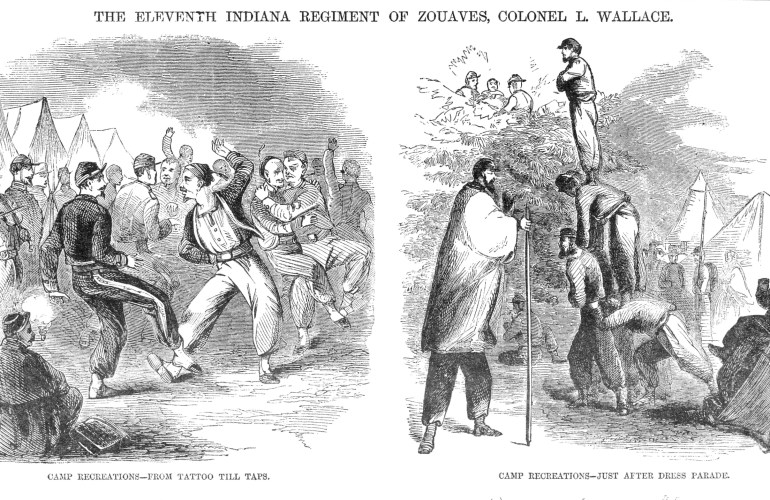
Wallace was a close friend of Indiana Governor Oliver P. Morton and a lawyer by trade. On the eve of the Civil War, Morton appointed him adjutant general of Indiana, where he oversaw the recruitment and organization of the state’s 90-day volunteers. After quickly completing that task, Wallace received command of the 11th Indiana Volunteer Regiment. He dressed his men in gray, French-inspired zouave jackets and drilled them in the tactics of those French colonial troops.
They were initially stationed in Evansville, Indiana inspecting traffic on the Ohio River, but would soon receive orders directly from Winfield Scott to join Patterson’s command.
On or about June 6, while en route along the B&O Railroad, Wallace and the 11th Indiana received another order to halt at Cumberland, secure the Potomac River bridges in the area, and await further instructions. Patterson also directed them to win the confidence of the local population and granted Wallace broad authority to “capture or rout” armed insurgents in the region, an order he was more than eager to carry out.
After picking up two local guides in Piedmont, Virginia, the regiment arrived in Cumberland on the mist-shrouded morning of June 10, 1861, but did not remain there long. Wallace left his men aboard the train while he and Lt. Col. George F. McGinnis accompanied the town’s mayor in search of a suitable campsite. Later that afternoon, an erroneous report that secessionists planned to burn the railroad bridge near New Creek prompted the regiment to backtrack, then it spent the night along the railroad near the future site of the Celanese Corporation (Amcelle) plant, today the North Branch Correctional Institution.
Wallace omitted this entire detour from his memoir. The Civilian and Telegraph mentioned the 11th Indiana first arrived on the morning of Monday, June 10. Letters from Lt. Col. McGinnis and an anonymous private printed in the Indiana State Sentinel both mentioned a detour that evening to investigate the secessionist threat.
The people of western Maryland were decidedly unionist in sentiment, and in April Capt. Horace Resley organized his antebellum militia company, the Cumberland Continentals, to defend the town and guard local railroad bridges. The unit received partial funding from the B&O Railroad, which had good reason to worry about the safety of its property.
On May 28, the covered railroad bridges over Patterson’s Creek in northern Hampshire County, along with the pump house and the 131-foot span over the canal at North Branch, were burned. In response, a detachment of the Continentals was sent to guard the railroad bridge over the North Branch of the Potomac River opposite what was then known as Paddy Town, twenty miles southwest of Cumberland. They were armed with two cannons: a single 6-pounder and an aging 4-pounder.
When Lew Wallace and the 11th Indiana rolled into Cumberland again on Tuesday morning, the local citizens welcomed them enthusiastically, raising Union flags and mingling freely. Curious civilians flocked to the railroad station and even crowded around the men at breakfast. The excitement ended in tragedy when a soldier’s rifle accidentally discharged inside a train car beneath a group of boys standing on the roof. The bullet pierced the roof and struck one of the boys, killing him. After breakfast, the entire regiment marched in paradelike formation from the station to their campsite on Rose Hill, called Camp McGinnis.
Determined to retain the element of surprise, Wallace again put his regiment in motion, this time toward Romney, leaving behind a small rearguard to finish setting up camp. What transpired next would win fame for the Hoosiers but inadvertently draw Confederate reinforcements to the region, sow panic, and ultimately put Wallace’s men on the defensive. These were dire consequences for what was, essentially, a bloodless victory.
Sources
Civilian and Telegraph (Cumberland, MD) 6 June 1861.
Civilian and Telegraph (Cumberland, MD) 13 June 1861.
Haselberger, Fritz. “Wallace’s Raid on Romney in 1861.” West Virginia History 27 (1966): 97-110.
Lowdermilk, William H. History of Cumberland, (Maryland) from the Time of the Indian Town, Caiuctucuc, in 1728, Up to the Present Day. James Anglim, 1878.
The Philadelphia Inquirer (Philadelphia, PA) 17 June 1861.
Snyder, Timothy R. “‘Making No Child’s Play of the Question’: Governor Hicks and the Secession Crisis Reconsidered.” Maryland Historical Magazine 101 (2006): 323.
Stephens, Gail. Shadow of Shiloh: Major General Lew Wallace in the Civil War. Indiana Historical Society Press, 2010.
Stover, John F. History of the Baltimore and Ohio Railroad. Purdue University Press, 1995.
Summers, Festus P. The Baltimore and Ohio in the Civil War. Stan Clark Military Books, 1993.
“Thirty-Fifth Annual Report of the President and Directors to the Stockholders of the Baltimore and Ohio Railroad Company, for the Year Ending September 30, 1861.” William M. Innes, 1863.
Wallace, Lewis. Lew Wallace: An Autobiography. Vol. 1. Harper & Brothers, 1906.
The War of the Rebellion: A Compilation of the Official Records of the Union and Confederate Armies. Series I, Vol. II. With additions and corrections. Washington: Government Printing Office, 1902.
Weekly State Sentinel (Indianapolis, IN) 26 June 1861.


