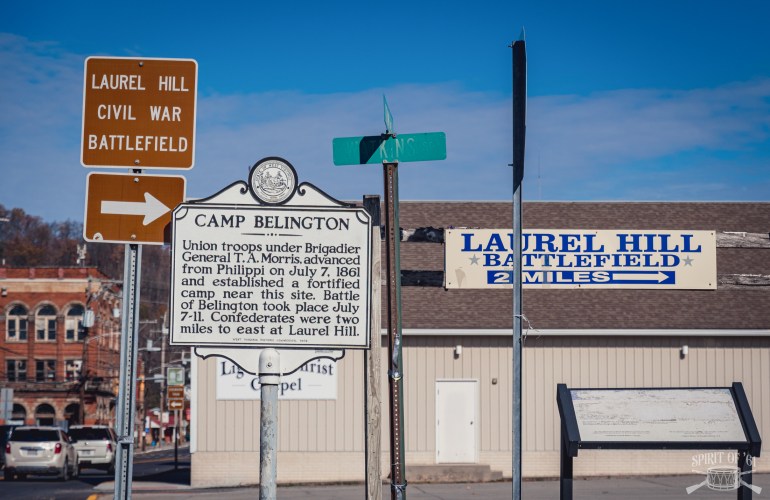
On July 6, 1861, Maj. Gen. George B. McClellan ordered Brig. Gen. Thomas A. Morris to advance on Confederate Brig. Gen. Robert S. Garnett’s position on Laurel Hill, near the small hamlet of Belington, also spelled Bealington or Beelington. McClellan instructed Morris to occupy a position “on the south side of Barker’s Mill Run, on the heights in rear of William Yeager’s house.” He was to ford the Tygart Valley River at the “Middle Fork road” (Three Fork Road, now Brown Avenue), just south of the intersection of the Beverly-Fairmont Turnpike and Morgantown Road.
Behind this position rose a ridge known as Elliott’s Hill, near the William Elliott house. Elliott, a known secessionist, had a son serving in the 31st Virginia. Morris established his headquarters at the Elliott house. At the time, Belington did not sit along the river as it does today, but farther up the turnpike, between the opposing forces’ initial positions. The order of march was:
| Order (front to rear) | Unit | Notes |
|---|---|---|
| 1 | 1st Virginia Infantry (U.S.) 4 companies | Lt. Col. Henry B. Hubbard commanding |
| 2 | 9th Indiana Infantry 9 companies | Company K was detached with headquarters. |
| 3 | 14th Ohio Infantry, 1st Battalion 5 companies | |
| 4 | First Ohio Light Artillery, 4 guns | |
| 5 | 14th Ohio Infantry, 2nd Battalion 5 companies | |
| 6 | First Ohio Light Artillery, 2 guns | |
| 7 | 1st Virginia Infantry (U.S.) 2 companies | |
| 8 | 7th Indiana Infantry | |
| 9 | Headquarters | Morris’ bodyguard included the 9th Indiana, Company K, “40 mounted scouts”, and the Grafton Guards, 2nd Virginia (U.S.) |
| 10 | 16th Ohio Infantry 3 companies | Under Lt. Col. John S. Fulton |
| 11 | 15th Ohio Infantry 3 companies | Under Lt. Col. Moses R. Dickey |
| 12 | 6th Indiana Infantry | |
| 13 | Baggage train, ammunition wagons, band | |
| 14 | First Ohio Light Artillery, 2 guns, 4 caissons | |
| 15 | 6th Ohio Infantry |
The order of march reported by a correspondent for the Cincinnati Commercial, who accompanied Morris’ column, largely matches that given in Reminiscences of the Cleveland Light Artillery (1906). The key difference is that six companies from the 15th and 16th Ohio appear ahead of the headquarters element. The correspondent also places the Sixth Ohio Infantry in the rear. It seems likely the Sixth was added at the last minute as a reserve.
Based on the best available sources, Morris’ force consisted of a little over 5,700 men. The following is a list of the units and their strength.
Sixth Ohio Infantry
The 6th Ohio Infantry Regiment, the “Guthrie Grays,” was mustered into three-year service at Cincinnati on June 17–18, 1861 under Col. William K. Bosley, having spent most of its original 90-day term in camp. It entered Virginia on June 30 or July 1. Held in reserve during the Battle of Belington, the regiment numbered about 1,031 officers and men.
14th Ohio Infantry
The 14th Ohio Infantry Regiment (three months) was mustered into service at Cleveland on April 25 under Col. James B. Steedman. It entered Virginia at Parkersburg on May 27, in the vanguard of McClellan’s advance along the Northwestern Virginia Railroad. Five companies took part in the march on Philippi on June 3. The entire regiment accompanied Morris to Belington, likely numbering around 1,013 officers and men.
15th Ohio Infantry (3 Companies)
The 15th Ohio Infantry Regiment (three months) was mustered into service at Columbus between May 13 and 24, 1861, to date from April 27, under Col. George W. Andrews. The regiment entered Virginia on May 28 and reached Philippi after midnight on June 4, too late for the fight. It was then broken up and assigned to guard points along the B&O Railroad. Three companies accompanied Morris to Belington, likely numbering around 300 men.
16th Ohio Infantry (3 Companies)
The 16th Ohio Infantry Regiment (three months), the “Carrington Guards,” was mustered into service at Columbus between May 11 and 12, 1861, to date from April 27, under Col. James Irvine. The regiment entered Virginia near Bellair on May 27 in support of the First Virginia Infantry (U.S.) and proceeded down the B&O Railroad to Grafton. Six companies participated in the march on Philippi on June 3, the rest were assigned to guard points along the B&O Railroad. Three companies accompanied Morris to Belington, likely numbering around 300 men.
Sixth Indiana Infantry
The 6th Indiana Infantry Regiment (three months) was mustered in at Indianapolis on April 25, 1861, under Col. Thomas T. Crittenden. It left for Virginia on May 30 and took part in the action at Philippi on June 3. The regiment initially numbered 781 officers and men; three were lost to noncombat causes before the march on Belington, leaving 778. It also provided Morris’ detail of 40 volunteer scouts.
Seventh Indiana Infantry
The 7th Indiana Infantry Regiment (three months) was mustered in at Indianapolis on April 28, 1861, under Col. Ebenezer Dumont. It left for Virginia on May 29 and took part in the action at Philippi on June 3. The regiment initially numbered 782 officers and men; six were lost to noncombat causes before the march on Belington, leaving 776.
Ninth Indiana Infantry
The 9th Indiana Infantry Regiment (three months), known as the “Swamp Devils” or the “Bloody Ninth,” was mustered in at Indianapolis on April 25, 1861, under Col. Robert H. Milroy. It left the state on May 25, the first Indiana organization bound for western Virginia. Reaching Grafton on June 1, it marched to Philippi and took part in the engagement on June 3. The Ninth was actively engaged at Belington, where it lost the first man of the battle, Pvt. William T. Girard. Girard was also the first Indianan killed in the Civil War.
First Virginia Infantry (U.S.) (6 Companies)
The 1st Virginia Infantry (U.S.) was recruited largely from unionist Virginians in the northwestern panhandle around Wheeling, with additional volunteers from neighboring states. It was mustered into service between May 10 and 23. During the opening phase of his advance into northwestern Virginia, McClellan placed the regiment in the vanguard. Its colonel, Benjamin F. Kelley, was seriously wounded in the action at Philippi. The regiment was then broken up and assigned to guard points along the B&O Railroad. It is unclear how many companies accompanied Morris to Belington, likely five or six, or what role they played in the fighting.
Grafton Guards
The Grafton Guards were a company of unionist Virginians organized by Capt. George R. Latham in mid-April 1861 in the key railroad town of Grafton. The unit was not formally mustered into federal service until May 25, when it became Company B of the 2nd Virginia Infantry (U.S.). It served as one of Morris’ headquarters companies during the advance on Belington and may have numbered as many as 114 officers and men.
First Ohio Light Artillery
Also known as the Cleveland Light Artillery, the 1st Ohio Light Artillery was a prewar unit dating to 1845. In 1861 it fielded six guns and 160 men under Col. James Barnett. Companies D and F entered Virginia at Parkersburg on the night of May 29–30 with two guns and played a key role in the action at Philippi on June 3. By July, all six “companies” were in Virginia. According to the order of march printed in Reminiscences of the Cleveland Light Artillery, the battery brought eight field pieces to Belington, though it likely put only six into action.
Order of Battle
The following order of battle represents the closest approximation of the Union forces at the Battle of Belington that can be reconstructed from the available sources.
| Unit | Commander(s) | Strength | Killed | Wounded | Captured |
|---|---|---|---|---|---|
| 6th Ohio Inf. Regiment | Col. William K. Bosley | 1,031 | 0 | 0 | 0 |
| 14th Ohio Inf. Regiment | Col. James B. Steedman | 1,013 | 2 | 2 | 0 |
| 15th Ohio Inf. Regiment, 3 Companies | Lt. Col. Moses R. Dickey | 300 | 0 | 0 | 0 |
| 16th Ohio Inf. Regiment, 3 Companies | Lt. Col. John S. Fulton | 300 | 0 | 0 | 0 |
| 6th Indiana Inf. Regiment | Col. Thomas T. Crittenden | 778 | 0 | 1 | 0 |
| 7th Indiana Inf. Regiment | Col. Ebenezer Dumont | 782 | 1 | 0 | 0 |
| 9th Indiana Inf. Regiment | Col. Robert H. Milroy | 786 | 3 | 2 | 1 |
| 1st Virginia Inf. Regiment (U.S.) 6 Companies | Lt. Col. Henry B. Hubbard | 465 | 0 | 0 | 1 |
| 2nd Virginia Inf. Regiment (U.S.), Company B “Grafton Guards” | Capt. George R. Latham | 114 | 0 | 0 | 0 |
| 1st Ohio Light Artillery | Col. James Barnett | 6 guns, 160 men | 0 | 1 | 0 |
| 5,729 | 6* | 6 | 2 |
Sources
Benham, Henry Washington. Recollections of West Virginia Campaign with ‘The Three Months Troops’. Boston: Privately Printed, 1873.
Chase, J.A. History of the Fourteenth Ohio Regiment, O.V.V.I. Toledo: St. John Printing House, 1881.
Cope, Alexis. The Fifteenth Ohio Volunteers and Its campaigns, War of 1861-5. Columbus, OH: By the author, 1916.
Daily Commercial (Cincinnati) 18 July 1861.
Grayson, Andrew J. “The Spirit of 1861”: History of the Sixth Indiana Regiment in the Three Months’ Campaign in Western Virginia. Madison: Courier Print, 1875.
Hannaford, Ebenezer. The Story of a Regiment: A History of the Campaigns, and Associations in the Field, of the Sixth Regiment Ohio Volunteer Infantry. Cincinnati: By the Author, 1868.
Kemper, G. W. H. The Seventh Regiment Indiana Volunteers Three Months Enlistment. Muncie: R. H. Cowan Printing Co., 1903.
Noyalas, Jonathan A. “My Will is Absolute Law”: A Biography of Union General Robert H. Milroy. Jefferson: McFarland & Company, Inc., 2006.
Official Roster of the Soldiers of the State of Ohio in the War of the Rebellion, 1861-1866, Vol. 1. Akron: The Werner Company, 1893.
The Ohio Twenty-Second (Clarksburg) 12 July 1861.
Rawling, C. J. History of the First Regiment Virginia Infantry. Philadelphia: J. B. Lippincott Company, 1887.
Reminiscences of the Cleveland Light Artillery. Cleveland: Cleveland Printing Co., 1906.
Report of the Adjutant General of the State of Indiana, 1861-1865, Vol. 1-4. Indianapolis: Samual M. Douglass, State Printer, 1866.
Skidmore, Richard S., ed., The Civil War Journal of Billy Davis from Hopewell, Indiana to Port Republic, Virginia. Greencastle: The Nugget Publishers, 1989.
The Soldier of Indiana in the War for the Union. Indianapolis: Merrill and Company, 1866.
Thomson, Orville. Narrative of the Service of the Seventh Indiana Infantry in the War for the Union. Baltimore: Butternut and Blue, 1993.
The War of the Rebellion: A Compilation of the Official Records of the Union and Confederate Armies. Series I, Vol. II. With additions and corrections. Washington: Government Printing Office, 1902.

 Spirit of '61