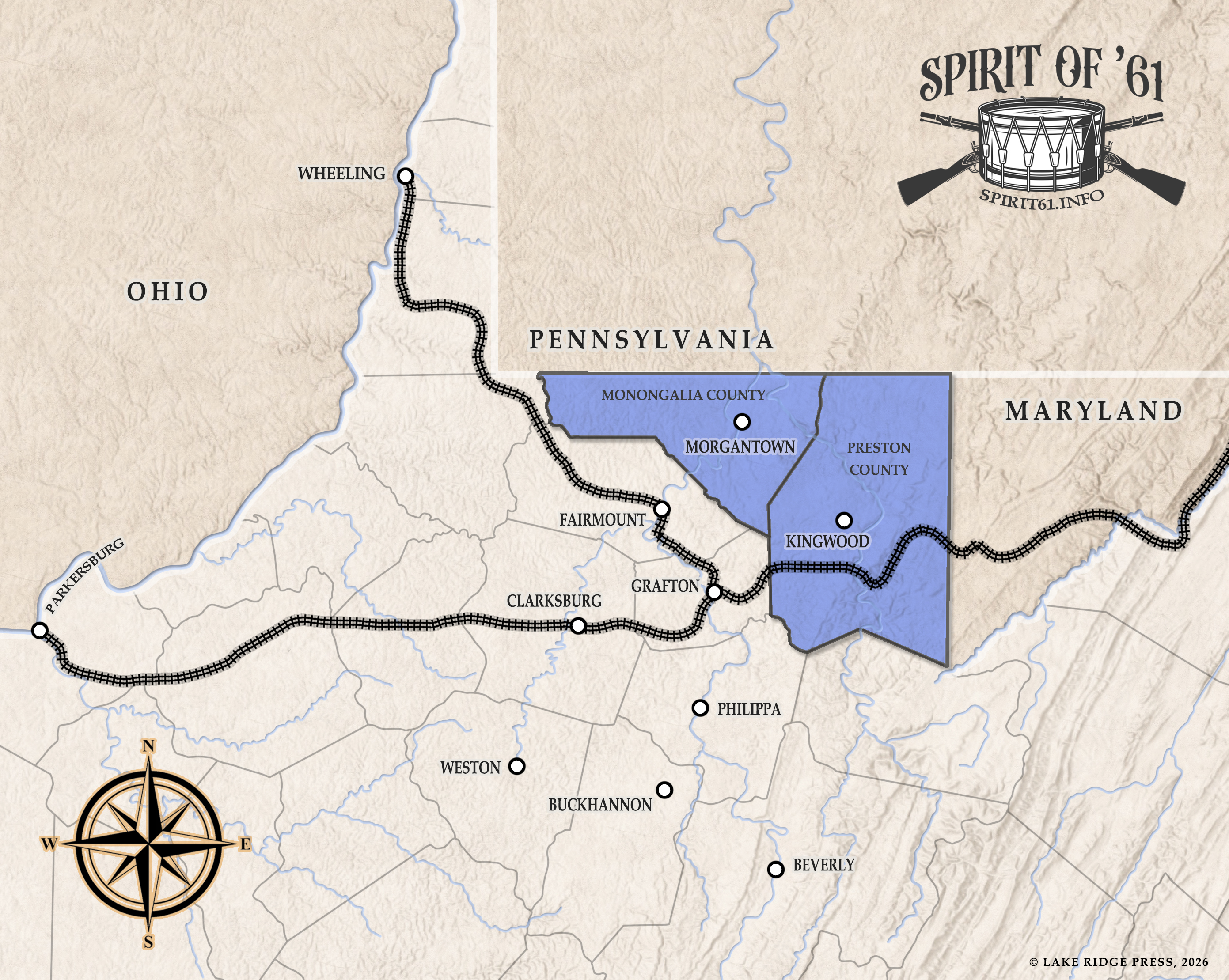
During the critical period of April-May 1861, Preston and Monongalia counties, in what was then northwestern Virginia, remained firmly in the Union camp. Both counties shared a northern border with Pennsylvania and, unlike their southern neighbors, organized no Confederate volunteer companies, though a few individuals may have enlisted in the Southern cause. Slavery was rare, playing virtually no role in the local economy. The towns of Morgantown and Kingwood had strong economic ties to Pittsburgh and southwestern Pennsylvania.
The Baltimore and Ohio (B&O) Railroad and the Northwestern Turnpike passed through southern Preston County. The B&O’s Tray Run Viaduct, a bridge over the Cheat River at Rowlesburg, was so strategically significant that Robert E. Lee called its destruction “worth to us an army.” Nevertheless, it remained undamaged throughout the war, thanks in large part to the area’s strong Union sentiment.
In February 1861, both counties sent unconditional unionists to the Secession Convention in Richmond. Monongalia’s delegates were Marshall M. Dent and Waitman T. Willey; Preston’s were Congressman William G. Brown, Sr., and James C. McGrew. Although two of the four were slave owners, they all voted against secession on April 4 and 17. They were later expelled from the Convention, having long since departed Richmond.
Shortly after returning home, they helped organize a competing convention in Wheeling on the Ohio River to address the secession crisis. Preston County’s William B. Zinn served as chairman of this First Wheeling Convention from May 13-15, 1861. Unlike conditional unionist delegates, such as Jubal A. Early or Upshur County’s George W. Berlin, the representatives from Preston and Monongalia counties rejected secession and worked to establish a new state government loyal to the United States. Waitman T. Willey was later elected, along with John S. Carlile, to serve as a U.S. Senator for this Reorganized Government.
The Kingwood Chronicle adopted the motto, “The Union, Right or Wrong–We’ll defend her when right, when wrong we’ll right her.”
On May 23, while Monongalia County voted on Virginia’s secession referendum, Capt. Jacob Hickman’s Home Guard company deployed around Morgantown to prevent disorder. Locally, the referendum was overwhelmingly defeated, with the vote in Monongalia being 2,259 to 115 against secession and 2,256 to 63 in neighboring Preston County. This sent a firm message to Richmond regarding where their sentiments lay.
Early in the war, volunteers flocked to the Union banner. Toward the end of May, the 104th Regiment, Virginia Militia, met outside Kingwood and pledged allegiance to the United States en masse. In Preston County, Captains Isaiah Kirk (Pleasant Valley Rangers) and Henry C. Hagans (Company F, 3rd VA) recruited the first Union companies. Meanwhile, Frank W. Thompson organized what would become Company A, 3rd Virginia Infantry (U.S.) in Morgantown. On July 18, 1861, Capt. J. Lowrie McBee mustered in the “Kelley Lancers” for a three-year term.
Jonathan McGee Heck, a Morgantown attorney and justice of the peace, was a notable exception. He played a key role in organizing secessionist companies in northwestern Virginia and traveled to Richmond in late May to plead for help. Upon returning to the northwest with reinforcements, he was given command of the 25th Virginia Infantry Regiment. His tenure was short-lived, however, as he was captured following the Battle of Rich Mountain and not paroled until a year later.
Taken together, the experience of Preston and Monongalia counties underscores a reality often lost in broader narratives of Virginia’s secession. Their residents made a sustained commitment that helped secure federal control of the region and laid the groundwork for the creation of West Virginia. In the opening months of the war, Preston and Monongalia chose unionism clearly and decisively, at a moment when that choice carried real consequence.
Sources
Armstrong, Richard L. 25th Virginia Infantry and 9th Battalion Virginia Infantry. Lynchburg: H.E. Howard, Inc., 1990.
Core, Earl L. The Monongalia Story, A Bicentennial History, Vol. 3. Parsons: McClain Printing Company, 1979.
The Kingwood Chronicle (Kingwood, VA) 13 July 1861.
The Kingwood Chronicle (Kingwood, VA) 27 July 1861.
Lang, Theodore F. Loyal West Virginia from 1861 to 1865. Baltimore: Deutsch Publishing Co., 1895.
Wiley, Samuel T. A History of Monongalia County, West Virginia. Kingwood: Preston Publishing Company, 1883.
Wiley, Samuel T. A History of Preston County, West Virginia. Kingwood: The Journal Printing House, 1882.

 Spirit of '61