On a hot July morning in 1861, a forage run five miles from Martinsburg turned into a brief, deadly clash that left one Union soldier dead and two in Confederate hands.
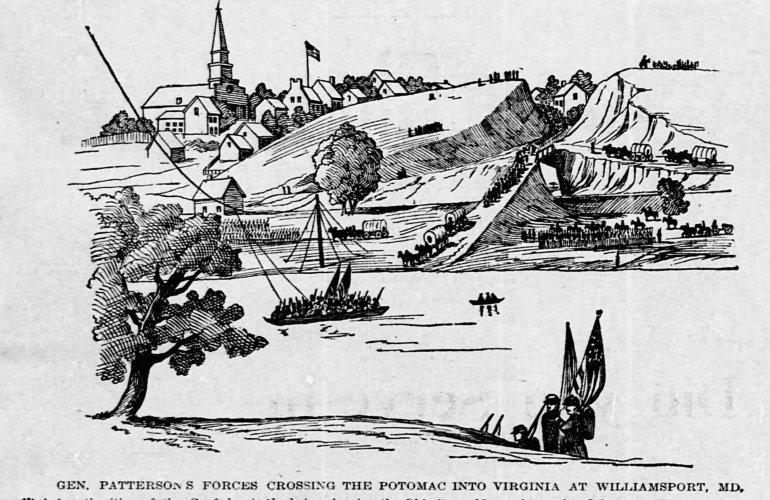
Acting under pressure from the War Department in Washington, DC, after one false start and with 90-day enlistments about to expire, scant artillery, and poor supply, 69-year-old Maj. Gen. Robert Patterson crossed the Potomac River at Williamsport, Maryland, on July 2, 1861. With an inexperienced and untested army, he stepped into Virginia to invade the lower Shenandoah Valley.
The Shenandoah Valley’s fertile farms and ironworks were vital to the Confederacy’s survival. At this early stage of the war, Confederate President Jefferson Davis entrusted its defense to Brig. Gen. Joseph E. Johnston, formerly the U.S. Army’s Quartermaster General. His Army of the Shenandoah included Col. Thomas J. Jackson’s brigade and Lt. Col. J. E. B. Stuart’s 1st Virginia Cavalry.
A single improved road ran from the ford opposite Williamsport up the Valley through Martinsburg, Winchester, and Harrisonburg to Staunton. The ninety-three-mile stretch of macadamized turnpike from Martinsburg to Staunton was known as the Valley Pike. When Patterson’s army crossed the Potomac, Jackson held Martinsburg ahead of the main Confederate force at Winchester. Martinsburg was also an important stop on the Baltimore & Ohio (B&O) Railroad.
In the late afternoon of July 2, Patterson’s leading brigades clashed with Jackson’s men along the road to Martinsburg in what became known as the Battle of Hoke’s Run, or Falling Waters. This delaying action allowed Jackson and Stuart to withdraw safely and rejoin Johnston. Patterson entered Martinsburg at noon on July 3, greeted by the cheers of its largely unionist population.
Meanwhile, Johnston assembled the Army of the Shenandoah for battle near the small village of Darkesville, about six miles south of Martinsburg, and remained there for four days before falling back to Winchester.
In Martinsburg, Patterson hesitated. His supply line from Hagerstown was stretched thin, and he believed Johnston outnumbered him. General Winfield Scott had warned him to “attempt nothing without a clear prospect of success,” and Patterson chose to wait for reinforcements. Col. Charles Pomeroy Stone, having completed his expedition along the Maryland shore of the Potomac, joined him on July 8 with elements of four regiments and a battalion of District of Columbia volunteers.
That same day, the 19th New York Infantry, the “Cayuga Regiment,” commanded by Col. John S. Clark, and the 28th New York Infantry, the “Scott Life Guard,” under Col. Dudley Donnelly, also arrived.
Patterson at last drafted orders to advance on Winchester but rescinded them at the last moment, citing the exhaustion of the newly arrived regiments. On July 9, he convened a council of war with his senior officers. They almost unanimously agreed the army was in a precarious position and ought to move farther east to Charlestown. Johnston might be luring them into a trap, and it seemed wiser to flank his position. Even so, Patterson remained in Martinsburg.
J. E. B. Stuart’s cavalry camped at Camp Vigilance near Bunker Hill, keeping the enemy under constant watch. Stuart kept Johnston informed of Patterson’s movements, harassed Union patrols, and drilled his men in tactics he had learned fighting the Apaches and Cheyenne.
Patterson’s army continued to suffer from shortages. He wrote to headquarters, “Supplies, especially provisions, are very scarce, and not even one day’s rations can be relied upon. The supply of grain also is very limited.” On the morning of July 11, Companies A and C of the 28th New York and four companies of the 19th New York, under Col. Clark, were assigned to guard a foraging expedition, with an eye toward catching some of the cavalry that had been giving them so much trouble.
The Harrisonburg Cavalry, led by Capt. Thomas L. Yancey, was also active that morning. Yancey and 27 of his men scouted toward Martinsburg. Corporal Martin Webster and Private Samuel J. Tobias of Company I, 19th New York, wandered beyond the safety of their picket line and were walking along the road when a party of Yancey’s horsemen rode up and demanded their surrender. There was a brief exchange of fire, during which Tobias was wounded, and both men were taken prisoner.
Meanwhile, the Union foraging party reached a farm about five miles southwest of Martinsburg. Capt. Elliot W. Cook, Lt. Daniel R. Whitcher, 20-year-old Private Isaac W. Sly, and five others from Company A, 28th New York, formed an advance guard to watch the road. Before long, they saw a body of cavalry approaching at full gallop and opened fire.
“About twenty of the scoundrels fired on us,” Yancey later boasted. “I made a charge on them, killed two, wounded one, and took a prisoner. The others retreated, and by the time his comrades came to his aid, [we] was out of the way.”
Cook’s party fell back toward their reserve, firing as they went. Private Sly was kneeling in a field to return fire when he was struck in the jaw; the bullet passed through his neck and killed him almost instantly. Another shot shattered the buckle on Lt. Whitcher’s scabbard.
By the time Col. Clark arrived with reinforcements, the Confederate cavalry had vanished over the horizon. Webster and Tobias were taken to Winchester for questioning, then sent on to Libby Prison in Richmond, where Tobias later died of his wound.
Shortly after returning from the foraging expedition, Clark was relieved of command and placed under arrest pending a court-martial. Several of his captains had accused him of “incompetency to command, harsh and ungentlemanly treatment of officers and men,” and frequent profanity. The charges were eventually dismissed, but he never again commanded a regiment.
Sources
Boyce, Charles W. A Brief History of the Twenty-Eighth Regiment New York State Volunteers, First Brigade, First Division, Twelfth Corps, Army of the Potomac, From the Author’s Diary and Official Reports. Buffalo: The Matthews-Northrup Co., 1896.
Buffalo Commercial (Buffalo, NY) 17 July 1861.
Driver, Robert J., Jr. 1st Virginia Cavalry. Lynchburg: H.E. Howard, Inc., 1991.
Hall, Henry and James Hall. Cayuga in the Field: A Record of the 19th N. Y. Volunteers, All the Batteries of the 3d New York Artillery, and 75th New York Volunteers. Auburn: Truair, Smith & Co., 1873.
New York Times (New York, NY) 18 July 1861.
Richmond Dispatch (Richmond, VA) 17 July 1861.
Richmond Dispatch (Richmond, VA) 23 September 1861.
Thomas, Emory M. Bold Dragoon: The Life of J.E.B. Stuart. New York: Harper & Row, 1986.
Trout, Robert J., ed. With Pen and Saber: The Letters and Diaries of J.E.B. Stuart’s Staff Officers. Mechanicsburg: Stackpole Books, 1995.

 Spirit of '61