When a quiet morning along the Potomac suddenly broke into a sharp, unexpected fight near Falling Waters, the resulting engagement helped determine the opening moves of the Civil War in the Shenandoah Valley.
The Shenandoah Valley lies between the Appalachians and Blue Ridge Mountains, its fertile soil shaped by the twin branches of the Shenandoah River. The North and South forks join northeast of Front Royal and continue to the Potomac at Harper’s Ferry. In 1861, this confluence formed one of the Upper South’s key strategic points, where the Baltimore & Ohio Railroad, the Chesapeake and Ohio Canal, and the Winchester & Potomac line running through Charlestown to Winchester converged near the U.S. arsenal at the river’s edge.
On the evening of April 18, 1861, one day after the Virginia Convention in Richmond voted to secede, U.S. troops abandoned and set fire to the Harper’s Ferry arsenal. Local civilians and Virginia militia rushed in, rescuing most of the machinery. Sixty-four-year-old Kenton Harper, a major general in the state militia, took charge of the volunteer companies gathering there. Colonel Thomas J. Jackson, then an instructor at the Virginia Military Institute, soon arrived to impose order and drill the new recruits.
On May 6, Jackson, acting on his own initiative, sent troops across the Potomac to fortify Maryland Heights. The decision made sound military sense but conflicted with Virginia’s political aims. Governor John Letcher and Robert E. Lee, who commanded the state’s volunteer forces, wished to avoid any appearance of aggression and feared provoking Maryland, which was attempting to remain neutral.
Union leaders had no such hesitation. After the fall of Fort Sumter, U.S. troops moved freely through Maryland toward Washington, D.C., and the state was initially placed within the Military Department of Washington. On April 27, as Jackson reached Harper’s Ferry, the War Department created the Military Department of Pennsylvania, covering Pennsylvania, Delaware, and much of Maryland. Sixty-nine-year-old Maj. Gen. Robert Patterson took command. His force consisted largely of 90-day Pennsylvania volunteers, supplemented by a handful of regular Army units.
In late May, Confederate President Jefferson Davis placed Brig. Gen. Joseph E. Johnston, formerly the U.S. Army’s Quartermaster General, in charge of the growing Southern force at Harper’s Ferry, soon called the Army of the Shenandoah. Doubting the position could be held, he secured permission to fall back to Winchester. On June 13, he began the withdrawal, ordering the destruction of the Potomac bridges behind him.
Patterson, under pressure from General Winfield Scott, crossed the Potomac at Williamsport on June 16, twenty miles north of Harper’s Ferry. His lead brigade, under Brig. Gen. George Cadwallader, pushed as far as Falling Waters before being recalled. Reports of a possible attack on Washington led Scott to withdraw the regulars attached to Patterson, along with the 1st Rhode Island Infantry and Tompkins Marine Artillery. Deprived of these units, Patterson lost confidence in his ability to challenge Johnston.
From Winchester, Johnston directed Jackson’s First Brigade, composed of the 2nd, 4th, 5th, and 27th Virginia Infantry regiments and the 1st Rockbridge Artillery, to join Lieutenant Colonel J.E.B. Stuart’s 1st Virginia Cavalry at Martinsburg, twenty-one miles up the Valley Pike. This macadamized turnpike stretched ninety-three miles from Martinsburg to Staunton, and Martinsburg itself was a key stop on the B&O Railroad. Johnston ordered Jackson to destroy dozens of locomotives and railcars and burn the roundhouses and machine shops. Jackson also torched the Colonnade Bridge over Tuscarora Creek, though he managed to save some locomotives and machinery, sending them down the Pike to Strasburg.
After receiving unclear instructions from headquarters, and concerned about expiring 90-day enlistments, limited artillery, and poor supply, Patterson chose to recross the Potomac at Williamsport on the morning of July 2. Four miles downriver lay a tumbling stream called Falling Waters. From that ford, the Williamsport Pike ran less than three miles to the small settlement of Hainesville. Midway between the two stood William Rush Porterfield’s farm and the junction with Hammonds Mill Road.
Capt. William McMullen’s Independent Rangers and Col. John J. Abercrombie’s Sixth Brigade led the advance, followed by Col. George H. Thomas’ First Brigade. Brigadier General James S. Negley’s Fifth Brigade moved along a road slightly to the west to guard the army’s right flank. The rest of the column was strung out behind.
Early that morning, videttes from Stuart’s cavalry spotted Union troops crossing the ford and quickly warned Jackson at Camp Stephens north of Martinsburg. Jackson dispatched Kenton Harper, now a Confederate colonel commanding the 5th Virginia, along with his regiment and the 1st Rockbridge Artillery. The 2nd and 4th Virginia Infantry moved forward but were held in reserve, while the 27th Virginia stayed behind to guard the wagons and baggage.
Around 10 a.m., Harper’s regiment reached the Porterfield farm. Though he had nine companies on hand, they numbered only about 380 men. Stuart’s command was similarly reduced, mustering roughly 334 officers and men. Jackson directed Harper to send one company to the right of the road to probe for the enemy. They had barely advanced before encountering skirmishers from the 1st Wisconsin Infantry, and firing commenced.
Temporarily outnumbered, the Federals fell back. Harper responded by placing three companies to the left of the road, three to the right, and sending the remaining three forward to occupy the farmhouse and its outbuildings.
Hearing the gunfire, Colonel Thomas sent forward two 6-pounder guns under Lieutenant Delavan D. Perkins of Company F, 4th U.S. Artillery, supported by the 23rd Pennsylvania. On the Union right, the 11th Pennsylvania of Abercrombie’s brigade advanced and pressed Stuart’s cavalry.
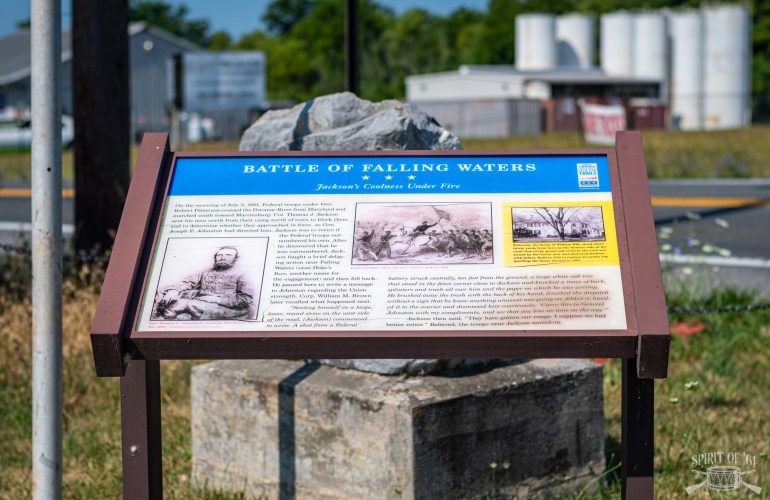
With these reinforcements in place, the Union line began to turn Harper’s flanks, forcing his small regiment to fall back in good order, firing as they withdrew. The Rockbridge Artillery positioned a single gun in the road to cover the retreat. Sitting on a rock outside the house known as Whitonia, Jackson was drafting a dispatch when a Union artillery shell burst nearby, scattering dirt and debris over him. He quietly brushed himself off, finished the message, and remarked, “They have gotten our range. I suppose we had better retire.”
Farther west, at the junction of Hammonds Mill and Vineyard roads, an area known as Stumpy’s Hollow, Company I of the 15th Pennsylvania was scouting ahead of Negley’s brigade. Captain Frank Hess left his men briefly to reconnoiter the road. During his absence, J. E. B. Stuart rode up and, mistaking the Pennsylvanians for his own troopers, ordered them to clear a fence. The Federals, seeing his dark blue uniform, assumed he was one of their officers. Stuart, however, realized the error first and commanded them to surrender. Most complied, but a few attempted to flee and were shot by Stuart’s reinforcements. One of the men involved in the firing was James Humbles, a freeman of color serving with the First Rockbridge Dragoons.
That afternoon, Jackson withdrew his entire brigade to Darkesville, about seven miles south of Martinsburg. Patterson occupied Jackson’s former camp, stopping for the night. He entered Martinsburg at noon on July 3, to the cheers of its predominantly unionist population.
The skirmish lasted less than an hour. One Confederate was killed and eight wounded; Union losses totaled three killed, seventeen wounded, and forty-nine captured.
Both sides could claim a measure of success. Patterson’s army drove the Confederates back and occupied Martinsburg, while Jackson’s disciplined withdrawal delayed the Federals long enough for Johnston to ready the Army of the Shenandoah to oppose them. Johnston commended Jackson’s composure under fire and recommended his promotion to brigadier general—a commission already en route.
Sources
Bates, Samuel P. History of Pennsylvania Volunteers, 1861-5. Harrisburg: B. Singerly, State Printer, 1869.
Driver, Robert J., Jr. 1st Virginia Cavalry. Lynchburg: H.E. Howard, Inc., 1991.
Driver, Robert J., Jr. The 1st and 2nd Rockbridge Artillery. Lynchburg: H.E. Howard, Inc., 1987.
Gwynne, S.C. Rebel Yell: The Violence, Passion and Redemption of Stonewall Jackson. New York: Scribner, 2015.
Hewett, Janet B., Noah Andre Trudeau, and Bryce A, Suderow, eds., Supplement to the Official Records of the Union and Confederate Armies. Pt. I, Vol. 1. Wilmington: Broadfoot Publishing Company, 1994.
Patterson, Robert. A Narrative of the Campaign in the Valley of the Shenandoah in 1861. Philadelphia: John Campbell, 1865.
Quiner, Edwin B. The Military History of Wisconsin: A Record of the Civil and Military Patriotism of the State, in the War for the Union. Chicago: Clarke & Co., 1866.
Rogers, Fairman, William Camac, M. Edward Rogers, et al. History of the First Troop Philadelphia City Cavalry. Philadelphia: Hollowell & Co., printers, 1875.
The War of the Rebellion: A Compilation of the Official Records of the Union and Confederate Armies. Series I, Vol. II. With additions and corrections. Washington: Government Printing Office, 1902.
Wallace, Lee A., Jr. 5th Virginia Infantry. Lynchburg: H.E. Howard, Inc., 1988.

 Spirit of '61
One thought on “Holding the Line at Hoke’s Run: Jackson’s First Test in the Shenandoah Valley”