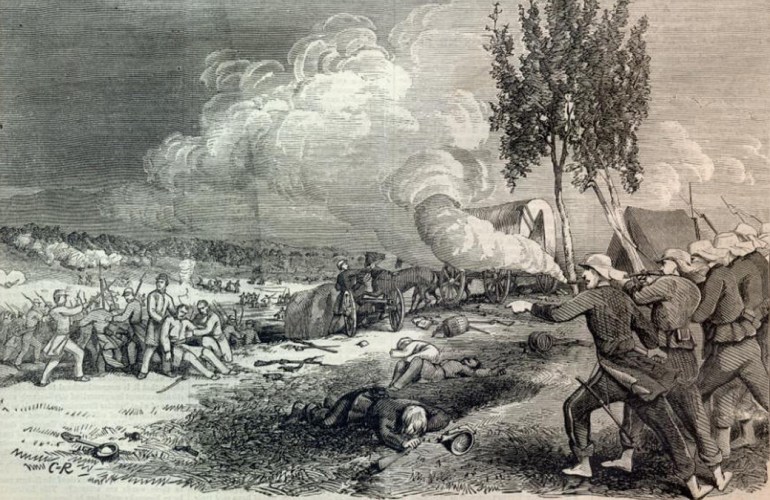
The Doyle brothers see the elephant in 1861
Guest Post by Steve Litteral, featured in Issue 2 of the Brass Bugle.
If you have traveled through the Shenandoah Valley of Virginia, then you know it is one of the most beautiful places in the country. The surrounding ancient rolling hills have seen men fighting men for countless years. Most of my family came to Virginia through the Jamestown Colony in the 17th Century, and they remained in the Commonwealth for centuries. My direct ancestors eventually settled in Bath County, Virginia, which now sits on the border of West Virginia.
After Virginia seceded from the Union, four men in my family joined local Confederate units. The Summer of 1861 was a very contentious time in Virginia, and by the end of the year they had all “Seen the Elephant” during the battles of Laurel Hill and Cheat Mountain.
My direct ancestor named George W. Doyle (1830-1904), and his two brothers (Eli and Jacob) left their family farm and joined the 31st Virginia Infantry in 1861. George Doyle lived in neighboring Highland County and joined the Highland County “Highlanders” led by Capt. Felix Hull. The company mustered in May 11, 1861 at Monterey and proceeded to Northwestern Virginia. After the retreat from Philippi, it was reorganized as Company E, 31st Virginia Infantry under Colonel William Lowther “Mudwall” Jackson, a lawyer, state legislator, and Virginia’s third Lieutenant Governor.
The Doyle brothers did not have to wait long to see action at the Battle of Laurel Hill, where they served under Brigadier General Robert S. Garnett (1819-1861). It was the first time the young farmers saw combat. The 31st was the first regiment to reach Laurel Hill and cut down trees and erected breastworks, to be joined later by other units of Garnett’s small army. Union troops commanded by Brig. Gen. Thomas A. Morris advanced on Laurel Hill July 7th and skirmished with Confederate forces for four days. Garnett was forced to abandon his fortifications on the night of the 11th when word reached him of the defeat at Rich Mountain.
Following the retreat from Laurel Hill and disaster at Corrick’s Ford, the 31st was reorganized again. The Highland County “Highlanders” had over 200 men, so on July 27, 1861 it was split into two companies. George and Jacob Doyle left with 100 other men to form the “new” Company B, also known as the Highlanders or Corn Creek Guards, under Capt. Robert Bradshaw.
Another direct ancestor of mine, John Martin Thomas (1844-1924) was a young cooper living in Bath County, and he joined the Fluvanna Guards, Company K, 44th Virginia Infantry at Bledsoe’s Church on June 11, 1861. The 44th rushed toward the fight at Rich Mountain but arrived too late to participate.
After the war, George Doyle and John Thomas would be related by marriage, but in September of 1861, they were both serving under the same leader, General Robert E. Lee. Lee was selected to lead Confederate forces against the Union soldiers marching through Western Virginia. My ancestors were present at the first battle where General Lee fought as a Confederate commander at the Battle of Cheat Mountain in September 1861.
The 31st VA joined Henry R. Jackson’s Brigade and the 44th VA joined Col. William B. Taliaferro ‘s brigade. Lee ordered a complicated envelopment of the Union camp on Cheat Mountain but the isolated units could not coordinate in such hostile terrain, with poor roads, mountain crevasses, and thick forests preventing communication.
The result of the battle was somewhat unremarkable since both sides ended the battle in the same spots where they started, but I find it interesting that I had family who were present at a historic moment in American history.
Both men survived the war, although they were both wounded and ended the war in cavalry units. George Doyle had one brother, Jacob, captured at the Battle of the Wilderness, and he eventually died at the POW camp in Elmira, NY. George and Eli Doyle went back to their family farm after the war.
John Martin Thomas was wounded in the hip at The Battle of Chancellorsville, and he later joined the 11th Virginia Cavalry once he was healed. He was eventually captured in March 1865, and he was imprisoned at the POW camp at Point Lookout, Maryland. He was eventually paroled in July 1865, and went back to being a cooper and he started a family.
I would encourage anyone who has the chance to investigate their own family history. You will never know where the road will lead you. I knew that I had ancestors who fought in the Civil War, but I had no idea when or where they served until I started to find gentlemen like George and John. I hope that you will find history in your own family tree.
Steve Litteral is a U.S. Army veteran, and he has a B.A. in history and M.A. in military history. He lives in Tennessee with his wife and children.

 Spirit of '61