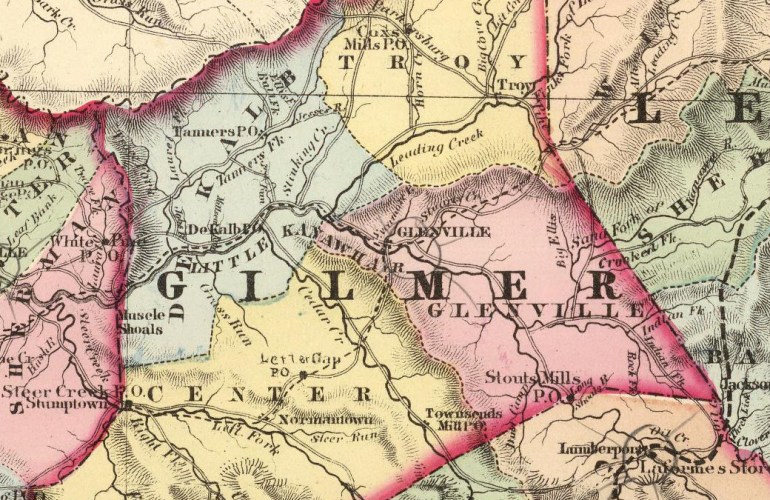
The Skirmish at Glenville was fought on July 7-8, 1861 in present-day Gilmer County, West Virginia. The dramatic episode proved to be a sideshow in the larger campaign of Union Maj. Gen. George B. McClellan to wrest control of Northwestern Virginia from the Confederacy. It’s often forgotten against the backdrop of the Battle of Rich Mountain.
The Union units involved are well known. Elements of the 17th Ohio Volunteer Regiment, led by Lt. Col. Francis B. Pond, were nearly surrounded, fighting for their lives, until relieved by the 7th and 10th Ohio regiments. The skirmish tied up these regiments and prevented them from being used at Rich Mountain. But who were the Confederates that so vexed them?
Widely published news reports cited Capt. Obadiah Jennings Wise (1831-1862), eldest son of former Virginia governor Henry A. Wise, as commander of the Confederate band, which reportedly numbered from several hundred to over one thousand. The Cincinnati Daily Gazette even reported that his cane had been captured and was on display as a war trophy:
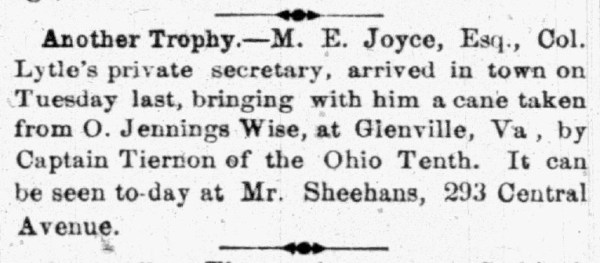
The only problem is that Obadiah Jennings Wise and his company, the Richmond Light Infantry Blues, were not at Glenville.
According to A Famous Command: The Richmond Light Infantry Blues by John A. Cutchins, Capt. Wise and his Light Infantry Blues were at Ripley on June 30th. They operated in and around that area until July 8th, when they started back to Charleston. They were at Ripley on July 6th. Ripley is approximately 64 miles west of Glenville. There’s no way Capt. Wise could have been in Glenville the following day, engage in a prolonged firefight, and return by the 8th.
Several secondary sources, however, explain that his father, Henry A. Wise, commander of the Wise Legion, which was operating in the Kanawha River Valley, did send a small force north to Glenville in Gilmer County. But they don’t say specifically what unit he sent.
In The First Year of the War, published in 1862, Edward A. Pollard wrote: “General Wise, anxious to give an assurance of support to the strong Southern sentiment reported to exist in Gilmer and Calhoun, sent an expedition into those counties to repress the excesses of the Union men.”
Terry D. Lowry, author of a regimental history of the 22nd Virginia Infantry, explained, “Wise had launched a separate attack north of Charleston at Glenville on July 7… but the 17th Ohio Volunteer Infantry held off the 160 rebels and sent them hurrying back to Charleston the following day.”
In Yanks from the South!, Fritz Haselberger echoed this. “Sometime during the 7th, about 160 well-armed and disciplined Confederates of the Wise Legion attacked four companies of the 17th Ohio at Glenville,” he wrote.
But who were they? What company? Who was their commander?
Thankfully, another name popped up in a few contemporary newspaper reports of the skirmish, that of Col. Robert Alexander Caskie (1830-1928), a well-known officer who served in the Richmond Grays prior to the war. At the outbreak of the war, he commanded a cavalry company called Caskie’s Mounted Rangers, which later became Company A, 10th Virginia Cavalry Regiment.
According to a letter dated July 17th in the July 22, 1861 issue of the Wheeling Daily Intelligencer:
“There rebel forces that had been congregated here [in Glenville] fled as soon as they got wind of the approach of the Federal troops. They sent on for reinforcements and an officer to lead them, with a view of retaking Glenville. Col. Caskie was sent on to reinforce and command them, having under his command four companies of well armed and well drilled soldiers… His whole force amounted in all, as nearly as I can learn, so one thousand or eleven hundred men. His force was to have been joined by O.J. Wise and whatever force he had under his command, but for some reason this arrangement was not consummated.”
The reason “this arrangement was not consummated” (if that truly was their plan) was because the 21st Ohio appeared in Ravenswood, 12 miles north of Ripley, and Obadiah Jennings Wise was compelled to withdraw. I wrote about this incident at length in a previous post.
An article about the Civil War in West Virginia in the Charleston Sunday Gazette-Mail, September 25, 1960, also stated: “On July 5, Capt. Robert A. Caskie, CSA, commanding the 160 cavalrymen raided north by way of Spencer and Arnoldsburg to Glenville, where they were met by a battalion of Ohio 17th Infantry and repulsed.”
Rosemary L. Gainer’s book The Civil War in Gilmer County, West Virginia (1991), also named Caskie as the Confederate commander at Glenville:
“The final break came on the seventh of July when a detachment of Confederate cavalry under the command of Captain R.A. Caskie approached Glenville from the south. At that time, the 17th Ohio Infantry commanded by Colonel Francis Pond was camped around the Courthouse, having arrived on May 26 with orders to protect the Staunton Parkersburg Pike.” -Pg. 7
Unfortunately, regimental historian Robert J. Driver, Jr. placed Caskie’s Mounted Rangers in Lewisburg on July 17th, having been in Richmond during the month of June. Lewisburg is roughly 120 miles south of Glenville.
Some piece of information is missing here. It’s possible Robert Caskie himself was in western Virginia, and his company was left behind while he commanded other cavalry units. (I have a newspaper article mentioning him alongside Henry Wise on or before July 1) But if that was the case, I have been unable to locate any other cavalry unit in Glenville on July 7-8, 1861 based on multiple regimental histories, principally the 8th Virginia Cavalry and 10th Virginia Cavalry.
Until this missing piece can be found, I can’t confirm what Confederate unit or units fought at Glenville in 1861, which is unfortunate because it was a dramatic action that deserves to be known.

 Spirit of '61