Fifty-eight. That’s how many days passed between the Union Army crossing the Potomac River into northeastern Virginia and the First Battle of Manassas (Bull Run). During those nearly two months, the Union and Confederate armies shadowboxed in that corner of Virginia, hampered by undisciplined and inexperienced soldiers while probing for enemy weaknesses. The exact number…
Tag: Potomac Front
Thank God for Michigan: Orlando B. Willcox (1823–1907)
Photographic Portrait of Orlando B. Willcox. Library of Congress Prints and Photographs Division. Orlando Bolivar Willcox (1823–1907) was born on April 16, 1823, in Detroit, Michigan Territory. He graduated from the United States Military Academy at West Point in 1847. Commissioned as a second lieutenant in the 4th U.S. Artillery, Willcox served at the end…
Continue reading ➞ Thank God for Michigan: Orlando B. Willcox (1823–1907)
A Costly Lesson at Blackburn’s Ford
Though minor in comparison to the clash that would erupt at Bull Run days later, the fight at Blackburn’s Ford rattled Union confidence and emboldened Confederate troops. With McDowell now seeking another route forward, the war’s first major battle loomed just beyond the horizon. Confederate Brig. Gen. Pierre Gustave Toutant-Beauregard arrived at Manassas Junction on…
Daniel Ruggles: A New England General in the Confederate Ranks
Photographic Portrait of Daniel Ruggles. Library of Congress Prints and Photographs Division. Daniel Ruggles (1810–1897), born in Barre, Massachusetts, became one of the few New Englanders to achieve the rank of general officer in the Confederate Army. After graduating 34th in his class from the U.S. Military Academy at West Point in 1833, he embarked…
Continue reading ➞ Daniel Ruggles: A New England General in the Confederate Ranks
In the Shadow of Shuter’s Hill: A Deadly Night on the Picket Line
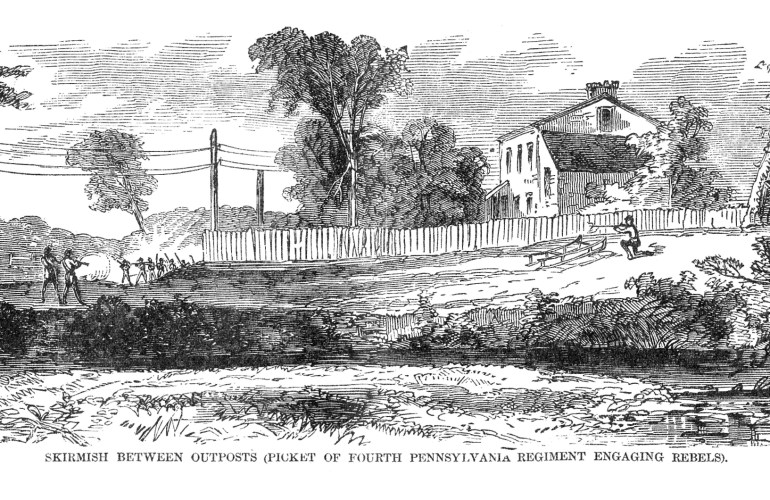
As June 1861 dragged on with little progress in northeast Virginia, restless Union and Confederate troops found themselves locked in a brief but bloody skirmish near Alexandria. A late-night clash between Pennsylvania infantry and Southern cavalry left men dead on both sides, yet did nothing to alter the course of the campaign. June 1861 passed…
Continue reading ➞ In the Shadow of Shuter’s Hill: A Deadly Night on the Picket Line
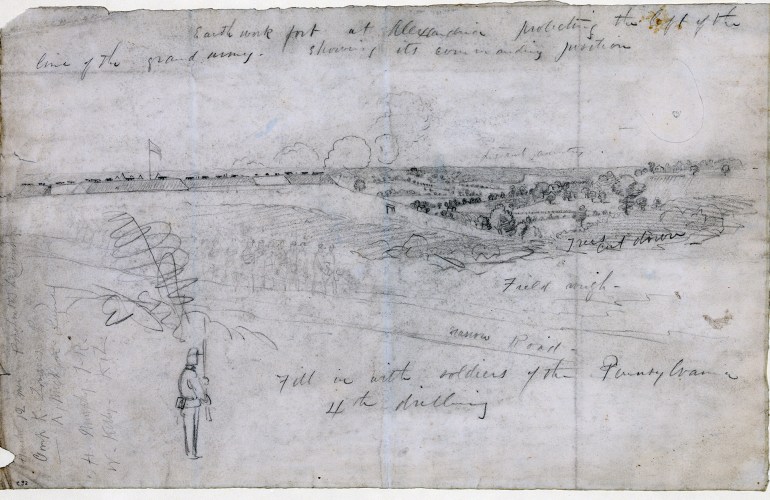
Earthwork Fort at Alexandria Protecting the Left of the Line of the Grand Army
This unfinished pencil drawing by famed artist Alfred Rudolph Waud (1828-1891) depicts Fort Ellsworth on Shuter’s (or Shooter’s) Hill, west of Alexandria in late June / early July 1861. Illustration has been enhanced to show details. Library of Congress Prints and Photographs Division. Click on the image to expand. The illustration is titled, Earthwork fort…
Continue reading ➞ Earthwork Fort at Alexandria Protecting the Left of the Line of the Grand Army
The Union’s Failed Gamble to Control Mathias Point
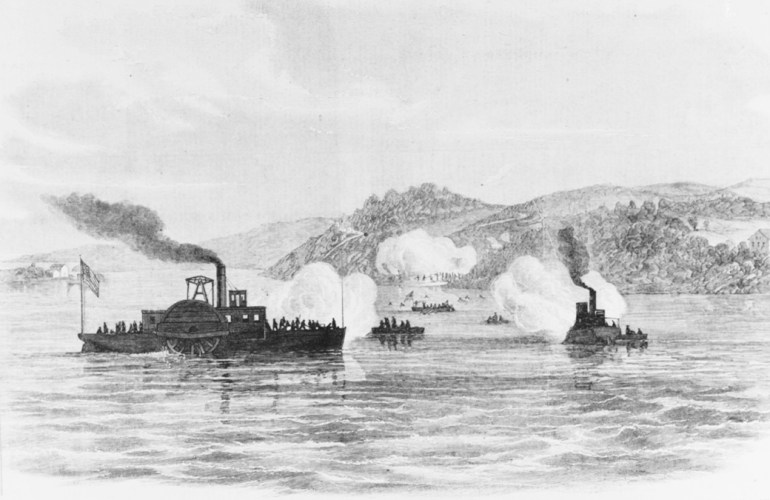
In the summer of 1861, Union forces launched a desperate attempt to secure Mathias Point, a strategic bend in the Potomac River that Confederate troops used to disrupt shipping. What began as a routine landing quickly unraveled into a deadly ambush, claiming the life of Commander James H. Ward and forcing the Union to abandon…
Continue reading ➞ The Union’s Failed Gamble to Control Mathias Point
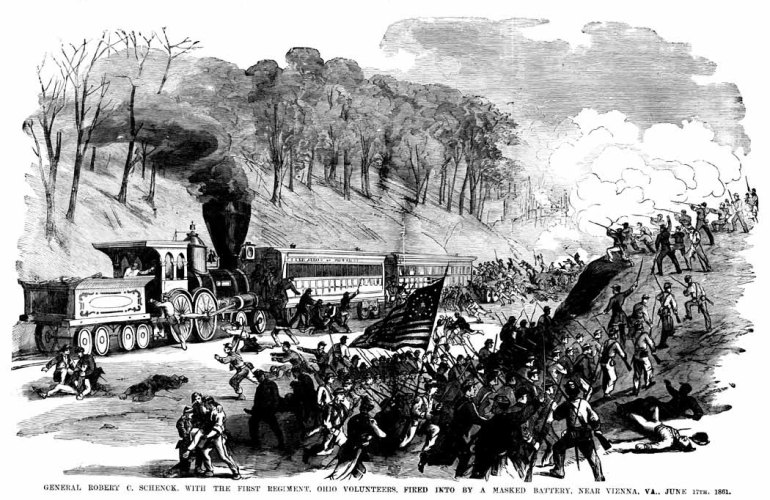
Rails, Rebels, and Ruin: The 1st Ohio Infantry’s Deadly Encounter at Vienna
In June 1861, a Union reconnaissance mission along the AL&H Railroad took a deadly turn when Confederate forces ambushed a troop train near Vienna, Virginia. The surprise attack exposed the vulnerability of Union operations, forcing a hasty retreat and reinforcing the caution of military leaders as the conflict escalated. By mid-June 1861, the Union’s rapid…
Continue reading ➞ Rails, Rebels, and Ruin: The 1st Ohio Infantry’s Deadly Encounter at Vienna
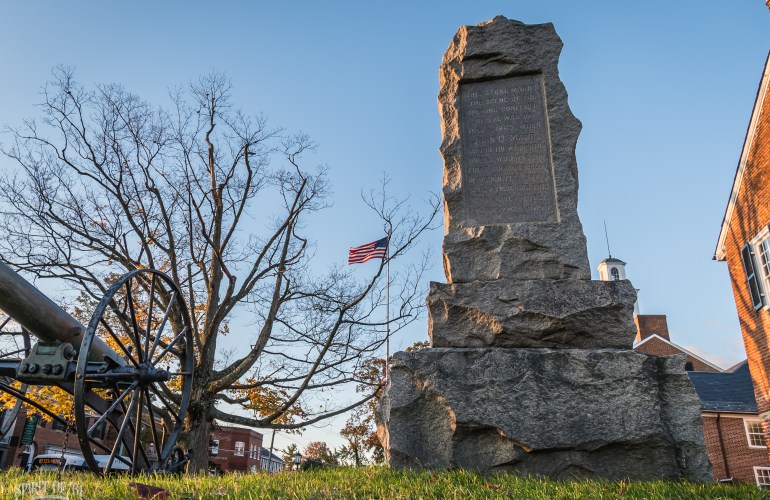
What Happened to Fairfax County’s John Q. Marr Monument?
John Q. Marr’s fatal encounter with Union cavalry in Fairfax Court House on June 1, 1861, marked a bloody opening salvo of the Civil War, yet the debate over his legacy—and the monument that once bore his name—continues over a century later. For over a century, a granite monument stood near the old Fairfax County…
Continue reading ➞ What Happened to Fairfax County’s John Q. Marr Monument?
Outpost Watching Falls Church, Virginia, 1861
This pencil drawing by famed artist Alfred Rudolph Waud (1828-1891) depicts a Union artillery piece and camp of 2nd United States Cavalry, Company B, led by Lieutenant Charles H. Tompkins, near Falls Church, Virginia on July 1, 1861. Exactly one month earlier, Tompkins led a chaotic reconnaissance on Fairfax Court House, in which several of…
Continue reading ➞ Outpost Watching Falls Church, Virginia, 1861