Saturday, June 29, 1861
Near the end of June 1861, a stalemate in Northwest Virginia ended when Union forces ambushed a Confederate scouting party along the Cheat River, securing a smooth election for delegates to the unionist Restored Government of Virginia.
Narrative
The Action at Bowman’s Place (aka Hannahsville or Cheat River) was fought on Saturday, June 29, 1861 between Union forces commanded by Capt. Hiram Miller and Confederate forces commanded by Lt. Robert McChesney in present-day Tucker County, West Virginia. The brief but deadly skirmish, tied to control of the Cheat River corridor, revealed how quickly political conflict in northwestern Virginia could turn violent.
More than a month had passed since Virginia’s secession referendum and Maj. Gen. George B. McClellan’s invasion of the northwest. Protected by McClellan’s Army of Occupation, the region’s unionists gathered in Wheeling, a city on the Ohio River in Virginia’s panhandle, to form a new state government that would remain loyal to the United States.
Between June 11 and 25, 1861, one hundred delegates from 34 counties convened to establish the Reorganized or “Restored” Government of Virginia. They argued that the existing government in Richmond had abdicated its authority by voting to secede.
On June 20, the delegates unanimously elected Francis H. Pierpont as governor. A staunch unionist, abolitionist, and attorney for the Baltimore & Ohio (B&O) Railroad, Pierpont’s new government was quickly granted recognition by President Abraham Lincoln.
With volunteer regiments arriving weekly, McClellan was ready to press his advantage. He arrived in Grafton on June 23, to take personal command of the coming offensive. His target was the small but growing Confederate force under Brig. Gen. Robert S. Garnett, which was blocking the vital east-west passages of the Allegheny Mountains and threatening the B&O Railroad.
Garnett had arrived nine days earlier to help restore confidence in Confederate forces in the region, whose morale had been badly shaken after a series of setbacks. He proceeded to fortify positions in Barbour and Randolph counties to guard the two main mountain roads leading into the Shenandoah Valley.
Garnett established his headquarters at Laurel Hill on the Beverly-Fairmont Turnpike and sent Lt. Col. Jonathan M. Heck and the 25th Virginia Infantry Regiment to fortify Rich Mountain overlooking the Staunton-Parkersburg Turnpike.
Toward the end of June, counties under Union control held elections for the Restored Government’s new House of Delegates. In Randolph and Tucker counties, Dr. Solomon Parsons, a delegate to the Wheeling Convention, ran unopposed.
Detached companies of the 15th and 16th Ohio Infantry, along with Capt. James F. Donnelly’s Cameron Volunteers, 1st Virginia (U.S.), were stationed around Rowlesburg to guard the B&O Railroad and the Tray Run Viaduct over the Cheat River.
Earlier that month, Capt. Hiram Miller of Company H, 15th Ohio, received word that secessionists had raised a flag over the Tucker County Courthouse in St. George, eighteen miles south of Rowlesburg and twenty-three miles north of Garnett’s camp at Laurel Hill. He set out the night of June 9 with forty men and reached St. George early the next morning. Finding no resistance, they seized a flag at the courthouse and another from a private home, then returned to Rowlesburg in triumph, one adorned with a rattlesnake and the other with a wildcat skin.
Now his unit returned to ensure the election proceeded smoothly.
The 2nd Rockbridge Dragoons, led by Capt. John R. McNutt and Lt. Robert McChesney, were camped with Garnett at Laurel Hill and regularly rode out on patrol. On the night of Friday, June 28, McChesney and nine picked men set out northeast toward St. George along the Cheat River on a scouting mission, intent on disrupting what they regarded as an illegitimate election.
The next morning, McChesney and his men, joined by a handful of local secessionist militia, rode into St. George and found the vote had already taken place. They continued north along a mountain road following the Cheat River toward the home of Adam H. Bowman, an attorney, which was being used as a polling place near the small hamlet of Hannahsville.
Captain Miller received word of their approach and prepared an ambush with his own company, along with men from Company D, 16th Ohio, and the Cameron Volunteers, for a total of roughly 150. Concealed on either side of the road, they allowed McChesney and his small troop to advance. Some may have been dressed in civilian clothes to avoid arousing suspicion.
Accounts differ on how the Confederate cavalry became aware of the trap. One suggests they “got a hint,” while another claims a detachment of Union soldiers inadvertently exposed themselves. McChesney, or someone in his party, spotted the soldiers and turned to escape. Shots rang out. McChesney was mortally wounded, and three of his men were wounded but escaped. It was said that Capt. Miller shot the young Confederate officer.
One man from the 15th Ohio, Pvt. Nathan O. Smith, a schoolteacher from Mansfield, was killed, and another wounded. Smith was the first combat death in his regiment, as McChesney was in his.
Brevet Brig. Gen. Charles W. Hill, writing from his headquarters in Grafton, where he oversaw defense of the railroad east to the Maryland border, reported to McClellan: “A light skirmish yesterday after the election in Tucker Co between Col Irvin’s men & a Company 60 sixty cavalry from Rockbridge a lieut of the cavalry was killed & several of his men believed to be wounded & several of his horses taken. One man of the sixteenth 16th killed & another wounded. Rebels dispersed.”
Colonel James Irvine of the 16th Ohio came into possession of McChesney’s personal effects and returned them to the lieutenant’s family. He wrote: “I will, therefore, not speak of it further than to say that he bore himself gallantly, and my sympathies were greatly enlisted for him when he fell. What should have been our common country, lost a brave and gallant man.”
Though soon eclipsed by larger, bloodier battles, the two men who fell at Bowman’s Place were mourned at home as martyrs for their respective causes. The skirmish had no bearing on the outcome of McClellan’s larger campaign. In early July, the new House of Delegates of the Restored Government sent Waitman T. Willey and John S. Carlile to the U.S. Senate. With the political groundwork laid, all that remained was to defeat Garnett’s small army at Laurel Hill and Rich Mountain, a task McClellan pursued with a vigor seldom displayed in his later campaigns.
Opposing Forces
Confederate
Brig. Gen. Robert S. Garnett, Commanding
| Confederate | Commander(s) | Strength | Killed | Wounded | Captured |
|---|---|---|---|---|---|
| Second Rockbridge Dragoons | Capt. John R. McNutt Lt. Robert McChesney | 10* | 1 | 3 | 0 |
Union
Brig. Gen. Charles W. Hill, Commanding
| Union | Commander(s) | Strength | Killed | Wounded | Captured |
|---|---|---|---|---|---|
| 15th Ohio Infantry Reg. (Company H) | Col. George W. Andrews Capt. Hiram Miller | 102 | 1 | 1 | 0 |
| 16th Ohio Infantry Reg. (Company D) | Col. James Irvine Capt. Richard W. McClain | 101* | 0 | 0 | 0 |
| 1st Virginia Infantry Reg. (Company F **) | Col. Benjamin F. Kelley Capt. James F. Donnelly | 76 | 0 | 0 | 0 |
** May have been H, but it’s unclear which company Donnelly commanded in late June
Casualties
| Name | Unit | Killed | Wounded |
|---|---|---|---|
| Lt. Robert McChesney | 2nd Rockbridge Dragoons | X | |
| Pvt. Albert G. M. Paxton | 2nd Rockbridge Dragoons | X | |
| Pvt. Isaac Friend | 2nd Rockbridge Dragoons | X | |
| Pvt. Franklin G. “Dock” Long | 2nd Rockbridge Dragoons | X |
| Name | Unit | Killed | Wounded |
|---|---|---|---|
| Pvt. Nathan O. Smith | 15th OH, Co. H | X | |
| Pvt. John Mathys | 15th OH, Co. H | X |
Timeline
May 26, 1861: Maj. Gen. George B. McClellan orders Union troops under his command to invade northwestern Virginia, converging on Grafton and securing the Baltimore and Ohio Railroad.
June 3, 1861: Virginia militia units commanded by Col. George A. Porterfield are routed at Philippi. Porterfield retreats to Beverly on the Tygart Valley River.
June 11, 1861: Second Wheeling Convention opens in Wheeling, Virginia on the Ohio River. Delegates meet to determine a new, pro-Union Restored Government of Virginia.
June 13-15, 1861: Brig. Gen. Robert S. Garnett is placed in command of Confederate forces in northwestern Virginia. He proceeds to fortify positions at Laurel Hill and Rich Mountain in Barbour and Randolph counties to guard the two main mountain roads.
June 29, 1861: An election is held in Randolph and Tucker counties for delegate to the Restored Government of Virginia.
Location
GPS Coordinates — 39.24128, -79.71168
Primary Sources
News Articles

SUNDAY NIGHT’S DISPATCHES
GRAFTON, June 30. — A skirmish took place at Bowman’s, 12 miles from the Cheat river bridge, yesterday, between portion of the 15th and 16th Ohio and 1st Virginia regiments and a company of rebel cavalry, the former were went to protect the pol [polls?], and the latter, mistaking their number, attacked them and were routed with the loss of several men, among them the Lieutenant of the company, and several horses. The only loss on our side was N.O. Smith, of the 15th, who was buried here to-day.
Daily Intelligencer (Wheeling) 1 July 1861.
A nearly identical dispatch appears in The Cincinnati Enquirer but states that Federal troops were there to protect the bridge.

A LITTLE FIGHT IN TUCKER COUNTY
–Dr. Parsons, who arrived from Tucker yesterday (Sunday) reports a little brush with the enemy at his election precinct, Esquire Bowman’s. An election was held there Saturday for member of the Legislature. The secessionists with the double motive of capturing the Doctor, whom they knew to be there, and of breaking up the election, undertook to make a descent on the place with a troop of cavalry, numbering some 60. But the Union men who had been apprised of their intention made preparation to receive them, by posting a company on each side of the road approaching the place, and would have certainly captured them, but for a hint the rebels had got of the arrangement. This made them cautious, and they discovered the ambuscade in time to wheel their horses and make good their escape, not however till a volley had killed one of their lieutenants and emptied three other saddles, the owners of which were supposed to have been wounded. The horses were captured, but the men could not be found. They were supposed to have been carried off by their comrades, who immediately took to the brush, and could not be pursued. One of the Union men, a soldier of the Ohio Sixteenth, was shot through the head and instantly killed, by a scattering volley from the retreating foe. Another was wounded in the leg.
The election, however, came off successfully, and Dr. Parsons was elected to the Legislature.
Daily Intelligencer (Wheeling) 1 July 1861.
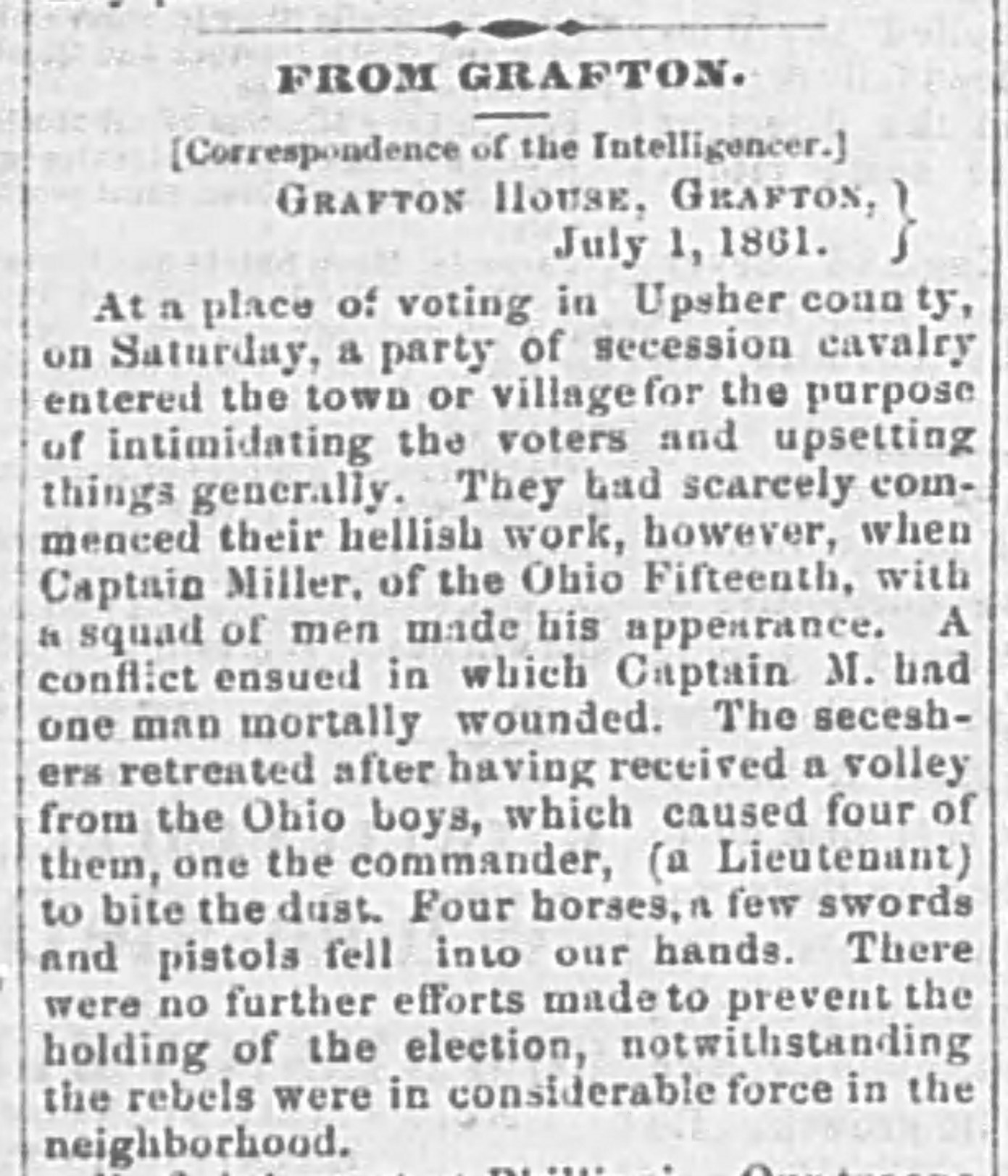
FROM GRAFTON.
[Correspondence of the Intelligencer.]
GRAFTON HOUSE, GRAFTON, July 1, 1861. }
At a place of voting in Upsher county, on Saturday, a party of secession cavalry entered the town or village for the purpose of intimidating the voters and upsetting things generally. They had scarcely commenced their hellish work, however, when Captain Miller, of the Ohio Fifteenth, with a squad of men made his appearance. A conflict ensued in which Captain M. had one man mortally wounded. The seceshers retreated after having received a volley from the Ohio boys, which caused four of them, one the commander, (a Lieutenant) to bite the dust. Four horses, a few swords and pistols fell into our hands. There were no further efforts made to prevent the holding of the election, notwithstanding the rebels were in considerable force in the neighborhood.
Daily Intelligencer (Wheeling) 2 July 1861.

Our First Victim.
A son of Richland county has fallen in defence of his country. On the 29th ult [?] a skirmish took place at Bowman’s, about 12 miles from Cheat River Bridge, on the Baltimore and Ohio Railroad, between the 15th and 16th Ohio regiments, and some rebels. The rebels were routed with a loss of several men. We had one killed; Mr. N.O. Smith, of Capt. Miller’s Company. Mr. S. lived about five miles from this city. His occupation was school teaching, but when he volunteered, he was a student at the Hayseville Seminary. He was an excellent young man, and died as a gallant soldier would desire to die–on the field of victory.
“Dulce est pro patria mori.” [Latin–“It is sweet to die for one’s country”]
Semi Weekly Herald (Mansfield) 3 Jul 1861.

The body of N. O. Smith, private of Captain Miller’s Company, of the 15th, passed through last night on the cars on the way to Mansfield. Mr. Smith was a worthy young man. He fell at Bowman’s, twelve miles from Cheat River Bridge. The circumstances attending his killing are very painful.
Daily Courier (Zanesville) 5 Jul 1861.

Semi Weekly Herald (Mansfield) 6 Jul 1861.
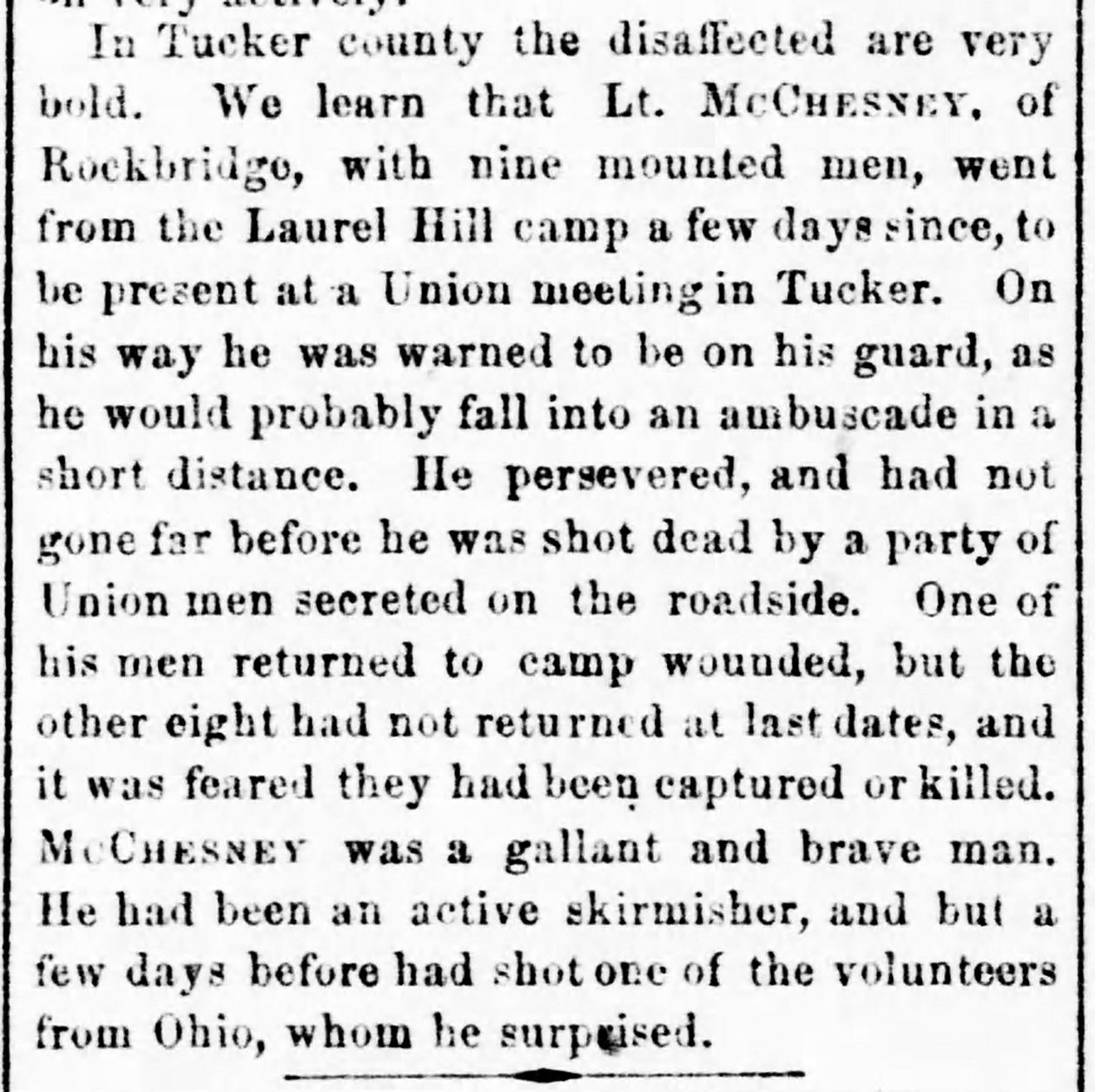
In Tucker County the disaffected are very bold. We learn that Lt. McChesney, of Rockbridge, with nine mounted men, went from the Laurel Hill camp a few days since, to be present at a Union meeting in Tucker [County]. On his way he was warned to be on his guard, as he would probably fall into an ambuscade in a short distance. He persevered, and had not gone far before he was shot dead by a party of Union men secreted on the roadside. One of his men returned to camp wounded, but the other eight had not returned at last dates, and it was feared they had been captured or killed. McChesney was a gallant and brave man. He had been an active skirmisher, and but a few days before had shot one of the volunteers from Ohio, whom he surprised.
Dispatch (Richmond) 8 Jul 1861.
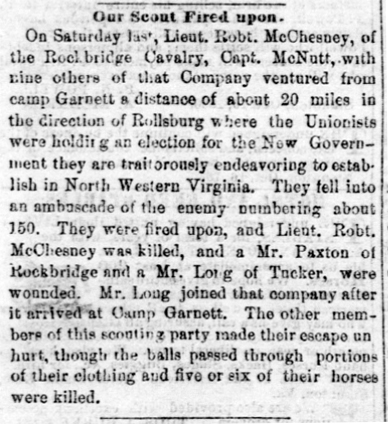
Our Scout Fired upon.
On Saturday last, Lieut. Robt. McChesney, of the Rockbridge Cavalry, Capt. McNutt, with nine others of that Company ventured from camp Garnett a distance of about 20 miles in the direction of Rollsburg where the Unionists were holding an election for the New Government they are traitorously endeavoring to establish in North Western Virginia. They fell into an ambuscade of the enemy numbering about 150. They were fired upon, and Lieut. Robt. McChesney was killed, and a Mr. Paxton of Rockbridge and a Mr. Long of Tucker, were wounded. Mr. Long joined that company after it arrived at Camp Garnett. The other members of this scouting party made their escape unhurt, though the balls passed through portions of their clothing and five or six of their horses were killed.
Spectator (Staunton) 9 Jul 1861.
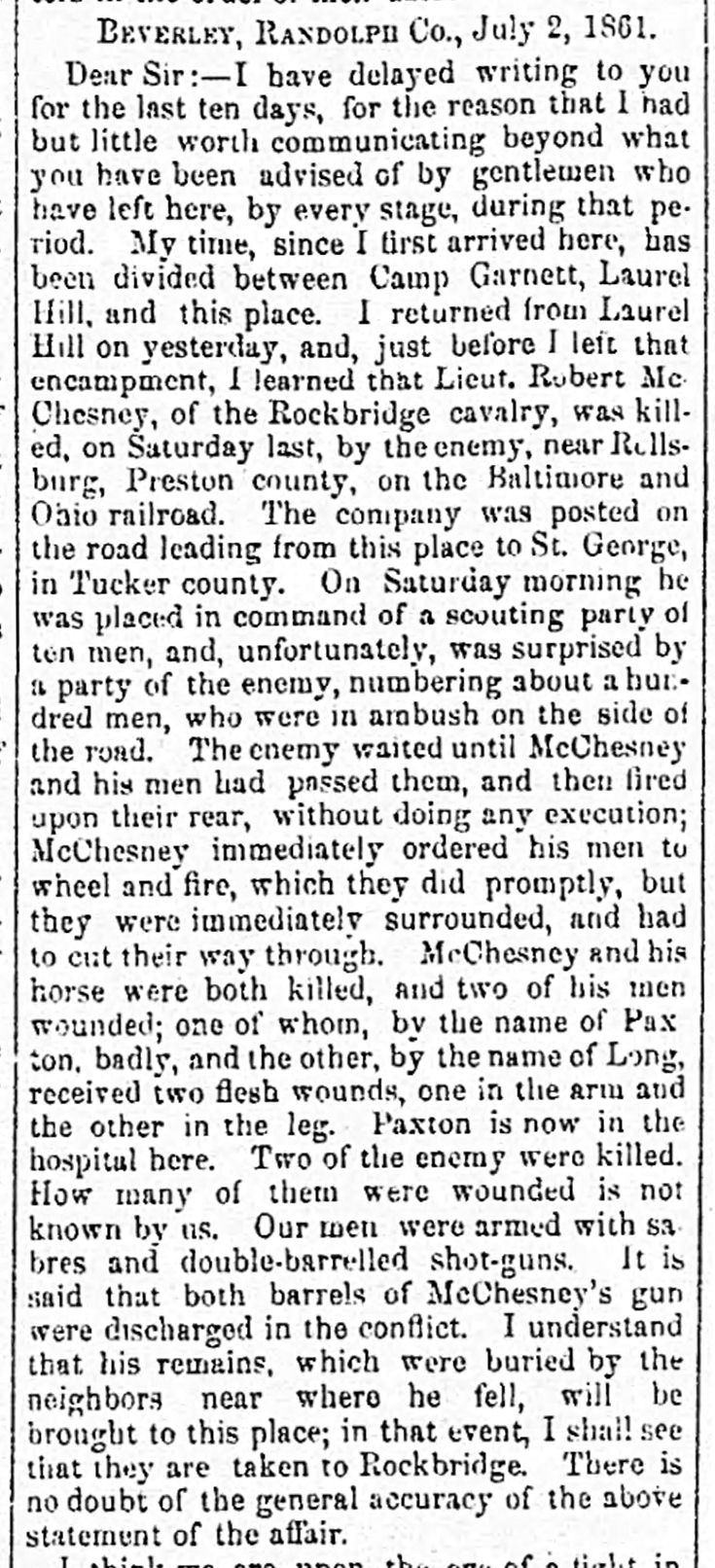
BEVERLEY, RANDOLPH CO., July, 2, 1861
Dear Sir:–I have delayed writing to you for the last ten days, for the reason that I had but little worth communicating beyond what you have been advised of by gentlemen who have left here, by every stage, during that period. My time, since I first arrived here, has been divided between Camp Garnett, Laurel Hill, and this place. I returned from Laurel Hill on yesterday, and, just before I left that encampment, I learned that Lieut. Robert McChesney, of the Rockbridge cavalry, was killed, on Saturday last, by the enemy, near Rollsburg, Preston county, on the Baltimore and Ohio railroad. The company was posted on the road leading from this place to St. George, in Tucker county. On Saturday morning he was placed in command of a scouting party of ten men, and, unfortunately, was surprised by a party of the enemy, numbering about a hundred men, who were in ambush on the side of the road. The enemy waited until McChesney and his men had passed them, and then fired upon their rear, without doing any execution; McChesney immediately ordered his men to wheel and fire, which they did promptly, but they were immediately surrounded, and had to cut their way through. McChesney and his horse were both killed, and two of his men wounded; one of whom, by the name of Paxton, badly, and the other, by the name of Long, received two flesh wounds, one in the arm and the other in the leg. Paxton is now in the hospital here. Two of the enemy were killed. How many of them were wounded is not known by us. Our men were armed with sabres and double-barrelled shot-guns. It is said that both barrels of McChesney’s gun were discharged in the conflict. I understand that his remains, which were buried by the neighbors near where he fell, will be brought to this place; in the event, I shall see that they are taken to Rockbridge. There is no doubt of the general accuracy of the above statement of the affair.
Inquirer (Richmond) 9 Jul 1861.
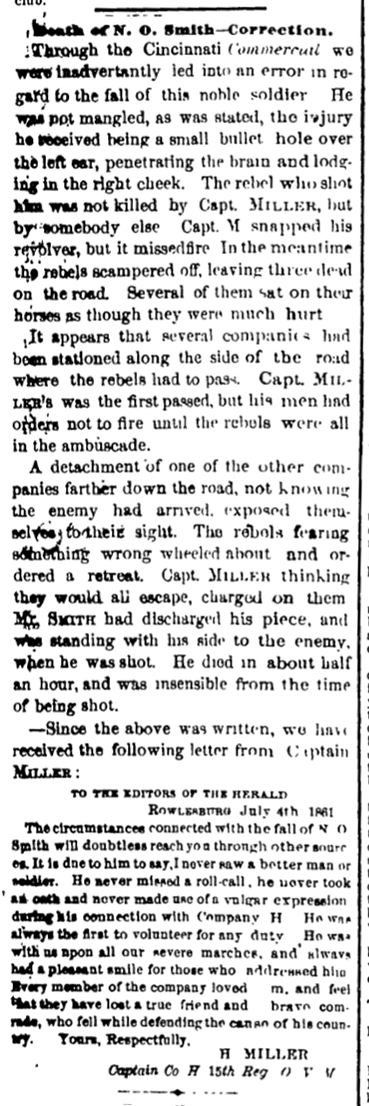
Death of N. O. Smith–Correction.
Through the Cincinnati Commercial we were inadvertently led into an error in regard to the fall of this noble soldier. He was not mangled, as was stated, the injury he received being a small bullet hole over the left ear, penetrating the brain and lodging in the right cheek. The rebel who shot him was not killed by Capt. Miller, but by somebody else. Capt. M snapped his revolver, but it missedfire. In the meantime the rebels scampered off, leaving three dead on the road. Several of them sat on their horses as though they were much hurt.
It appears that several companies had been stationed along the side of the road where the rebels had to pass. Capt. Miller’s was the first passed, but his men had orders not to fire until the rebels were all in the ambuscade.
A detachment of one of the other companies farther down the road, not knowing the enemy had arrived, exposed themselves to their sight. The rebels fearing something wrong wheeled about and ordered a retreat. Capt. Miller thinking they would all escape, charged on them. Mr. Smith had discharged his piece, and was standing with his side to the enemy, when he was shot. He died in about half an hour, and was insensible from the time of being shot.
–Since the above was written, we have received the following letter from Captain Miller:
TO THE EDITORS OF THE HERALD
Rowlesburg, July 4th, 1861.
The circumstances connected with the fall of N. O. Smith will doubtless reach you through other sources. It is due to him to say, I never saw a better man or soldier. He never missed a roll-call; he never took an oath and never made use of a vulgar expression during his connection with Company H. He was always the first to volunteer for any duty. He was with us upon all our severe marches, and always had a pleasant smile for those who addressed him. Every member of the company loved him and feel that they have lost a true friend and brave comrade, who fell while defending the cause of his country. Yours Respectfully,
H. MILLER
Captain Co. H. 15th Reg. O. V. I.
Semi Weekly Herald (Mansfield) 10 Jul 1861.

Daily Intelligencer (Wheeling) 11 July 1861.
Reports and Letters
- June 25 Report of Brig. Gen. Robert S. Garnett, C. S. Army
- June 25 Letter from Robert E. Lee to Robert S. Garnett
- June 30 Report of Brevet Brig. Gen. Charles W. Hill
- July 1 Report of Brig. Gen. Robert S. Garnett, C. S. Army
- July 1 Letter from Robert E. Lee to Robert S. Garnett
Sources
Carnes, Eva Margaret. The Tygarts Valley Line, June-July 1861. Philippi: First Land Battle of the Civil War Centennial Commemoration, Inc., 1961. Parsons: McClain Printing Company, 2003.
Cope, Alexis. The Fifteenth Ohio Volunteers and Its campaigns, War of 1861-5. Columbus, OH: By the author, 1916.
Driver, Robert J., Jr. 14th Virginia Cavalry. Lynchburg: H.E. Howard, Inc, 1988.
Dyer, Frederick. A Compendium of the War of the Rebellion. Des Moines: The Dyer Publishing Company, 1908.
Evans, Clement, Ed. Confederate Military History, Vol. II. New York: Thomas Yoseloff, 1962.
Fansler, Homer Floyd. History of Tucker County, West Virginia. Parsons: McClain Printing Company, 1962.
Hill, N.N., Jr. History of Coshocton County, Ohio: Its Past and Present, 1740-1881. Newark, OH: A.A. Iraham & Co., 1881.
Irvine, Dallas, ed. Military Operations of the Civil War: A Guide-Index to the Official Records of the Union and Confederate Armies, 1861-1865, Vol. II. Washington, DC: The National Archives, 1971.
Maxwell, Hu. History of Tucker County, West Virginia. Kingwood: Preston Publishing Company, 1884.
Morton, Oren F. A History of Rockbridge County, Virginia. Staunton: The McClure Co., Inc, 1920.
Official Roster of the Soldiers of the State of Ohio in the War of the Rebellion, 1861-1866, Vol. 1. Akron: The Werner Company, 1893.
Updated: 25 April 2026
Created: 23 April 2021


Say some more about Adam H. Bowman if you can. Jeff Felton
LikeLiked by 1 person
Appreciate the comment! Unfortunately, I haven’t found much about him, just that he was an attorney and ran for office at some point. Why are you curious about him in particular?
LikeLike