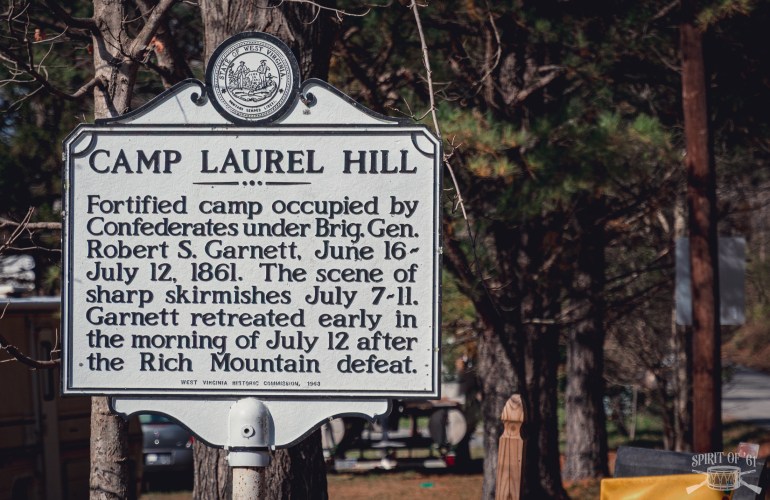
Following the rout at Philippi on June 3, Confederate President Jefferson Davis promoted Robert S. Garnett, adjutant to Robert E. Lee, to brigadier general and placed him in command of the army in the northwest. Garnett, 41, was a former U.S. Army officer and assistant instructor of infantry tactics at West Point. He joined Col. George Porterfield and the remnants of his small force at Huttonsville on June 14 and immediately set about organizing what he had on hand.
Faced with a fragile and untested command, Garnett nonetheless understood the importance of blocking the two main turnpikes that crossed the Alleghenies into the Shenandoah Valley. He established his headquarters at Laurel Hill in Barbour County along the Beverly-Fairmont Turnpike and sent a smaller force to fortify Rich Mountain overlooking the Staunton-Parkersburg Turnpike.
Garnett surrounded himself with a capable staff who, given time, might have forged an effective fighting force. His staff officers included Maj. James S. Williams, chief engineer; Maj. Robert G. Cole, commissary of subsistence; Capt. Samuel M. Yost, assistant quartermaster; Capt. James L. Corley, adjutant general, later chief quartermaster of the Army of Northern Virginia; Jebediah Hotchkiss, topographical engineer; and Capt. Julius A. DeLagnel, chief of artillery. Aides-de-camp included Capt. James B. S. Alexander, Lt. Col. William E. Starke, Lt. William D. Humphries, Waddy S. Bacon, and Thomas R. Harrison.
DeLagnel and Hotchkiss were assigned to Rich Mountain. Captain Alexander, a West Point graduate who had served with Garnett in the Regular Army, contracted a serious illness while carrying messages during the fighting at Belington and Rich Mountain and died on August 13.
Determining the exact strength and composition of Garnett’s force at Laurel Hill is difficult. Record keeping was uneven, and much of what was kept was lost or destroyed during the retreat. Fortunately, one return of his forces survived and appears in the Official Records, Series I, Vol. II.
On July 8, 1861, as Morris’ force advanced on Belington and Laurel Hill, Garnett reported the following troops “present for duty” at Laurel Hill. He listed a “total present” of 209 officers and 3,351 men. He offered no explanation for the discrepancy of 483 officers and men, though it was likely due to sickness, as measles had broken out in camp. Using this and other data from primary and secondary sources, we can make a fairly accurate estimate of each unit’s strength.
| Infantry | Cavalry | Artillery | Total | |
|---|---|---|---|---|
| Officers | 178 | 6 | 4 | 188 |
| Men | 2,666 | 131 | 92 | 2,889 |
| 2,844 | 137 | 96 | 3,077 |
23rd Virginia Infantry
The 23rd Virginia Infantry was organized at Camp Lee in Richmond in May 1861 under Col. William B. Taliaferro. Ordered to northwestern Virginia on June 7, it reached Laurel Hill on June 19. The regiment initially numbered about 686 officers and men but was soon ravaged by illness. How many of the 49 men listed as sick in July were present for the fighting on July 7–11 is difficult to determine.
31st Virginia Infantry
Garnett formed the 31st Virginia Infantry Regiment largely from companies that fled Philippi. William J. Willey was originally assigned as its colonel when the regiment existed only on paper, but he was sick in bed at Philippi and captured. Lt. Col. William Lowther Jackson, a judge and former lieutenant governor from Clarksburg, assumed command. No return survives for the 31st Virginia for this period, so I have estimated its strength at about 630 officers and men based on Garnett’s total infantry “present for duty.” Figures for six of the regiment’s ten companies, totaling roughly 555, suggest that the estimate is reasonably sound.
37th Virginia Infantry
Samuel Vance Fulkerson, a Virginia Military Institute graduate and veteran of the Mexican-American War, assembled the 37th Virginia Infantry from volunteers in southwestern Virginia. When the regiment reached Richmond in late May, it had only eight of its ten companies. Six went on to join Garnett at Laurel Hill, arriving by June 25; the remaining two followed within the week. The regiment was not brought up to the standard ten companies until August 1861. As with the 31st Virginia, no return survives for this period, so I have estimated its strength at about 630 officers and men based on Garnett’s total infantry “present for duty.”
1st Georgia Infantry (Ramsey’s)
Raised by Col. James Newton Ramsey and mustered for one year in March 1861, the 1st Georgia Volunteer Regiment played a central role in the war’s opening months in Virginia. Its first assignment was garrison duty at Pensacola, Florida, after which it went to Richmond to be sworn into Confederate service. The regiment then moved into northwestern Virginia, arriving at Laurel Hill on June 24. It numbered about 947 officers and men, though that figure fluctuated as recruits joined at Laurel Hill and others were discharged or died.
The Cavalry
Garnett had four cavalry companies at Laurel Hill, while the Greenbrier Cavalry guarded Leedsville with Hansbrough’s Battalion and the Churchville Cavalry was at Rich Mountain. My research suggests a combined strength of about 268 officers and men, yet Garnett reported only 137 “present for duty” at Laurel Hill. That figure closely matches the Second Rockbridge Dragoons (70) and Bath Cavalry (67), totaling 137. So who was missing?
On June 20, Garnett complained that his cavalry had been “worn down” by frequent patrols and brushes with the enemy. Lee informed Garnett on June 24 that two cavalry companies were on their way to reinforce him. These were the Pittsylvania Dragoons and Charlotte Cavalry, totaling approximately 130 officers and men. They arrived at Laurel Hill on July 6, too late, perhaps, to be included in Garnett’s count.
Maj. George Jackson, West Point graduate and brother of Col. William Lowther Jackson, was assigned to organize and command Garnett’s cavalry. The following four companies were at Laurel Hill during the battle, July 7-11.
Second Rockbridge Dragoons
In mid-April 1861, 60 men gathered at Brownsburg, Virginia, to form the Second Rockbridge Dragoons under Capt. John Rice McNutt and 1st Lt. Robert McChesney. Though a small company, they took part in some of the war’s earliest skirmishes. The Dragoons were ordered to Philippi and were present on June 3 when Union troops drove the Confederates from the town, though their role there is poorly documented. They later went into camp with Garnett at Laurel Hill and received a few recruits. On June 29, 1861, Lt. McChesney was killed and three others wounded in an ambush near the residence of Adam H. Bowman in Tucker County.
Bath Cavalry
The 67-man Bath Cavalry was sworn into service on May 14, 1861, at Warm Springs for one year under Capt. Archibald T. Richards. The company was present at Philippi on June 3 and lost the blue silk flag presented to it in Staunton by Mayor Nicholas K. Trout on behalf of their wives, mothers, and sisters at home, who had commissioned it from George Ruskell in Richmond. In the rush to escape as Union forces entered town from two directions, the company abandoned its supply wagon, which carried the banner in its case. Men of the 14th Ohio seized it.
Charlotte Cavalry
The Charlotte Cavalry was sworn into service at Ashland on May 15, 1861, for one year under Capt. John G. Smith. The 70-man company was among the few fortunate enough to receive modern arms, including breech-loading rifles. Throughout June, it trained at the Ashland Racecourse near Richmond before being ordered to northwestern Virginia to reinforce Garnett. The Charlotte Cavalry skirmished with Union forces during the Battle of Belington and served as a rearguard in the Confederate retreat.
Pittsylvania Dragoons
The 61-man Pittsylvania Dragoons were sworn into Confederate service on May 27, 1861, at Chatham for one year under Capt. Cabel E. Flournoy. A dragoon was, in theory, a mounted infantryman who rode into battle before dismounting to fight with light weapons. In practice, much like the colorfully uniformed Zouave-style infantry regiments, the distinction was largely ornamental. On June 24, Robert E. Lee informed Garnett that two cavalry companies were on their way to reinforce him: the Pittsylvania Dragoons and the Charlotte Cavalry. They reached Laurel Hill on July 6 and played an important role in the retreat that followed.
The Artillery
Danville Battery
The Danville Battery was mustered into service on April 22, 1861, under Capt. Lindsay M. Shumaker, an attorney who clashed with his more popular subordinate, Lt. George W. Wooding. The battery fielded five guns: one iron rifled 6-pounder, three bronze 6-pounders, and one iron 6-pounder, likely a smoothbore. On June 8, it was ordered to join Garnett and reached Laurel Hill nine days later. Tensions between Shumaker and Wooding grew so pronounced that Wooding offered to resign, but he instead remained and was promoted to captain in 1862. Garnett’s July 8 return lists the battery at 96 officers and men. Shumaker reported on July 20 that he had four officers, 12 NCOs, and 81 privates, eight of them sick, for a total of 97.
Eighth Star New Market Battery
The Eighth Star New Market Battery was also mustered into service on April 22, 1861, under Capt. William H. Rice. Its name reflected Virginia’s status as the eighth state to secede. The battery had no guns of its own. It escorted cannon to northwestern Virginia and turned them over to the Lee Battery on Rich Mountain. The Eighth Star then divided into two sections. One went to Rich Mountain, while the other drilled with the Danville Battery as it awaited its own pieces. According to historian Robert H. Moore, an analysis of the muster rolls indicates a strength of 80 to 81 officers and men. Garnett did not include the unit in his artillery return, and it remains unclear whether he counted them with the infantry or omitted them entirely.
Order of Battle
| Unit | Commander(s) | Strength | Killed | Wounded | Captured / Missing |
|---|---|---|---|---|---|
| 23rd Virginia Inf. Regiment | Col. William B. Taliaferro | 620 | 3 | 2 | 4 |
| 31st Virginia Inf. Regiment | Lt. Col. William L. Jackson | 640 | 0 | 0 | 0 |
| 37th Virginia Inf. Regiment | Col. Samuel V. Fulkerson | 640 | 1 | 0 | 0 |
| 1st Regiment, Georgia Infantry (Ramsey’s) | Col. James N. Ramsey | 950 | 1 | 3 | 2 |
| Second Rockbridge Dragoons | Capt. John R. McNutt | 70 | 0 | 0 | 0 |
| Bath Cavalry | Capt. Archibald T. Richards | 67 | 0 | 0 | 0 |
| Charlotte Cavalry | Capt. John G. Smith | 70 | 0 | 0 | 0 |
| Pittsylvania Dragoons | Capt. Cabel E. Flournoy | 61 | 0 | 0 | 0 |
| Danville Battery | Capt. Lindsay M. Shumaker | 5 Guns, 96 men | 0 | 0 | 0 |
| Eighth Star New Market Battery | Capt. William H. Rice | 0 Guns, 40 men | 0 | 0 | 0 |
| 3,254 | 5 | 5 | 6* |
In his July 8 return, Garnett reported 3,077 “present for duty” out of 3,560 “total present” at Laurel Hill. My estimate comes to 3,254, only slightly higher. It includes 131 men from the two cavalry companies Garnett omitted and 40 from the Eighth Star New Market Battery. Based on the available sources, I believe this is an accurate figure.
Sources
Ashcraft, John M. 31st Virginia Infantry. Lynchburg: H.E. Howard, Inc., 1988.
Carnes, Eva Margaret. The Tygarts Valley Line, June-July 1861. Philippi: First Land Battle of the Civil War Centennial Commemoration, Inc., 1961. Parsons: McClain Printing Company, 2003.
Driver, Robert J., Jr. 14th Virginia Cavalry. Lynchburg: H.E. Howard, Inc, 1988.
Henderson, Lillian. Roster of the Confederate Soldiers of Georgia, 1861-1865, Vol. I. Hapeville: Longino & Porter, Inc., 1960.
Haselberger, Fritz. Yanks from the South! The First Land Campaign of the Civil War. Baltimore: Past Glories, 1987.
Martin, George Winston. “I Will Give Them One More Shot”: Ramsey’s First Regiment Georgia Volunteers. Macon: Mercer University Press, 2011.
Moore, Robert H. The Danville, Eight Star New Market and Dixie Artillery. Lynchburg: H.E. Howard, Inc., 1989.
Musick, Michael P. 6th Virginia Cavalry. Lynchburg: H.E. Howard, Inc, 1990.
Rankin, Thomas M. 23rd Virginia Infantry. Lynchburg: H.E. Howard, Inc., 1985.
__________. 37th Virginia Infantry. Lynchburg: H.E. Howard, Inc., 1987.
Richmond Enquirer (Richmond, VA) 16 August 1861.
Taliaferro, William B. “Folly and Fiasco in West Virginia” in Battles and Leaders of the Civil War, Vol. 5. Champaign: University of Illinois Press, 2002.
The War of the Rebellion: A Compilation of the Official Records of the Union and Confederate Armies. Series I, Vol. II. With additions and corrections. Washington: Government Printing Office, 1902.

 Spirit of '61