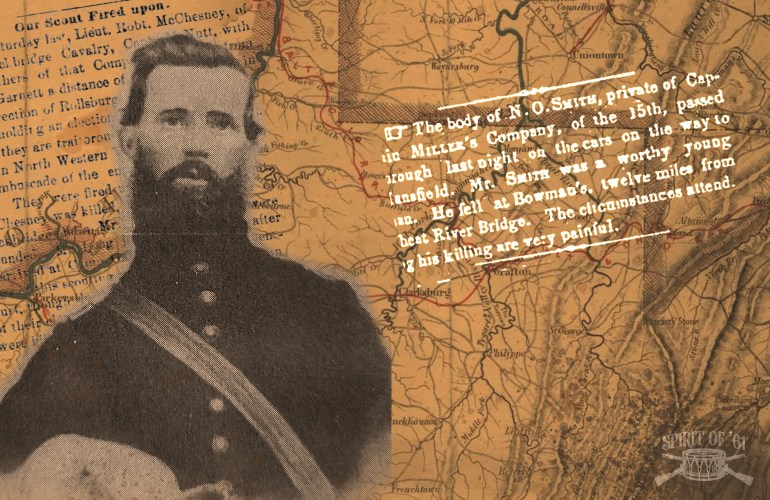
In late June 1861, Union troops guarding the B&O Railroad clashed with Confederate cavalry near Bowman’s Place in Tucker County as they attempted to disrupt elections for Virginia’s Restored Government. The brief but deadly skirmish, tied to control of the Cheat River corridor, revealed how quickly political conflict in northwestern Virginia could turn violent.
More than a month had passed since Virginia’s secession referendum and Maj. Gen. George B. McClellan’s invasion of the northwest. Protected by McClellan’s Army of Occupation, the region’s unionists gathered in Wheeling, a city on the Ohio River in Virginia’s panhandle, to form a new state government that would remain loyal to the United States.
Between June 11 and 25, 1861, one hundred delegates from 34 counties convened to establish the Reorganized or “Restored” Government of Virginia. They argued that the existing government in Richmond had abdicated its authority by voting to secede.
On June 20, the delegates unanimously elected Francis H. Pierpont as governor. A staunch unionist, abolitionist, and attorney for the Baltimore & Ohio (B&O) Railroad, Pierpont’s new government was quickly granted recognition by President Abraham Lincoln.
With volunteer regiments arriving weekly, McClellan was ready to press his advantage. He arrived in Grafton on June 23, to take personal command of the coming offensive. His target was the small but growing Confederate force under Brig. Gen. Robert S. Garnett, which was blocking the vital east-west passages of the Allegheny Mountains and threatening the B&O Railroad.
Garnett had arrived nine days earlier to help restore confidence in Confederate forces in the region, whose morale had been badly shaken after a series of setbacks. He proceeded to fortify positions in Barbour and Randolph counties to guard the two main mountain roads leading into the Shenandoah Valley.
Garnett established his headquarters at Laurel Hill on the Beverly-Fairmont Turnpike and sent Lt. Col. Jonathan M. Heck and the 25th Virginia Infantry Regiment to fortify Rich Mountain overlooking the Staunton-Parkersburg Turnpike.
Toward the end of June, counties under Union control held elections for the Restored Government’s new House of Delegates. In Randolph and Tucker counties, Dr. Solomon Parsons, a delegate to the Wheeling Convention, ran unopposed.
Detached companies of the 15th and 16th Ohio Infantry, along with Capt. James F. Donnelly’s Cameron Volunteers, 1st Virginia (U.S.), were stationed around Rowlesburg to guard the B&O Railroad and the Tray Run Viaduct over the Cheat River.
Earlier that month, Capt. Hiram Miller of Company H, 15th Ohio, received word that secessionists had raised a flag over the Tucker County Courthouse in St. George, eighteen miles south of Rowlesburg and twenty-three miles north of Garnett’s camp at Laurel Hill. He set out the night of June 9 with forty men and reached St. George early the next morning. Finding no resistance, they seized a flag at the courthouse and another from a private home, then returned to Rowlesburg in triumph, one adorned with a rattlesnake and the other with a wildcat skin.
Now his unit returned to ensure the election proceeded smoothly.
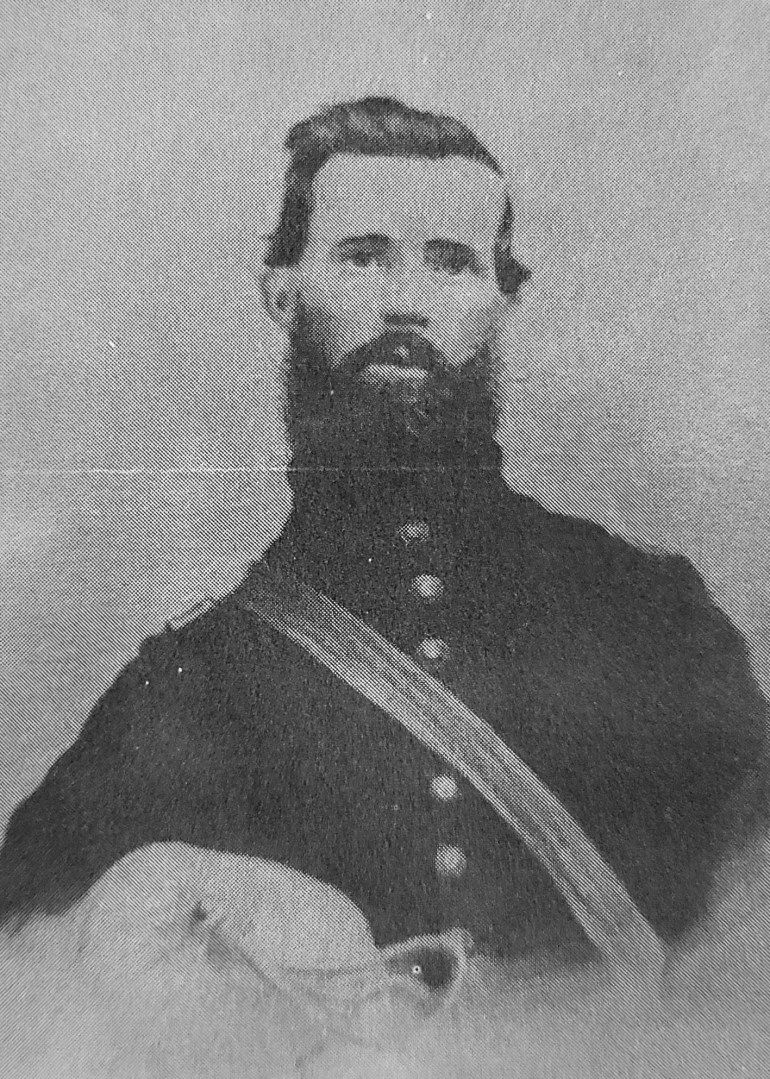
From Robert J. Driver, Jr., 14th Virginia Cavalry (Lynchburg: H.E. Howard, Inc, 1988).
The 2nd Rockbridge Dragoons, led by Capt. John R. McNutt and Lt. Robert McChesney, were camped with Garnett at Laurel Hill and regularly rode out on patrol. On the night of Friday, June 28, McChesney and nine picked men set out northeast toward St. George along the Cheat River on a scouting mission, intent on disrupting what they regarded as an illegitimate election.
The next morning, McChesney and his men, joined by a handful of local secessionist militia, rode into St. George and found the vote had already taken place. They continued north along a mountain road following the Cheat River toward the home of Adam H. Bowman, an attorney, which was being used as a polling place near the small hamlet of Hannahsville.
Captain Miller received word of their approach and prepared an ambush with his own company, along with men from Company D, 16th Ohio, and the Cameron Volunteers, for a total of roughly 150. Concealed on either side of the road, they allowed McChesney and his small troop to advance. Some may have been dressed in civilian clothes to avoid arousing suspicion.
Accounts differ on how the Confederate cavalry became aware of the trap. One suggests they “got a hint,” while another claims a detachment of Union soldiers inadvertently exposed themselves. McChesney, or someone in his party, spotted the soldiers and turned to escape. Shots rang out. McChesney was mortally wounded, and three of his men were wounded but escaped. It was said that Capt. Miller shot the young Confederate officer.
One man from the 15th Ohio, Pvt. Nathan O. Smith, a schoolteacher from Mansfield, was killed, and another wounded. Smith was the first combat death in his regiment, as McChesney was in his.
Brevet Brig. Gen. Charles W. Hill, writing from his headquarters in Grafton, where he oversaw defense of the railroad east to the Maryland border, reported to McClellan: “A light skirmish yesterday after the election in Tucker Co between Col Irvin’s men & a Company 60 sixty cavalry from Rockbridge a lieut of the cavalry was killed & several of his men believed to be wounded & several of his horses taken. One man of the sixteenth 16th killed & another wounded. Rebels dispersed.”
Colonel James Irvine of the 16th Ohio came into possession of McChesney’s personal effects and returned them to the lieutenant’s family. He wrote: “I will, therefore, not speak of it further than to say that he bore himself gallantly, and my sympathies were greatly enlisted for him when he fell. What should have been our common country, lost a brave and gallant man.”
Though soon eclipsed by larger, bloodier battles, the two men who fell at Bowman’s Place were mourned at home as martyrs for their respective causes. The skirmish had no bearing on the outcome of McClellan’s larger campaign. In early July, the new House of Delegates of the Restored Government sent Waitman T. Willey and John S. Carlile to the U.S. Senate. With the political groundwork laid, all that remained was to defeat Garnett’s small army at Laurel Hill and Rich Mountain, a task McClellan pursued with a vigor seldom displayed in his later campaigns.
Sources
Carnes, Eva Margaret. The Tygarts Valley Line, June-July 1861. Philippi: First Land Battle of the Civil War Centennial Commemoration, Inc., 1961. Parsons: McClain Printing Company, 2003.
Cope, Alexis. The Fifteenth Ohio Volunteers and Its campaigns, War of 1861-5. Columbus, OH: By the author, 1916.
Daily Intelligencer (Wheeling) 1 July 1861.
Driver, Robert J., Jr. 14th Virginia Cavalry. Lynchburg: H.E. Howard, Inc, 1988.
The Kingwood Chronicle (Kingwood, VA) 15 June 1861.
Fansler, Homer Floyd. History of Tucker County, West Virginia. Parsons: McClain Printing Company, 1962.
Hill, N.N., Jr. History of Coshocton County, Ohio: Its Past and Present, 1740-1881. Newark, OH: A.A. Iraham & Co., 1881.
Library of Congress. George B. McClellan Papers. Correspondence I, 1783–1888; June 29-July 1, 1861. Image 109.
Maxwell, Hu. History of Tucker County, West Virginia. Kingwood: Preston Publishing Company, 1884.
Morton, Oren F. A History of Rockbridge County, Virginia. Staunton: The McClure Co., Inc, 1920.
Official Roster of the Soldiers of the State of Ohio in the War of the Rebellion, 1861-1866, Vol. 1. Akron: The Werner Company, 1893.
Richmond Inquirer (Richmond) 9 Jul 1861.
Semi Weekly Herald (Mansfield) 3 Jul 1861.
Semi Weekly Herald (Mansfield) 10 Jul 1861.

 Spirit of '61