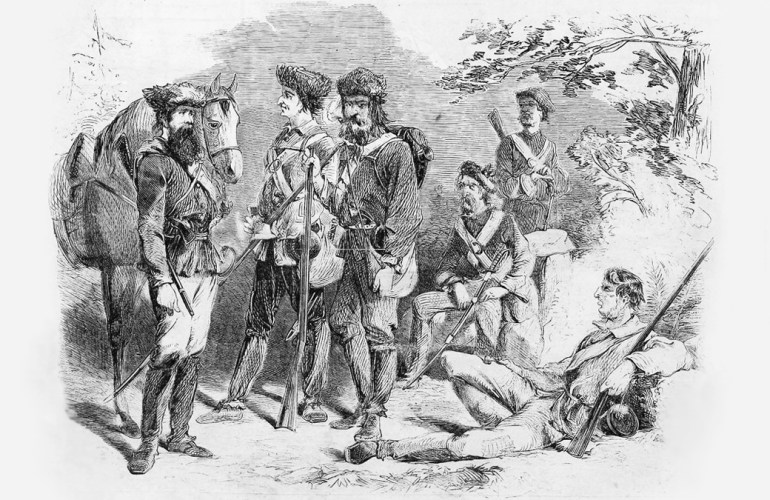
As one of the earliest engagements in the American Civil War, the Action at Philippi on June 3, 1861 is clouded in faulty and incomplete information. We owe it to history (and the ancestors of the men involved) to get an accurate picture of who was present on that day, for either side. Today we will be focusing on the secessionist volunteers.
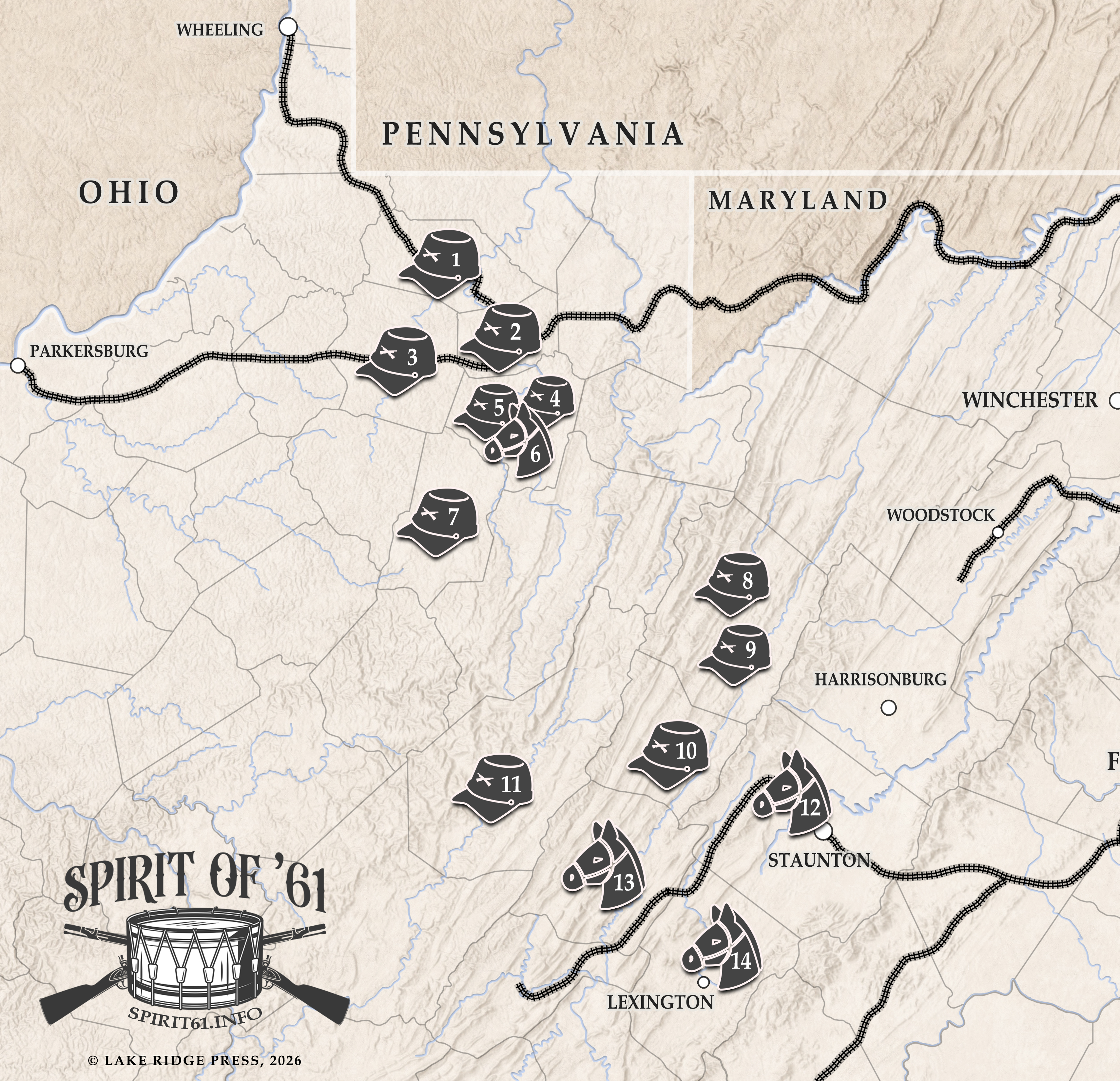
Depending on the source, the specific units engaged and the number of men engaged vary. After comparing sources in 2023, I found the most accurate list was provided by Fritz Haselberger in his book Yanks from the South! The following is a list of these companies, their captains, county of origin, and future regiment.
| Unit | Commander(s) | County | Future Regiment |
|---|---|---|---|
| Letcher Guard | Capt. John A. Robinson | Taylor | 9th VA Bn. (Hansbrough’s), Co. A |
| Pocahontas Rescues | Capt. Daniel A. Stofer | Pocahontas | 9th VA Bn. (Hansbrough’s), Co. D |
| Upshur Grays | Capt. John C. Higginbotham | Upshur | 25th VA Inf, Co. A |
| Franklin Guards | Capt. John B. Moomau | Pendleton | 25th VA Inf, Co. F |
| Marion Guards | Capt. William P. Thompson | Marion | 31st VA Inf, Co. A |
| Pendleton Minutemen | Capt. David C. Anderson | Pendleton | 31st VA Inf, Co. B (first) |
| Harrison Rifles | Capt. Uriel M. Turner | Harrison | 31st VA Inf, Co. C |
| Highland County Highlanders | Capt. Felix H. Hull | Highland | 31st VA Inf, Co. E |
| Barbour Grays | Capt. Albert G. Reger | Barbour | 31st VA Inf, Co. H |
| Potomac Guards or Barbour Mountain Guards | Capt. Henry Sturm | Barbour | 31st VA Inf, Co. K |
| Churchville Cavalry | Capt. Francis F. Sterrett | Augusta | 14th VA Cav, Co. I |
| Second Rockbridge Dragoons | Capt. John R. McNutt | Rockbridge | 14th VA Cav, Co. H |
| Barbour Lighthorse Cavalry | Capt. William K. Jenkins | Barbour | Disbanded |
| Bath Grays (Cavalry) | Capt. Archibald T. Richards | Bath | 11th VA Cav, Co. F |
These early units came from two primary clusters. The first centered on the Monongahela / Tygart / West Fork river valleys in northwestern Virginia. Five companies of infantry and one of cavalry hailed from Marion, Taylor, Harrison, Barbour, and Upshur counties. They coalesced around George Porterfield at Fetterman in mid-May, although the Upshur Grays joined them on the march as they retreated to Philippi in Barbour County, where secession sentiment was stronger.
The second cluster centered on the Shenandoah and Potomac Highlands, with four infantry and three cavalry companies hailing from Pendleton, Highland, Pocahontas, Bath, Augusta, and Rockbridge counties. These reinforcements, some of whom accompanied Col. Rudolph Turk from Staunton, were belatedly ordered by Robert E. Lee when it became clear volunteers were not flocking to Porterfield’s command as expected.
Estimates for the number of secessionist volunteers at Philippi vary widely, from around 500 to upwards of 800 or more. It’s impossible to say for certain, with records scarce and no accounting for the number of sick or on “French leave.” Discipline was lax and these early volunteers tended to come and go as they pleased.
The findings of Porterfield’s Court of Inquiry, published July 4, 1861, stated that on the morning of June 3, Porterfield had on hand “some six hundred effective infantry (or thereabouts), and one hundred and seventy-five cavalry (or thereabouts)…” For a total of 775. The qualifiers “effective” and “thereabouts” are doing a lot of heavy lifting here.
On paper, and based on what numbers I have been able to find in primary and secondary sources, it seems there were between 985 and 1,024 men under Porterfield’s command. A new Civil War infantry regiment was supposed to include 10 companies and roughly 1,000 men. Porterfield had 10 infantry and 4 cavalry companies. Half of Porterfield’s infantry companies were under strength, while two (from the Potomac Highlands) were over strength.
| Unit | Muster Date | Strength | Source |
|---|---|---|---|
| Letcher Guard | 5/13 | 42 | Roster (Armstrong) |
| Pocahontas Rescues | 5/18 | 64 / 66 / 59 | Roster (Armstrong) / Price, pg. 581 / McClellan Papers (mss31898.0017) |
| Upshur Grays | 5/27 | 57 | McClellan Papers (mss31898.0017) |
| Franklin Guards | 5/14 | 97 | McClellan Papers (mss31898.0017) |
| Marion Guards | 5/17 | 58 | Ashcraft, pg. 1 |
| Pendleton Minutemen | 5/18 | 115 | Armstrong, pg. 11 |
| Harrison Rifles | 5/21 | 60 / 76 | Lang, pg. 53 McClellan Papers (mss31898.0017) |
| Highland County Highlanders | 5/11 | 113 | McClellan Papers (mss31898.0017) |
| Barbour Grays | 5/14 | 56 / 64 | Haselberger, pg. 20 / McClellan Papers (mss31898.0017) |
| Potomac Guards or Barbour Mountain Guards | 5/21 | 100 | Ashcraft, pg. 12 |
| Churchville Cavalry | 4/19 | 68 / 60 | Driver, pg. 1 McClellan Papers (mss31898.0017) |
| Second Rockbridge Dragoons | 5/14 | 60 | Roster (Driver) |
| Barbour Lighthorse Cavalry | 5/14 | 40 | Haselberger, pg. 20 |
| Bath Grays (Cavalry) | 5/14 | 68 | Roster (Armstrong) |
| 985 – 1,024 |
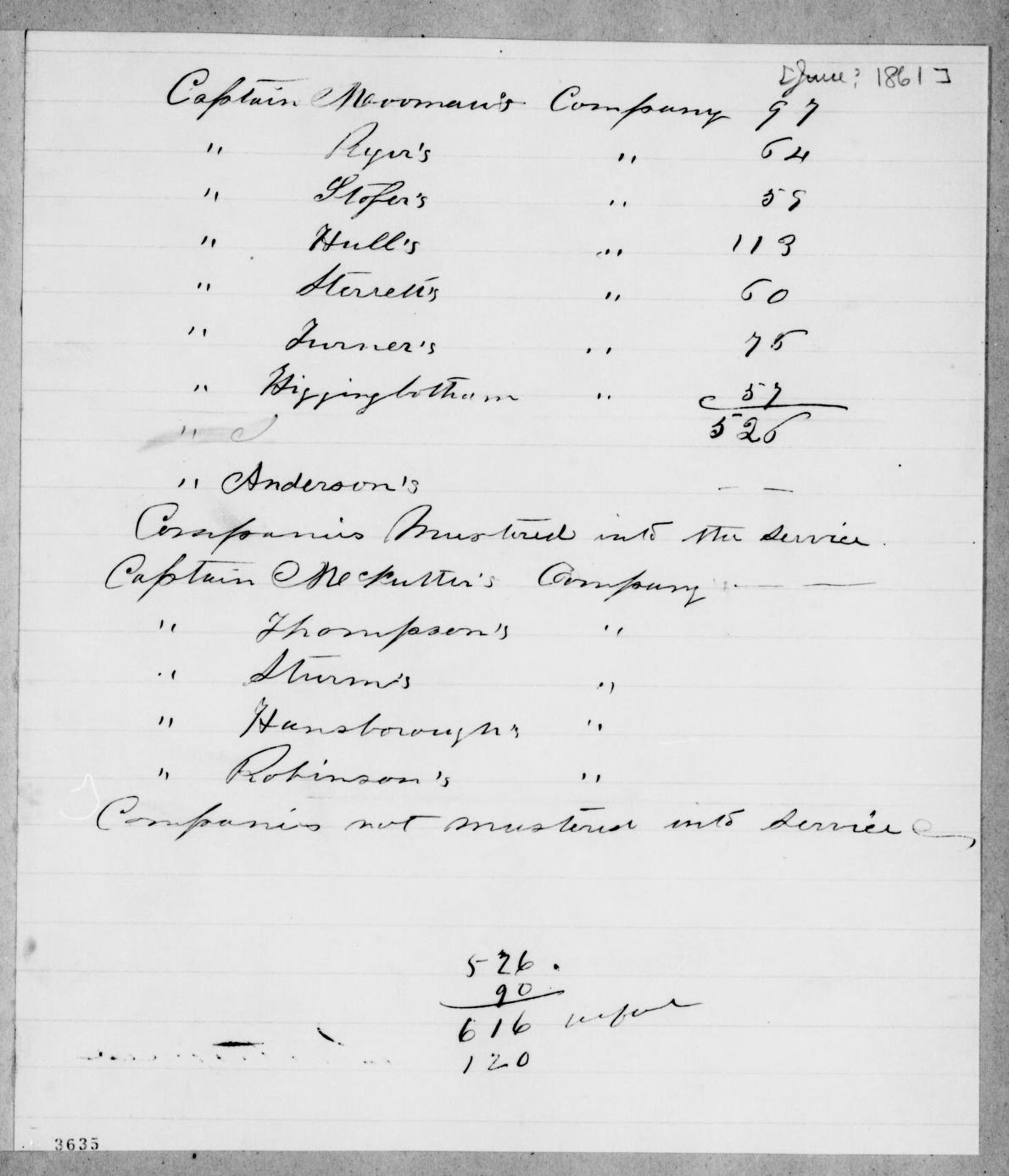
The document below is found in the George Brinton McClellan Papers: Correspondence I, 1783-1888; 1861; June 29-July 1 at the Library of Congress. The collection includes papers that were captured during the campaign in northwestern Virginia. Unfortunately, we don’t know who wrote this or when. It shows seven companies with what can be assumed are enrollment numbers, and six without. Five are listed above the sentence “Companies not mustered into service.”
The companies are listed under their captain’s last name. In the first group, we find Moorman [Moomau]’s Franklin Guards, Reger’s Barbour Grays, Stofer’s Pocahontas Rescues, Hull’s Highland County Highlanders, Sterrett’s Churchville Cavalry, Turner’s Harrison Rifles, and Higginbotham’s Upshur Grays. These companies have a total of 526 men.
The unnumbered companies are Anderson’s Pendleton Minutemen, McNutter [McNutt]’s Second Rockbridge Dragoons, Thompson’s Marion Guards, Sturm’s Barbour Mountain Guards, Hansborough’s Company, and Robinson’s Letcher Guard. George W. Hansbrough’s small company was from Taylor County and most likely merged with the Letcher Guard.
Neither Jenkins’ Barbour Lighthorse Cavalry nor Richards’ Bath Grays (Cavalry) are listed on the paper. Excluding those two units, the total at the bottom of this document is 736.
On June 9, less than a week after Philippi, Porterfield reported from Huttonsville that, “The force here now numbers about one thousand, of which one hundred and eighty are cavalry and the balance infantry.” Porterfield disbanded the Barbour Lighthorse Cavalry following the retreat from Philippi, accusing them of dereliction of duty. This would leave him with 188 cavalry, which, after accounting for the wounded and missing, would be about 180.
One day, I hope to have complete rosters with enlistment dates for all companies involved on June 3, 1861, but until then, this represents the best picture of the secessionist forces at Philippi on that fateful morning.
Sources
Armstrong, Richard L. 11th Virginia Cavalry. Lynchburg: H.E. Howard, Inc., 1989.
Armstrong, Richard L. 25th Virginia Infantry and 9th Battalion Virginia Infantry. Lynchburg: H.E. Howard, Inc., 1990.
Ashcraft, John M. 31st Virginia Infantry. Lynchburg: H.E. Howard, Inc., 1988.
Driver, Robert J., Jr. 14th Virginia Cavalry. Lynchburg: H.E. Howard, Inc, 1988.
Haselberger, Fritz. Yanks from the South! The First Land Campaign of the Civil War. Baltimore: Past Glories, 1987.
Hewett, Janet B., ed. Virginia Confederate Soldiers, 1861-1865, Vol. III-IV. Wilmington: Broadfoot Publishing Company, 1998.
Lang, Theodore F. Loyal West Virginia from 1861 to 1865. Baltimore: Deutsch Publishing Company, 1895.
Price, William T. Historical Sketches of Pocahontas County, West Virginia. Marlinton, WV: Price Brothers, 1901.
The War of the Rebellion: A Compilation of the Official Records of the Union and Confederate Armies. Series I, Vol. II. With additions and corrections. Washington: Government Printing Office, 1902.
Wallace, Lee A., Jr. A guide to Virginia Military Organizations, 1861-1865. Lynchburg: H.E. Howard, Inc., 1986.

 Spirit of '61