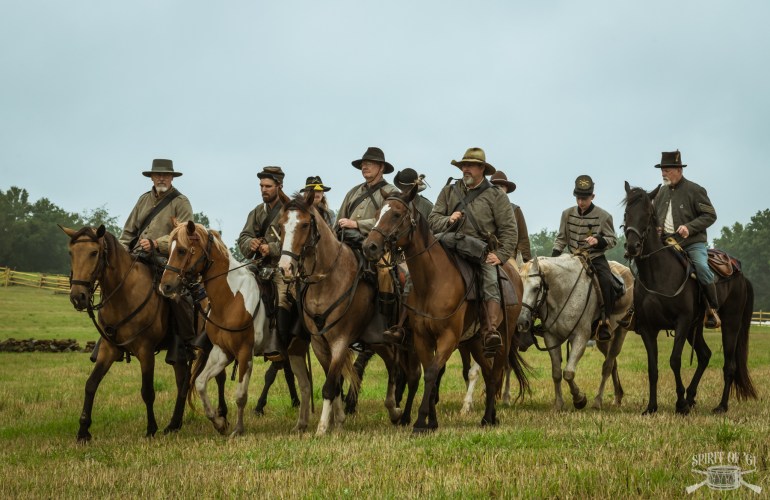
Like many ex-Confederates, Thomas W. Colley wrote a memoir years after the war. And, like John Singleton Mosby, Colley enlisted in the Washington Mounted Rifles, a storied unit initially led by Capt. William E. “Grumble” Jones. He served with the company for the duration of the war and was wounded several times, ultimately losing a foot to amputation.
Colley was in the lower Shenandoah in July 1861, but unlike Mosby, he did not take part in the scouting expedition that culminated in the capture of two Union soldiers just south of Martinsburg on July 11—at least not in his own account. He did, however, describe the company’s first exposure to artillery fire at Bunker Hill on July 15, shortly before the withdrawal toward Manassas Junction:
“I was in the Valley of Virginia with my regiment in front of Gen. Joseph E. Johnston whose forces in June 1861 and up till July 21st were at Winchester. My command was on picket duty in the medical front and scouting in the country watching the movements of Gen. Patterson. Was on camp guard the morning Gen. Patterson advanced towards Winchester in his “first” movement to hold Johnston there, while he [Patterson] went to the aid of Gen. Banks [Colley means Irvin McDowell] at Manassas and in this advance, where I heard the first shell “fired” from an enemy gun; the thing most dreaded by raw recruits “the peculiar whizzing sound of those missiles of death” as they pass through the air caused the hair to rise on one’s head and a creepy horrible sensation run over his flesh and a great desire to be back at home with Ma. And at this particular time and place this horrible feeling seized almost the entire regiment and they started down the Pike, one co. actually going into Winchester 12 miles from the point they started from.
“At the time the shell passed over us Co. D was drawn in marching order by 2, with horses heads turned toward Winchester. Captain Jones was on the front with the advance picket watching the enemys movements. Some of the boys were dismounted searching among a lot of blankets & other camp equipment that had been thrown away by a stampeded wagon driver. We had been hurried out of camp and left our baggage to the care of the wagoners. I was among the dismounted ones and would have sworn the shell that passed over the mounted mens heads some 50 or so feet in the air did not miss me 2 inches. This was a signal with out a word of command.
“The whole mounted positions hit out down the pike. Captain Jones seeing or hearing the movements dashed up cursing the cowardly wretches for running away. Came in time to save me from running with the rest. Captain sent Lieut. Blackford after the boys, and he over hauled them and brought them back.
“The captain gave us a lecture on the harmlessness of these terrible missiles, especially if they were as high in the air as that one was; in 12 months from that time the sound of artillery and the whizzing of shells would only lull a soldier to sleep. He ordered me to dismount and open a place in the fence so our company could be drawn up in line to oppose any forward movement of the enemy. General Johnston succeeded in deceiving Gen. Patterson after all his shrewd maneuvers and left him in the lower valley.”
In Memory of Self and Comrades, pg. 2-3
Colley’s account is sprinkled with inaccuracies (hardly surprising, given that he wrote it decades after the war), but it offers enough detail and contextual clues to paint a vivid picture of events. It’s unclear what he meant by “the medical front,” which may be a transcription error, a misspelling, or a reference to life in camp, where disease ran rampant.
A significant clue is when he writes “…they started down the Pike, one co. actually going into Winchester 12 miles from the point they started from.” Bunker Hill is almost exactly 12 miles north of downtown Winchester along the Valley Pike (today, U.S. Route 1).
Colley reinforces many of the firsthand accounts given by Union volunteers that the Confederate cavalry fled under fire from Capt. Charles H. Tompkins’ six guns of the 1st Rhode Island Battery. He mentions camp equipment being discarded in haste. He also mentions “Lieut. Blackford,” who rallied the fleeing troopers and brought them back into formation.
This was William W. Blackford, who wrote his own memoir and his own version of these events, which differs slightly from Colley’s:
“Having no artillery then attached to the cavalry and being greatly inferior to them in numbers, the only thing to do was to get out of the way. Stuart was on the hill watching and saw them start; he galloped down to us, laughing, and gave the order for each company to get back to some woods, half a mile in the rear, as fast as possible. There was no time lost, but before we got out of the orchard their battery was in position on the hill above us and pounding away at our fleeing troopers. The companies being separated saved us from much loss but it was the first time any of us had been under artillery fire and most of the command were a good deal demoralized. Our company was the only one which came off in perfect order, due in a large measure to my efforts, as I brought up the rear. Some of them stampeded utterly and did not stop for miles.”
War Years with Jeb Stuart. pg. 18-19
Neither man explicitly states where this occurred, but it is highly likely they were referring to the same event. I haven’t come across any other incident during this short campaign in which Union artillery was “pounding away” at Stuart’s retreating troopers. If they were not writing about Bunker Hill here, it must have been some other, as-yet-unknown encounter I haven’t read about.
Sources
Blackford, William W. War Years with Jeb Stuart. New York: Charles Scribner’s Sons, 1945.
Shaffer, Michael K., ed. In Memory of Self and Comrades: Thomas Wallace Colley’s Recollections of Civil War Service in the 1st Virginia Cavalry. Knoxville: The University of Tennessee Press, 2018.

 Spirit of '61