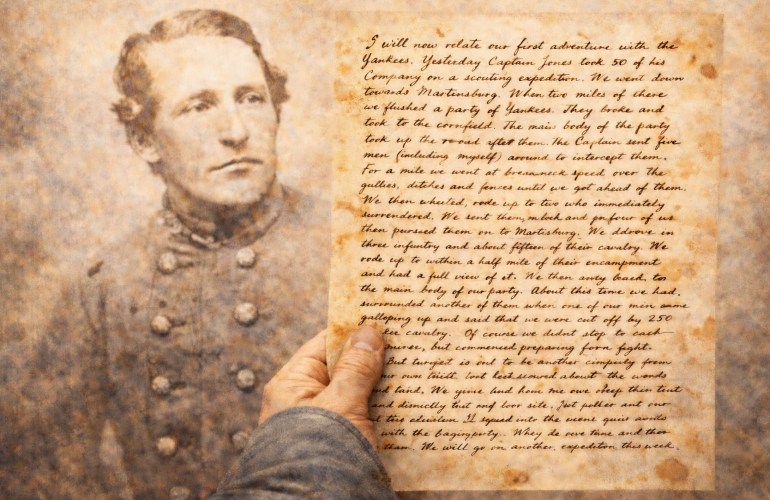
During the American Civil War, John Singleton Mosby became a famous (or infamous) partisan leader in northern Virginia. The “Gray Ghost” vexed Union commanders and wreaked havoc behind the lines. But in the spring and summer of 1861, he was a private in the Washington Mounted Rifles, a cavalry company in J.E.B. Stuart’s 1st Virginia Cavalry Regiment.
I recently picked up the book Private John S. Mosby, First Virginia Cavalry (2015) by Gregory P. Wilson and I was pleasantly surprised to find a letter inside written by Mosby describing his first encounter with Union troops, and it was on July 11, 1861 south of what was then Martinsburg, Virginia. Incredibly, this letter clarifies and fills in much needed details about the Action at Martinsburg from the Southern perspective.
Previously, I made some assumptions based on the primary sources I had about what cavalry units were involved on the Confederate side. The Harrisonburg Cavalry, from Rockingham County, was still likely the one involved in the brief skirmish that killed New York private Isaac W. Sly. But, it turns out, Mosby’s company was the one that captured Corporal Martin Webster and Private Samuel J. Tobias of Company I, 19th New York in a separate action.
Mosby’s July 12, 1861 letter to his wife lays it all out:
I will now relate our first adventure with the Yankees. Yesterday Captain Jones took 50 of his Company on a scouting expedition. We went down towards Martinsburg. When two miles of there we flushed a party of Yankees. They broke and took to the cornfield. The main body of the party took up the road after them. The Captain sent five men (including myself) around to intercept them. For a mile we went at breakneck speed over the gullies, ditches and fences until we got ahead of them. We then wheeled, rode up to two who immediately surrendered. We sent them on back and four of us then pursued them on to Martinsburg. We drove in three infantry and about fifteen of their cavalry. We rode up to within a half mile of their encampment and had a full view of it. We then rode back to the main body of our party. About this time we had surrounded another of them when one of our men came galloping up and said that we were cut off by 250 Yankee cavalry. Of course we didn’t stop to catch a prisoner but commenced preparing for a fight. But it turned out to be another company from our own regiment. We scoured about the woods and fields fully two hours in full view of their tents and they didn’t dare to come out and attack us. We divided the accoutrements of the two prisoners with the squad that took them. I got one of their canteens, the finest I ever saw made of zinc which will keep water cool much longer than tin. At the time we were after them we could distinctly hear the firing at an engagement between another company of our regiment (from Rockingham) and a Yankee foraging party. They dispersed them and killed one and took a horse. “Nobody hurt” on our side. Our men were very eager for the fray and I believe would have dashed into their camp if Captain Jones would have let them… We will go on another expedition this week.
The “Captain Jones” referred to in the letter was William E. “Grumble” Jones, captain of the Washington Mounted Rifles and later a brigadier general.
The book Cayuga in the Field: A Record of the 19th N. Y. Volunteers framed Webster and Tobias’ capture as a consequence of acting on their own accord and moving too far outside of their lines. In Mosby’s account, it sounds more like they were part of a picket line or a scouting expedition and got cut off. Cayuga in the Field claimed they surrendered after putting up a fight, but Mosby doesn’t mention any resistance. Instead, he wrote that they “immediately surrendered.”
Cayuga in the Field was published in 1873. Tobias died as a prisoner in Richmond in September 1861. Martin S. Webster survived the war. Perhaps he provided that version of events to the author?
Since Mosby’s letter was written shortly after the events, meant for a private audience, I don’t see any reason for him to lie about what happened. He provided the additional detail that only one member of the “Yankee foraging party” was killed, which is accurate. Measured against other sources, I find Mosby’s account to be reliable.
This letter is a valuable counterweight to Union accounts and suppliments Capt. Thomas L. Yancey’s letter in the Richmond Dispatch, which is among the few Confederate sources I’ve been able to find relating to these events.
Sources
Hall, Henry and James Hall. Cayuga in the Field: A Record of the 19th N. Y. Volunteers, All the Batteries of the 3d New York Artillery, and 75th New York Volunteers. Auburn: Truair, Smith & Co., 1873.
Wilson, Gregory P. Private John S. Mosby, First Virginia Cavalry: Picketing Fairfax County Before Becoming the Confederacy’s “Gray Ghost.” CreateSpace: By the author, 2015.

 Spirit of '61
One thought on “Mosby Sheds Light on What Happened Outside of Martinsburg on July 11, 1861”