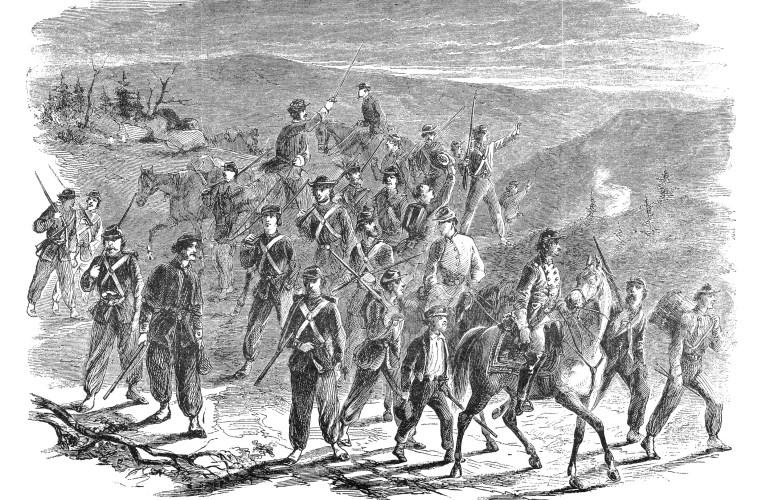
In July 1861, a series of sharp skirmishes between 90-day Union volunteers and J. E. B. Stuart’s cavalry outside the village of Bunker Hill convinced Federal commanders that Joseph E. Johnston still stood between them and Winchester. That misjudgment helped shape the movements that allowed Confederate reinforcements to reach Manassas in time.
At the beginning of July 1861, Union Maj. Gen. Robert Patterson, 69-year-old veteran of the War of 1812 and Mexican-American War and commander of the Military Department of Pennsylvania, moved his army across the Potomac River into Virginia’s lower Shenandoah Valley. The march was key to the Federal strategy to contain Confederate Brig. Gen. Joseph E. Johnston’s Army of the Shenandoah and prevent it from reinforcing P. G. T. Beauregard’s forces near Manassas Junction.
Moving cautiously, Patterson pressed Col. Thomas J. Jackson’s brigade at Hoke’s Run and then occupied Martinsburg, an important stop on the Baltimore & Ohio (B&O) Railroad whose population was largely sympathetic to the Union cause. Even so, his army suffered from supply shortages and struggled with undisciplined 90-day volunteers. Forced to forage for food in the countryside, Patterson’s men stumbled into at least one deadly clash with Lt. Col. J. E. B. Stuart’s 1st Virginia Cavalry.
On July 9, Patterson convened a council of war with his senior officers. They almost unanimously agreed the army was in a precarious position and should move farther east to Charlestown. For nearly a week, they waited while reinforcements trickled in. Finally, on the morning of July 15, 1861, they broke camp and marched south along the Valley Turnpike.
At the head of the Union advance was Col. George H. Thomas’ First Brigade, consisting of Capt. Charles H. Tompkins’ 1st Rhode Island Battery, with six rifled guns, supported by the 21st Pennsylvania Infantry under Col. John F. Ballier. Close behind marched Col. Charles P. Dare’s 23rd Pennsylvania Infantry, with other regiments following in the long column. The Union soldiers stepped off in fine spirits. Many three-month volunteers had expected to be going home, but instead found themselves marching toward Winchester, looking for a fight.
By this time, Johnston had already withdrawn his main infantry force several miles south to Winchester, wary of engaging Patterson’s numerically superior army in a direct confrontation. In his place, he left a screen of cavalry under J. E. B. Stuart to observe and delay the Union advance. Stuart’s command, several hundred cavalrymen, acted as the eyes and ears of the Confederate army.
As Patterson’s vanguard pushed through the hamlet of Darkesville, about two miles north of Bunker Hill, the 21st Pennsylvania fired a few potshots at Confederate pickets retreating out of town. One musket ball struck Mrs. Chapman, a local resident, in the hip as she ran into the street to gather her children to safety. Fortunately, the injury was not grave. A Union army surgeon, Dr. William H. Worthington of the 9th Pennsylvania, was called to treat her and found it to be a “slight” flesh wound.
After a march of about two hours, Patterson’s lead elements approached Bunker Hill. As they neared the village, they encountered Confederate cavalry outposts. Patterson’s advance deployed to meet this threat: Maj. George C. Spear of the 23rd Pennsylvania took four companies and extended to the right as skirmishers, a maneuver that successfully flushed the enemy horsemen from concealment on the flank.
The Confederate cavalry, about 600 strong, rallied astride the turnpike behind Mill Creek. Union sources reported that Lt. Col. Stuart began forming his troopers as if to charge the 21st Pennsylvania Infantry in the road. Unbeknownst to Stuart, however, the Rhode Island artillery lay concealed just behind the infantry.
When the Confederates drew up to attack, Tompkins’s battery suddenly opened fire at close range, hurling shells and grape shot with “powerful effect” directly into the cavalry column. At the same moment, the 21st Pennsylvania loosed a volley into the stunned horsemen. Caught by surprise, the Confederate charge collapsed almost at once; according to eyewitnesses, the rebel troopers “immediately scattered” under the deadly fire.
A detachment of the 2nd U.S. Cavalry pursued the fleeing rebels down the turnpike for about two miles toward Winchester. The chase yielded at least two prisoners, both of whom were brought back to Gen. Patterson.
Disorganized and outgunned, Stuart’s cavalry withdrew in haste, skirmishing intermittently as they fell back. Their retreat was covered by a series of impromptu roadblocks—trees felled across the turnpike and fences thrown into the path of the pursuing Federals. These obstructions significantly slowed Patterson’s advance.
By evening, Patterson’s forces had fully occupied Bunker Hill and found the Confederate camps hastily abandoned. Tents, provisions, and even cooking fires had been left behind. That night, Union scouts probing beyond the village encountered a small Confederate cavalry rear guard, resulting in a brief but sharp exchange of fire in the dark. No significant casualties were reported on the Union side, and Confederate accounts give no indication that the skirmish led to further loss of life.
Many in Patterson’s camp expected a larger battle at Winchester in the coming days. On July 16, he kept his army at Bunker Hill for a day of rest and reorganization. The troops were footsore and low on rations after the rapid march. That night, he received troubling intelligence: a reconnaissance found the direct turnpike from Bunker Hill to Winchester barricaded with more fallen trees and fences.
He was also acutely aware that most of his troops’ enlistments were set to expire within days. In an official report, he warned that a “very large portion” of his force would “lay down their arms” when their term ended in late July, and that no “active operations towards Winchester can be thought of” until fresh three-year volunteers replaced them.
As Patterson’s army lingered at Bunker Hill, Brig. Gen. Johnston took full advantage. He prepared to evacuate Winchester, leaving his sick and the town’s defense in the care of Virginia militia. Stuart’s cavalry screen continued to monitor Union movements and cover their own. By the time Patterson resumed his march on July 17, pivoting toward Charlestown rather than continuing directly south, Johnston had already set his withdrawal in motion. Two days later, on July 18, he slipped away toward Piedmont Station and travelled by rail to join Gen. Beauregard at Manassas.
Though minor in casualties and tactical results, the running skirmish at Bunker Hill helped mask Johnston’s movement and reinforced the mistaken impression among Union leaders that a large force remained in front of them. In this way, the clash at Bunker Hill became a modest but integral part of the maneuvers that set the stage for the Confederate victory at First Manassas.
Sources
Blackford, William W. War Years with Jeb Stuart. New York: Charles Scribner’s Sons, 1945.
Driver, Robert J., Jr. 1st Virginia Cavalry. Lynchburg: H.E. Howard, Inc., 1991.
Dwight, Wilder and Elizabeth Amelia Dwight, ed. Life and Letters of Wilder Dwight, Lieut.-Col. Second Mass. Inf. Vols. Boston: Ticknor & Fields, 1868.
Morse, Charles F. Letters Written During the Civil War, 1861-1865. Boston: T.R. Marvin & Son, Printers, 1898.
New York Daily Herald (New York) 18 July 1861.
The New York Times (New York) 29 July 1861.
New York Tribune (New York) 18 July 1861.
Public Ledger (Philadelphia) 16 July 1861.
Richmond Dispatch (Richmond, VA) 20 July 1861.
Strother, David H. “Personal Recollections of the War, by a Virginian: Patterson’s Campaign.” Harper’s New Monthly Magazine 33 (1866): 137-160.
The War of the Rebellion: A Compilation of the Official Records of the Union and Confederate Armies. Series I, Vol. II. With additions and corrections. Washington: Government Printing Office, 1902.

 Spirit of '61