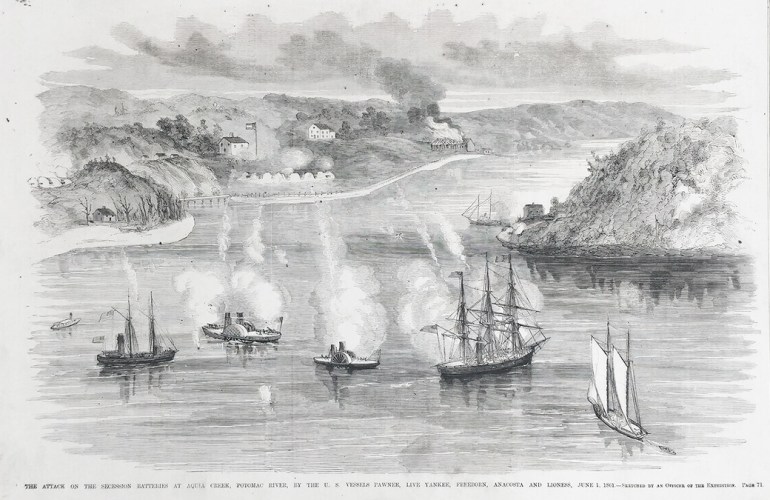
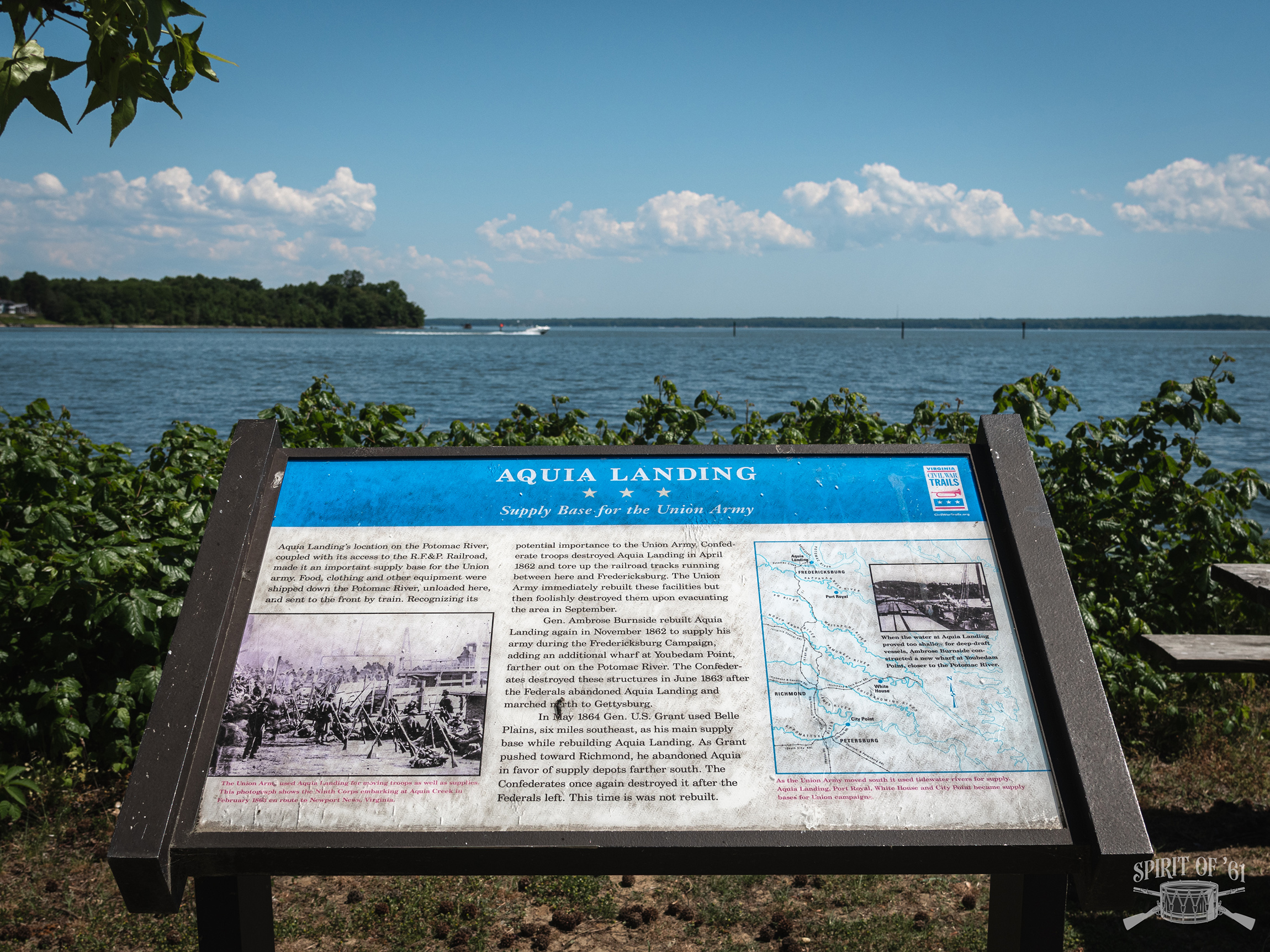
In late May and early June of 1861, Union gunboats of the newly formed Potomac Flotilla clashed with Confederate shore batteries at Aquia Landing, a key rail terminus on Virginia’s Potomac River. Over three days of bombardment, the USS Thomas Freeborn and supporting vessels attempted to silence the Confederate defenses, but despite sustaining damage, the Southern gunners held their ground, forcing the Union flotilla to withdraw—marking one of the first naval engagements of the Civil War.
In late April and early May of 1861, tensions between federal forces and the Commonwealth of Virginia threatened to escalate into full-scale war. On April 17, 1861, delegates at the Virginia Secession Convention in Richmond passed an ordinance of secession, contingent upon the results of a popular referendum scheduled for May 23. In response, U.S. President Abraham Lincoln extended the naval blockade of the Deep South to include Virginia’s ports, leading to skirmishes between Virginia shore batteries and U.S. Navy ships in the Chesapeake Bay.
Daniel Ruggles (1810–1897), a Massachusetts-born officer, was appointed brigadier general in the Provisional Army of Virginia and placed in command of the Military Department of Fredericksburg. This region encompassed Fredericksburg, Stafford, Spotsylvania, Caroline, King George, and Westmoreland counties. A captain in the regular U.S. Army, Ruggles was on extended sick leave when the Civil War began. His wife, Richardetta—niece of George Mason—had deep ties to Virginia, prompting Ruggles to adopt the state as his new home and vigorously rise to its defense.
Ruggles, who was administratively reduced in rank to colonel as Virginia opted to limit its number of general officers, immediately began identifying key defensive positions along the Potomac River. Approximately ten miles northeast of Fredericksburg lay Aquia Landing, the terminus of the Fredericksburg and Potomac Railroad. Initially, Ruggles viewed defending Aquia Landing as a secondary concern. However, John M. Brooke, a former U.S. Navy officer, relayed instructions from Robert E. Lee emphasizing the importance of protecting the railroad terminus. In early May, Ruggles tasked Major Thomas H. Williamson with constructing a battery at Aquia Landing and on nearby Split Rock Bluff.
Captain William F. Lynch of the Virginia Navy was placed in direct command of the Aquia Battery, which consisted of four guns. Meanwhile, Captain Reuben L. Walker and the Richmond “Purcell” Artillery Battery—armed with four 6-pounder rifled guns (sometimes described as Parrott rifles)—dug in on a bluff overlooking the landing. Their goal was to control maritime traffic on the Potomac River and deter any Union attempt to seize the landing by force.
At the same time, U.S. Navy Commander James Harmon Ward (1806–1861), a seasoned seaman who had captained the USS Cumberland during the Mexican-American War, proposed the creation of a “flying squadron” to Navy Secretary Gideon Welles. This force, later called the Potomac Flotilla, was tasked with maintaining Lincoln’s blockade, monitoring Virginia’s shoreline for Confederate activity, and preventing pro-Confederate Marylanders from smuggling supplies across the river.
With naval vessels in short supply, Ward chartered civilian ships and converted them for military use. His flagship, the USS Thomas Freeborn, was a 269-ton side-wheel steam tugboat built in 1860 and armed with two 32-pounder guns. It departed the New York Navy Yard for Virginia on May 16, 1861, accompanied by the USS Reliance and USS Resolute—two 90-ton screw steamers equipped with one 24-pounder and one 12-pounder howitzer each.
Union naval vessels observed the construction of the Aquia Battery from a safe distance but refrained from engaging. By late May 1861, Virginia’s allegiance in the Civil War was beyond doubt. On May 23, Virginia voters overwhelmingly ratified secession. The next morning, Union troops crossed the Potomac River, seizing Arlington Heights and Alexandria, Virginia. Ruggles grew increasingly concerned that Union forces might land upriver and flank his position.
On the evening of Wednesday, May 29, 1861, the USS Thomas Freeborn approached the Aquia Battery and fired 14 rounds. The low tide caused most shots to fall short, inflicting only minor damage and wounding one Confederate—a man slightly injured in the hand. Ruggles rushed to the scene with 700 men, including troops from the 2nd Regiment Tennessee Infantry (Walker Legion), the 1st Virginia Infantry Regiment, Company F, and the Richmond Light Infantry Blues. However, the guns were silent by the time they arrived after dark.
The following day, Commander Ward sailed south to reconnoiter Mathias Point with a small landing party but found no Confederate troops. On Friday, May 31, Ward returned to Aquia Landing with the USS Thomas Freeborn, supported by the 2-gun USS Resolute and USS Anacostia, a 217-ton screw steamer commissioned in 1859. The three ships exchanged fire with Confederate forces for several hours. One shot breached the sand embankment and exploded in the officers’ quarters, but no one was injured. Captain Lynch, aiming to conserve ammunition, ordered his guns to fall silent, though Captain Walker’s “Purcell” battery continued firing, wounding one Union sailor. The Union ships, unable to elevate their guns high enough to return fire effectively, withdrew.
Ruggles again rushed his infantry to the scene, but once again, they arrived too late. He hastily telegraphed Richmond for additional ammunition. A polite but firm response came the next day, chastising him for wasting resources on what Robert E. Lee deemed a futile exchange.
At 11:30 a.m. on Saturday, June 1, the steam-powered sloop-of-war USS Pawnee joined the flotilla, adding its eight 9-inch guns and two 12-pounders to the cannonade. To disrupt the Union’s line of sight, Captain Lynch ordered several outbuildings and the wharf to be set ablaze. He also repositioned one of Walker’s rifled cannons to the shore battery, where it proved effective. “Our sand banks not being en barbette, we could only fire as the enemy came within range through the embrasures,” Lynch reported. “This… constrained me to withhold fire except when something like a fair shot presented.”
The USS Pawnee sustained nine hits, suffering minor damage and one casualty—its commander, who was scratched by a splinter. “The enemy’s fire was almost exclusively directed at this ship, his rifled shot passing constantly over and around us,” wrote Commander Stephen C. Rowan. Ward described the Pawnee as “a sheet of flame” due to the rapid pace of its broadsides. The Thomas Freeborn also sustained damage and began taking on water, though its crew was unscathed.
After three days of bombardment, with limited ammunition and minor damage, the Union flotilla withdrew. The USS Thomas Freeborn sailed to the Washington Navy Yard for repairs, while the USS Pawnee maintained a distant watch on the Confederate battery.
Sources
Carmichael, Peter S. The Purcell, Crenshaw and Letcher Artillery. Lynchburg: H.E. Howard, Inc., 1990.
Official Records of the Union and Confederate Navies in the War of the Rebellion. Series I, Vol. 4. Washington: Government Printing Office, 1896.
Scharf, J. Thomas. History of the Confederate States Navy from its Organization to the Surrender of its Last Vessel. New York: Rogers & Sherwood, 1887.
Stuart, Meriwether, ed. “The Military Orders of Daniel Ruggles: Department of Fredericksburg, April 22–June 5, 1861.” The Virginia Magazine of History and Biography 69 (April 1961): 149-180.
The War of the Rebellion: A Compilation of the Official Records of the Union and Confederate Armies. Series I, Vol. II. With additions and corrections. Washington: Government Printing Office, 1902.
Wills, Mary Alice. The Confederate Blockade of Washington, D.C. 1861-1862. Parsons: McClain Printing Company, 1975.

 Spirit of '61