In the spring and summer of 1861, James H. Ward and the Union’s Potomac Flotilla faced the daunting task of enforcing a blockade, securing safe passage for friendly river traffic, and countering Confederate shore batteries along the Potomac River. He would not live to see it succeed.
At the start of the American Civil War, 74-year-old Lieutenant General Winfield Scott, general-in-chief of the U.S. Army, devised a plan to “strangle” the Confederacy by blockading its ports and gaining control of the Mississippi River. Dubbed the “Anaconda Plan” by the press, this strategy aimed to suffocate the seceding states economically. On April 19, 1861, one week after the bombardment of Fort Sumter, President Abraham Lincoln enacted the plan by issuing Proclamation 81, which declared a blockade of ports in rebellious states, including South Carolina, Georgia, Alabama, Florida, Mississippi, Louisiana, and Texas.
Just two days earlier, on April 17, delegates at the Virginia Secession Convention had voted 88 to 55 in favor of secession, pending a popular referendum scheduled for May 23. Pro-secession militias swiftly seized federal properties, including the U.S. Customs House in Richmond, Harpers Ferry Arsenal, and Gosport Navy Yard. In response, Lincoln extended the blockade on April 27 to include Virginia and North Carolina, even though North Carolina had not yet seceded (it would join the Confederacy on May 21).
Washington, D.C., was in a precarious position, surrounded by Virginia and Maryland. Maryland, despite declaring neutrality, had a significant secessionist population. The Potomac River was a critical lifeline, carrying mail, supplies, troops, and military orders between the capital, Fort Monroe, and beyond. Securing the lower Potomac was a top priority for both Lincoln and General Scott.
To enforce the blockade and secure the river, U.S. Navy Commander James Harmon Ward (1806-1861), an experienced seaman and naval tactician who captained the USS Cumberland during the Mexican-American War, proposed the creation of a “flying squadron” to Secretary of the Navy Gideon Welles. This force, later known as the Potomac Flotilla, was tasked with maintaining the blockade, monitoring the Virginia shoreline for enemy activity, and preventing pro-Confederate Marylanders from ferrying supplies across the river.
With naval vessels in short supply, Ward chartered civilian ships and converted them for military use. His flagship, the USS Thomas Freeborn, was a 269-ton side-wheel steam tugboat built in 1860, armed with two 32-pounder guns. It set sail for Virginia from the New York Navy Yard on May 16, 1861. Accompanying it were the USS Reliance and USS Resolute, two 90-ton screw steamers equipped with one 24-pounder and one 12-pounder howitzer each.
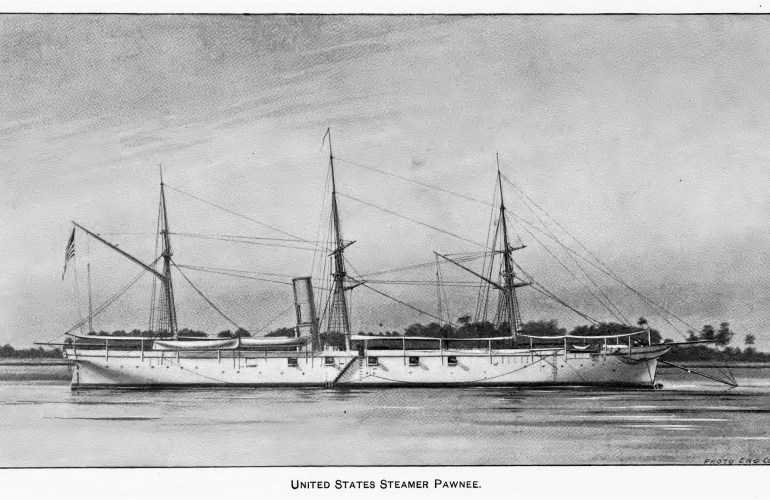
The USS Anacostia, a 217-ton screw steamer commissioned in 1859, operated out of the Washington Navy Yard. The USS Pawnee, a steam-powered sloop-of-war also stationed in Washington, was crewed by 94 men and armed with eight 9-inch guns and two 12-pounder guns. On May 24th, the Pawnee assisted in the occupation of Alexandria, Virginia. Its commander was Stephen C. Rowan, another veteran of the Mexican-American War.
The Potomac Flotilla faced significant challenges. The Gosport Navy Yard in Norfolk, abandoned by the U.S. Navy on April 21, had been only partially destroyed, allowing Virginia secessionists to seize approximately 1,085 cannons of various sizes. These were quickly deployed to fortify defenses along the Virginia coast. Fifty-one-year-old Brigadier General Daniel Ruggles, in charge of the Fredericksburg Military District, worked with Captain William F. Lynch to establish artillery batteries at Aquia Landing, Potomac Creek, and Simms’ Point. Meanwhile, closer to Washington, Brigadier General Philip St. George Cocke, under orders from Robert E. Lee, removed lights and navigation buoys from the Potomac to disrupt Union river traffic.
At this early stage, there was no plan to besiege Washington, DC, as U.S. war planners feared, but to act defensively and protect strategic points from naval invasion. In May, both Ruggles and Cocke were administratively reduced to colonels as Virginia opted to limit its number of general officers.
The Potomac Flotilla engaged in two major military actions prior to the Battle of Bull Run. From May 29 to June 1, 1861, it clashed inconclusively with Confederate batteries at Aquia Landing before withdrawing due to low ammunition. On June 27, Ward led an attempted landing at Mathias Point with U.S. Marines but was repulsed. While sighting a gun aboard the USS Thomas Freeborn to cover the retreat, Ward was mortally wounded, becoming the first U.S. naval officer killed in the Civil War. Captain Thomas Tingey Craven succeeded him as commander of the Potomac Flotilla.
It wasn’t until August that Robert E. Lee ordered a Confederate blockade of the Potomac. By fall, Confederate shore batteries effectively controlled the river, preventing the Potomac Flotilla from keeping the waterway open. River traffic to Washington ceased until the spring of 1862, when most of the Confederate guns were withdrawn to defend Richmond during the Peninsula Campaign.
Sources
Murray, Jennifer M. The Civil War Begins: Opening Clashes, 1861. Washington, DC: Center of Military History, United States Army, 2012.
Official Records of the Union and Confederate Navies in the War of the Rebellion. Series I, Vol. 4. Washington: Government Printing Office, 1896.
Stuart, Meriwether, ed. “The Military Orders of Daniel Ruggles: Department of Fredericksburg, April 22–June 5, 1861.” The Virginia Magazine of History and Biography 69 (April 1961): 149-180.
The War of the Rebellion: A Compilation of the Official Records of the Union and Confederate Armies. Series I, Vol. II. With additions and corrections. Washington: Government Printing Office, 1902.
Wills, Mary Alice. The Confederate Blockade of Washington, D.C. 1861-1862. Parsons: McClain Printing Company, 1975.

 Spirit of '61
4 thoughts on “The Potomac Flotilla”