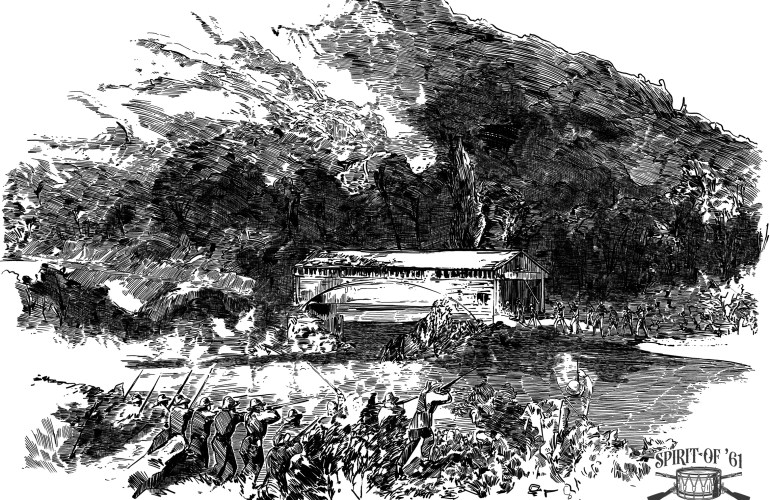
In a tense twilight skirmish at the covered bridge over Middle Fork River, Union and Confederate forces traded deadly volleys, with bullets tearing through the darkness. This fierce encounter would prove to be the critical opening move that cleared the Union’s path to a decisive victory at Rich Mountain just days later.
Following the Confederate retreat from Philippi in early June, Brigadier General Robert S. Garnett took command of Confederate forces in northwestern Virginia. Garnett organized disassociated companies into regiments and fortified positions at Laurel Hill and Rich Mountain in Barbour and Randolph counties, aiming to guard the two main mountain roads leading into the Shenandoah Valley.
On June 21, Major General George B. McClellan, 34 years old and head of the Military Department of the Ohio, entered Virginia at Parkersburg to personally assume command of Union forces in northwest Virginia. He arrived in Grafton on June 23 and remained there for nearly a week, addressing supply and logistical challenges.
On June 26, Garnett ordered Lieutenant Colonel Jonathan McGee Heck to lead a portion of his 25th Virginia Infantry Regiment, along with all available wagons, to the town of Buckhannon for a foraging expedition. Buckhannon, the seat of Upshur County, lay along the Buckhannon River and the Staunton-Parkersburg Turnpike, a crucial transportation route from the Shenandoah Valley to the Ohio River. Heck stationed pickets at the covered bridge over the Middle Fork River, halfway between Buckhannon and Camp Garnett on Rich Mountain, to provide early warning of any Union approach from that direction.
Upon hearing that Confederate troops had occupied Buckhannon, McClellan quickly left for Clarksburg, where he ordered his quartermasters to prepare 100 wagons. However, assembling the wagons proved challenging, and transportation issues remained unresolved even as Union regiments began advancing into Upshur County. Not a single ambulance was available should the troops encounter trouble.
The 9th Ohio Infantry Regiment, led by Colonel Robert L. McCook, reached Buckhannon on the evening of June 29. Brigadier General William S. Rosecrans soon arrived with the 8th and 10th Indiana and 19th Ohio Regiments. By the time elements of Brigadier General Newton Schleich’s brigade, including the 3rd and 4th Ohio Regiments, arrived on July 2, the Union troop presence in Upshur County nearly equaled the local population. Schleich was a politician known more for his vulgarity than military prowess.
On July 5, without McClellan’s approval, Schleich dispatched a mixed scouting party of 50 men from the 3rd Ohio, led by Captain Orris A. Lawson, to scout Middle Fork Bridge. The party halted five miles from the bridge and set up camp. Shortly after midnight, Lawson led his men over two miles upstream, crossed the river, and attempted to sneak up on the Confederate pickets sheltered in the covered bridge. These pickets consisted of Captain Francis Sterrett’s Churchville Cavalry and ten men from the Pendleton Rifles.
Sentinels spotted the Union troops sneaking through the brush, prompting both sides to open fire simultaneously. According to one Ohio soldier, the shooting was “hot as Hell.” Corporal Samuel R. Johns was killed, and six others were wounded. Realizing his forces were outnumbered and had lost the element of surprise, Lawson retreated with the wounded, leaving Johns’ body on the field. The brief yet intense firefight also left three Confederate soldiers wounded.
Angry over Schleich’s costly error, McClellan the next morning, July 7, ordered Colonel McCook to take the 4th and 9th Ohio Regiments, Loomis’s Michigan artillery battery, and Burdsall’s Dragoons to secure Middle Fork Bridge. The Confederate pickets stationed at the bridge fired a few shots at the advancing Union troops before retreating up the turnpike to alert their comrades. McCook’s men discovered and buried Johns’ body before setting up camp.
Meanwhile, Lt. Col. Heck sent Major Nathaniel Tyler of the 20th Virginia Infantry with Company G (the Hampden-Sydney Boys) from his own regiment and Company A (the Upshur Grays) of the 25th Virginia, totaling about 160 men. Along the way, they encountered a local woman who warned them of nearby federal cavalry. Upon reaching the vicinity of the bridge, they saw two Union infantry regiments and an artillery battery in a defensive position.
After exchanging a few volleys, Major Tyler wisely chose to withdraw to their fortified position on Rich Mountain. There were no casualties on either side, though Captain John C. Higginbotham of the Upshur Grays later remarked, “I got my pants and boot-legs riddled with bullets, but without serious injury.”
Securing Middle Fork Bridge removed the final barrier between McClellan’s army and the Confederate stronghold on Rich Mountain. By the morning of July 9, McClellan’s advance units had reached Roaring Creek, from where they would launch a flanking attack two days later, overwhelming the Confederate defenders at Rich Mountain.

 Spirit of '61