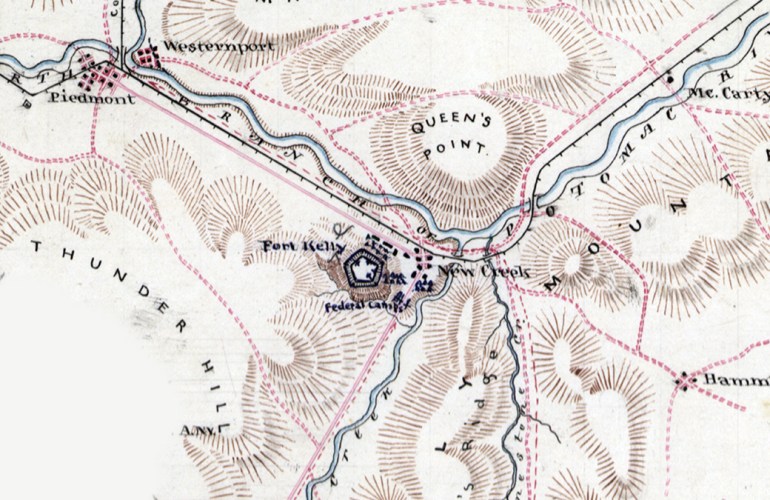
When the departure of Lew Wallace’s 11th Indiana left the B&O Railroad exposed in July 1861, Pennsylvania Reserves faced off against Confederate raiders in another fierce skirmish at New Creek Station.
In early July, Colonel Lewis “Lew” Wallace and his 11th Indiana Infantry Regiment, stationed in Cumberland, Maryland, along the Potomac River, were ordered to join Major General Robert Patterson’s army north of Winchester, Virginia. The 11th Indiana counter-marched to Romney from July 11-13, then proceeded home to Indianapolis to be mustered out and re-organized as a three-year regiment in early August.
Meanwhile, the 13th and 5th Pennsylvania Reserve Regiments and Battery A, 1st Pennsylvania Artillery were encamped at Camp Mason & Dixon just north of the Maryland border for two weeks debating the constitutionality of Pennsylvania state troops entering Maryland. On July 7, the departure of Wallace’s regiment left Cumberland and key points along the Baltimore & Ohio Railroad vulnerable to attack.
At the request of General Winfield Scott, Pennsylvania Governor Andrew Curtin finally ordered the troops at Camp Mason & Dixon to advance and protect Cumberland. The 13th Pennsylvania Reserve Regiment, nicknamed the “Bucktails” for the deer tails they wore on their hats, was led by Colonel Charles J. Biddle and later became the 42nd Pennsylvania Volunteer Infantry.
Opposing them was Colonel Angus W. McDonald, Sr.’s 7th Virginia Cavalry Regiment, tasked with guarding and patrolling the area from Harper’s Ferry to the headwaters of the Potomac River. McDonald’s over-strength regiment, containing more than a dozen companies, had already skirmished with Wallace’s Indiana Zouaves and Colonel Charles P. Stone’s Maryland expeditionary force.
On Friday, July 12, Colonel Biddle received word that rebels had destroyed train cars and two trestle bridges over George’s Creek on the Maryland side of the Potomac River, north of Piedmont. Early the next morning, Biddle moved his regiment and the 5th Pennsylvania Reserves, led by Colonel Seneca G. Simmons, 20 miles south by rail. They disembarked at the remains of the Potomac River bridge north of New Creek Station (present-day Keyser), which the Confederates had destroyed on June 19.
From there, Lt. Col. Thomas L. Kane led 40 men from Companies H and I of the Bucktail Regiment and two members of the Cumberland Home Guard on foot to New Creek Station. That night, Kane and his men took shelter in a stone house belonging to Mr. William Armstrong on the road to Romney, while the two Cumberland men slept on the station platform.
Just before sunrise on July 14, Captain Macon Jordan’s Company, joined by part of the Letcher Brock’s Gap Rifles and the Mountain Rangers, around 85 to 100 men in total, rode into New Creek from Piedmont. Private Richard Black of the Brock’s Gap Rifles dramatically charged his horse onto the station platform, surprising the two members of the Cumberland Home Guard. One was taken prisoner, and the other, William Kelly, was killed.
Hearing the commotion, Lt. Col. Kane sent a squad to investigate. His men hid in a meadow of tall grass, fired a few shots at Jordan’s Confederate soldiers, then retreated to the stone house. The Confederate cavalrymen formed up and charged the house, but the Bucktails, renowned for their marksmanship, opened fire from the windows. “They came up in fine order, but broke and ran on receiving a fire which was reserved till they were ready to dismount,” Kane wrote. Lieutenant Reuben L. Booten, Pvt. William L. Miller, and two horses were killed, with an unknown number wounded.
The Confederate raiders retreated south, and Kane and his men pursued them. About eight miles down the road toward Romney, near the small village of Ridgeville, they briefly exchanged fire again. Kane’s force took refuge in a large stone house and awaited reinforcements. The following day, a detachment of Pennsylvania troops occupied Piedmont, and Colonel Biddle reached Kane with the remainder of his two regiments on the night of the 16th. Instead of advancing on Romney, however, they withdrew back to New Creek.
Due to Major General Patterson’s advance in the Shenandoah Valley, on July 17, Brigadier General Joseph E. Johnston ordered Angus McDonald to relocate his entire regiment to Winchester, abandoning the Romney area. McDonald’s forces covered Johnston’s advance to Manassas but did not participate in that battle. No further military activity would occur in that corner of Virginia until autumn.
Sources
Armstrong, Richard L. 7th Virginia Cavalry. The Virginia Regimental History Series. Lynchburg: H.E. Howard, Inc., 1992.
Avirett, James B. The Memoirs of General Turner Ashby and His Compeers. Baltimore: Selby & Dulany, 1867.
Bates, Samuel P. History of Pennsylvania Volunteers, 1861-5. Harrisburg: B. Singerly, State Printer, 1869.
Civilian and Telegraph (Cumberland, MD) 18 July 1861.
The Daily Express (Lancaster, PA) 24 July 1861.
Richmond Dispatch (Richmond, VA) 27 July 1861.
Rockingham Register and Advertiser (Harrisonburg, VA) 2 August 1861.
Sypher, Josiah R. History of the Pennsylvania Reserve Corps. Lancaster: Elias Barr & Co., 1865.

 Spirit of '61