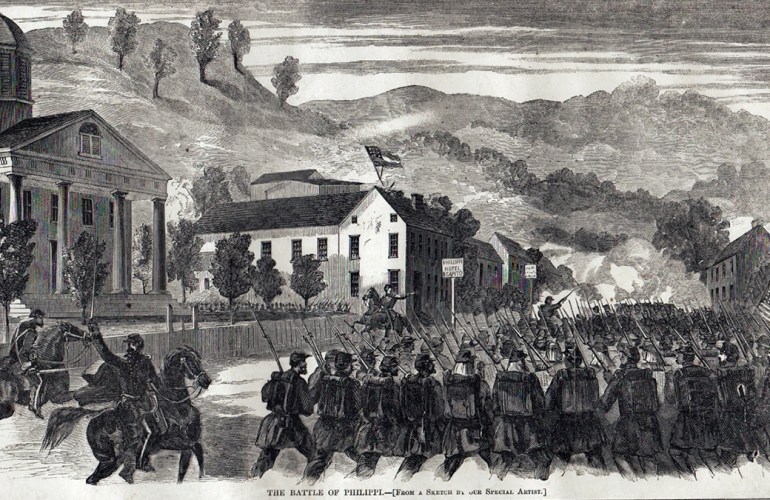
Following the Union occupation of Philippi, Virginia in early June 1861, a black soldier was accused of shooting down an elderly man in cold blood. Who was he, and how did he end up in the Union army so early in the war?
A few days ago, we wrote about James Humbles, a freeman of mixed ancestry who served in the 1st Virginia Cavalry in 1861. It is surprising to see a free person of color on Confederate muster rolls, but equally surprising to see one in Union ranks. The Second Militia Act of 1792 restricted militia members to “free able-bodied white male” citizens between the ages of 18 and 45, something that wasn’t amended to include African Americans until 1862.
So when Sergeant Andrew J. Grayson of Company E, 6th Indiana Infantry Regiment wrote about an incident involving a free black member of his unit in Philippi, (West) Virginia in 1861, we had to know more.
According to Grayson, “John Lott, of Madison, was the first colored man that shouldered a musket in the Union army, for I saw him standing in line with gun in hand and cartridge-box buckled to his hip when Capt. Gale’s company was drawn up in front of the Court House at Phillippi.”
Rufus Gale was captain of Company E, 6th Indiana. The 6th Indiana Infantry Regiment participated in the Action at Philippi on June 3, 1861. Sgt. Grayson described John Lott as being a member of his company, but no one by that name is on the company’s muster roll.
Sometime after the Confederates cleared out of town, John Lott confronted an elderly black resident and asked if he was a “rebel”. The man answered in the affirmative, and Lott gave him fifteen minutes to “retract” his statement. Apparently the man refused, and Lott shot him in the chest, killing him.
“Was it murder? I think so,” Sgt. Grayson wrote. “Lott was arrested and lodged in the Court House along with the rebel that shot Col. Kelly, and afterwards they were both sent back to Wheeling and lodged in jail.”
It is difficult to verify Grayson’s account. No one by the name “John Lott” appears on the 6th Indiana muster rolls in any company. There is a “John Lott” in the 1860 census in Madison, Indiana, but he is around 13 years old and later censuses list his race as white. A search of Newspapers.com turned up nothing for that name or any variant of that name.
However, we were able to find several contemporary newspaper articles mentioning the incident. Unfortunately, they didn’t name names and several got the regiment wrong. They described the man as belonging to the “9th Indiana”. The 9th was also at Philippi, so it’s understandable that the regiments could be confused. Newspaper reports often mixed up regiment numbers.
The earliest newspaper report of the incident that we could find was published in The Wheeling Daily Intelligencer on Friday, June 07, 1861, dated two days earlier. “Col. Crittenden’s servant, who killed the other negro, has not yet been executed.–There is a very bitter feeling against him among the men. They say this makes his eighth victim. He is part Indian, and a blood-thirsty sort of a devil, as this atrocious act testifies.”
A letter from Grafton in the same newspaper two days later states. “The negro who committed the murder at Phillippi, is also here in confinement.”
A more detailed account appeared in the Cincinnati Daily Commercial on Monday, June 10, 1861. “There were some excesses committed by the troops, after the capture of the town…” it read. It later continued:
“Three prisoners have been brought in from Phillippi: the redoubtable Col. Willey, Simmes, who shot Kelley, and a negro who, on Tuesday, shot one of his own color for calling him “a d–d Secessionist.” … The negro looks as though he had Indian blood in his veins. The negro killed by him is said to be his third victim, though it is known that in one instance he was justified in shooting down his man. He wears a red hunting shirt, fringed with buckskin, a slouch hat looped up at one side, and is altogether an ugly looking customer. He will doubtless be turned over to the civil authorities.”
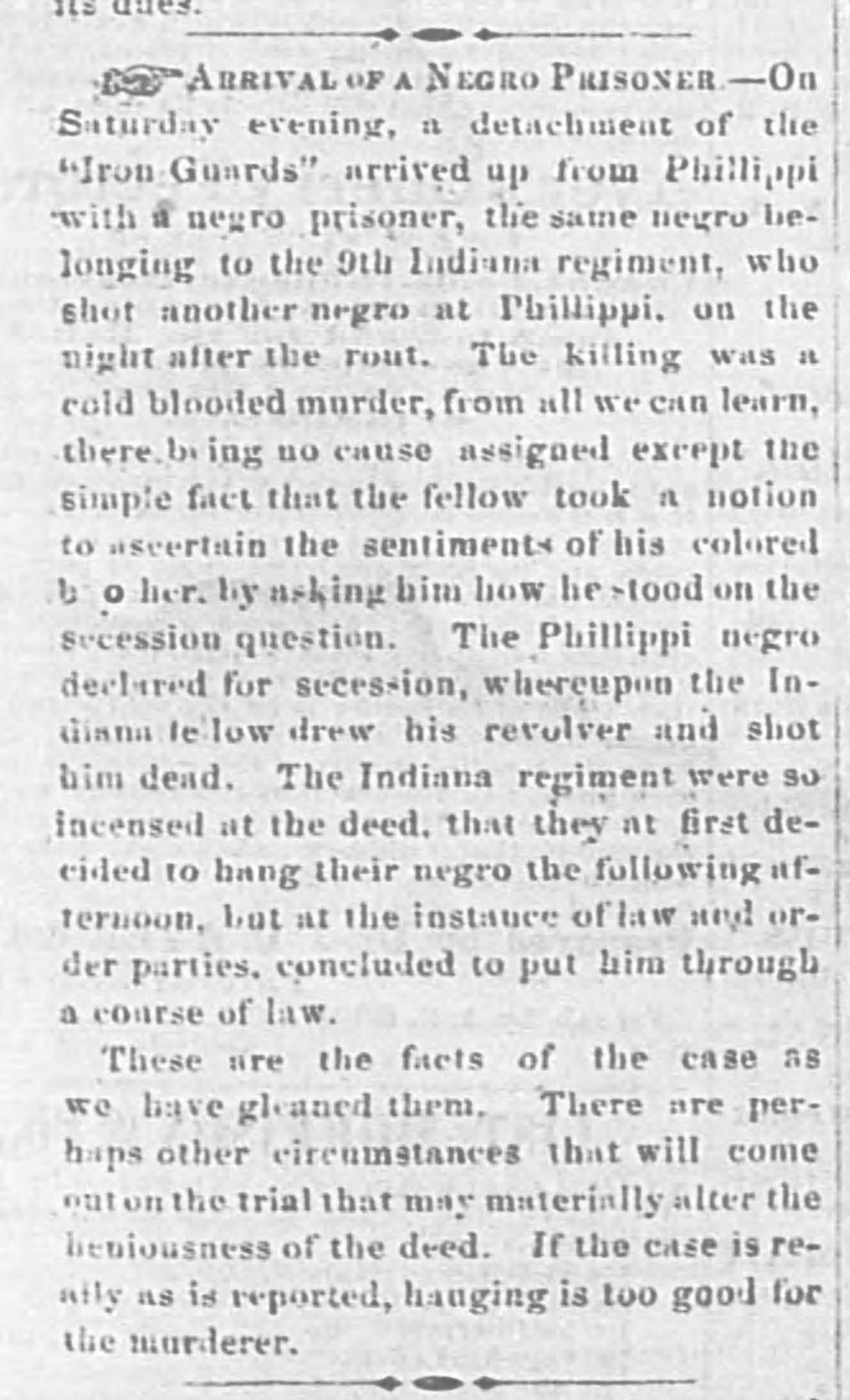
That same day, an article titled “Arrival of a Negro Prisoner” appeared in the The Wheeling Daily Intelligencer:
“On Saturday evening, a detachment of the ‘Iron Guards’ arrived up from Phillippi with a negro prisoner, the same negro belonging to the 9th Indiana regiment, who shot another negro at Phillippi, the night after the rout. The killing was a cold blooded murder, from all we can learn, there being no cause assigned except the simple fact that the fellow took a notion to ascertain the sentiments of his colored brother by asking him how he stood on the secession question. The Phillippi negro declared for secession, whereupon the Indiana fellow drew his revolver and shot him dead. The Indiana regiment were so incensed at the deed, that they at first decided to hang their negro the following afternoon, but at the insistence of law and order parties, concluded to put him through a course of law.”
The Intelligencer confirmed key details of Sgt. Andrew Grayson’s account, but, unfortunately, not the man’s name.
Later that month, Col. Frederick W. Lander, commander of the 1st Ohio Light Artillery, wrote a letter to the Intelligencer defending the conduct of the Union soldiers who stormed Philippi. “I cannot… deny that some unjustifiable acts were committed after the rout of the Secession forces at Phillippi,” he admitted. “They arose from a general break of the tired troops to search the town for Secession flags, and concealed men and munitions.” He did not, however, specifically mention a murder.
Sgt. Grayson wrote that, upon their return home to Indiana when their three-month term of enlistment expired, Major John Gerber stopped off in Wheeling and released John Lott from jail. “Lott was glad to see us looking so well,” he wrote. Contrary to the newspaper reports, it didn’t sound like the man was in danger of being lynched, or perhaps enough time had passed for those feelings to subside.
So who was John Lott, if that was even his name? He wasn’t a uniformed member of the 6th Indiana, being prohibited from enlisting by the Second Militia Act of 1792. Based on the description of his dress and the fact he was armed, he probably served as a scout. Men on this campaign often wrote about the dozens of scouts employed to patrol the mountains looking for enemy activity. It was a thankless task, and most of their names have been lost to history.
While Lott’s ultimate fate is unknown, being able to corroborate this story does lend it credence, and shows Andrew Grayson is a reliable source, even though he wrote his account over a decade later. It demonstrates that while African Americans were unable to enlist in the Union army in 1861, they did serve in other capacities and aided the war effort however they could under the circumstances.
Sources
- Daily Commercial (Cincinnati) 10 June 1861.
- The Wheeling Daily Intelligencer (Wheeling) 7 June 1861.
- The Wheeling Daily Intelligencer (Wheeling) 10 June 1861.
- The Wheeling Daily Intelligencer (Wheeling) 20 June 1861.
- Grayson, Andrew J. “The Spirit of 1861”: History of the Sixth Indiana Regiment in the Three Months’ Campaign in Western Virginia. Madison: Courier Print, 1875.
- Heselberger, Fritz. Yanks from the South! The First Land Campaign of the Civil War: Rich Mountain, West Virginia. Baltimore: Past Glories, 1987.
- Report of the Adjutant General of the State of Indiana, 1861-1865, Vol. 4. Indianapolis: Samual M. Douglass, State Printer, 1866.


“It is surprising to see a free person of color on Confederate muster rolls, but equally surprising to see one in Union ranks.”
I agree but at the same time it isn’t surprising. Off topic, I know, but people may be surprised to learn there were blonde hair blue-eyed fighters in the 2000s Iraq / middle east wars, there to “bag a yankee”.
I think today, the histories and especially media try to paint pictures they want; but, aside from the Wheeling Intelligencer, which hopefully everyone views as a pro-Union propaganda rag, there were other Northern papers that wrote similarly of Indians and Blacks siding with one or the other combatant. Take for instance, this excerpt:
“Cherokee Indians from North Carolina, with other savages, are stated positively to be seen among the troops of the Traitor army at Harper’s Ferry. We presume, of course, it will shock the delicate nerves of our contemporaries of the Harrisburg Patriot, Greensburg Argus, and other papers of that class, but we must again say that if these Indian and Negro allies of the Secessionists are to fight against our brave fellows, we insist that the General Government should meet them with like troops [i.e. conscription of Indians and Blacks in the Union Army]. War is war – not pastime – and we are for giving what we take.” May 23rd 1861
LikeLiked by 1 person
The Intelligencer is definitely pro-Union but unfortunately it’s one of the few newspapers that stayed open in Northwestern Virginia. The subject of non-white people (for lack of a better term) fighting for either side in 1861 is definitely something we want to explore further.
LikeLike