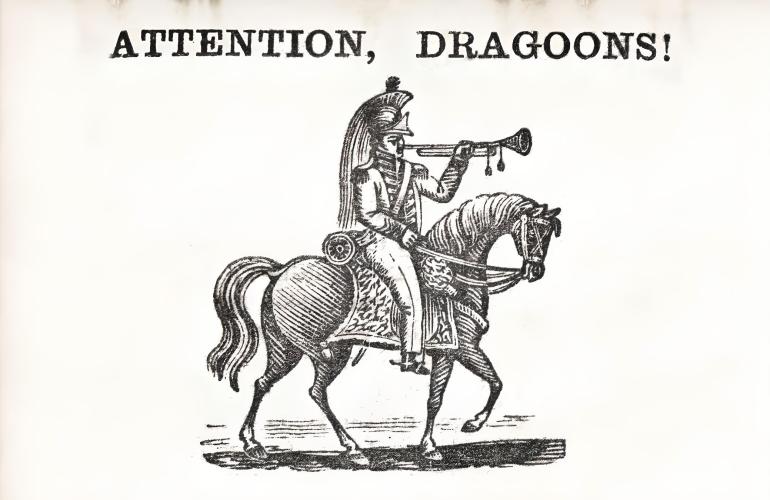
In mid-April 1861, as federal troops evacuated and set fire to Harpers Ferry Arsenal, 60 men assembled in Brownsburg, Virginia to form the Second Rockbridge Dragoons. They were led by 42-year-old Captain John Rice McNutt and 1st Lieutenant Robert McChesney. Though a small company, they would go on to play a role in one of the Civil War’s first skirmishes, in which Robert McChesney would be Rockbridge County’s first to fall.
Rockbridge County raised two companies of dragoons that April. A dragoon was a type of mounted infantry that, in theory, carried light weapons and rode into battle on horseback before dismounting to fight. But like the colorfully-uniformed infantry regiments modeled after French Zouaves, the distinction was ornamental.
In reality, dragoons performed the same role as other cavalry in the Civil War—as scouts, raiders, and skirmishers. The Rockbridge outfit donned uniforms, knapsacks, haversacks, canteen covers, and caps handmade by women throughout the county and armed themselves with knives, pistols, and shotguns. They mounted horses bred for pulling buggies and plows.
John McNutt was a Washington College graduate and wealthy merchant and farmer. According to the 1860 census, he owned one female slave and her six children. Robert McChesney, 28, was born in Brownsburg and served with his brothers, Alexander and James. He was tall and sinewy, 6’2”, with dark hair, tapered, collar-length beard, and a commanding voice. Robert and James lived at home on a farm with their widowed mother. Neither owned slaves. Dr. Alexander McChesney, 31, lived in Bath County with his wife and four young children, and a female slave and her two children.
Shortly after forming, the Rockbridge Dragoons proceeded down the Shenandoah Valley toward Harpers Ferry, but were in Mount Crawford on April 20, 1861, over 100 miles away. By then, other Virginia militia already occupied the U.S. arsenal and its ashes had gone cold. Not needed, they returned to Staunton to be sworn into Confederate service. Virginia still considered itself to be an independent state, but its pro-secession government voted to place control of its militia into the hands of Confederate President Jefferson Davis in Montgomery, Alabama.
The Second Rockbridge Dragoons were ordered to Philippi, Virginia, where Colonel George Porterfield set up his headquarters. Philippi, 16 miles south of Grafton along the Tygart Valley River, was a pro-secession stronghold that had been flying a blue palmetto flag in solidarity with South Carolina since January. Porterfield was facing an invasion from tens of thousands of Union troops across the Ohio River and needed all the help he could get. The Dragoons arrived on May 29th.
The Dragoons were at Philippi on June 3rd when Union troops chased the Confederates out of town but their role is not well-documented. A man named James Withers, reportedly a member of that unit, hid in a house to escape capture and was smuggled out disguised as a soap peddler.

From Robert J. Driver, Jr., 14th Virginia Cavalry (Lynchburg: H.E. Howard, Inc, 1988).
They next appeared in historical records with Brig. Gen. Robert Selden Garnett at Camp Laurel Hill in Barbour County. On the night of Friday, June 28, 1861, Lt. Robert McChesney and nine picked men rode northeast toward Saint George along the Cheat River on a scouting mission and to disrupt an election for delegates to the pro-Union Restored Government of Virginia.
The next morning, a day before Lt. McChesney’s 29th birthday, McChesney and his men proceeded to Saint George with a handful of local Home Guards, where they found the vote had already taken place. They traveled north along a mountain road following the Cheat River toward the residence of Adam H. Bowman, an attorney, which was being used as a polling place somewhere near the small hamlet of Hannahsville.
There they were ambushed by Company H, 15th Ohio; Company F, 1st Virginia (U.S.); and part of the 16th Ohio (likely Company D) in what became known as the Skirmish at Bowman’s Place. Lt. McChesney was killed and three of his men wounded, including privates Albert G. M. Paxton, Isaac Friend, and Franklin G. “Dock” Long. Long, from Randolph County, had joined the unit a few days earlier.
Col. James Irvine of the 16th Ohio ended up with McChesney’s personal effects, which he returned to the lieutenant’s family. He wrote: “I will, therefore, not speak of it further than to say that he bore himself gallantly, and my sympathies were greatly enlisted for him when he fell. What should have been our common country, lost a brave and gallant man.”
The Second Rockbridge Dragoons were at the Battle of Laurel Hill and joined Garnett on his fateful retreat, but their role in these events is not well documented. They later became Company H of the 14th Virginia Cavalry Regiment and fought alongside it for the remainder of the war.
Sources
Driver, Robert J., Jr. 14th Virginia Cavalry. Lynchburg: H.E. Howard, Inc, 1988.
Fansler, Homer Floyd. History of Tucker County, West Virginia. Parsons: McClain Printing Company, 1962.
Haselberger, Fritz. Yanks from the South! The First Land Campaign of the Civil War. Baltimore: Past Glories, 1987.
Maxwell, Hu. History of Tucker County, West Virginia. Kingwood: Preston Publishing Company, 1884.
Morton, Oren F. A History of Rockbridge County, Virginia. Staunton: The McClure Co., Inc, 1920.

 Spirit of '61
One thought on “The Second Rockbridge Dragoons”